
Beatrix moth
Lymantria beatrix
Description
How to identify
Lymantria beatrix belongs to the family Erebidae, subfamily Lymantriinae. It is a moth species closely related to the well-known gypsy moth (Lymantria dispar).
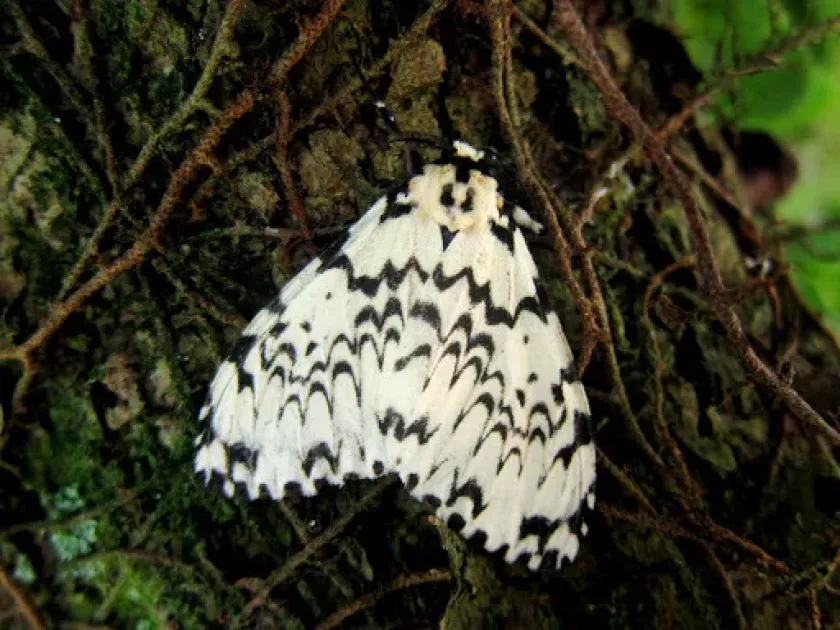
Adult moths are characterized by a moderate wingspan and typical Lymantriid wing morphology. The coloration is generally brownish or greyish with wavy transverse lines on the forewings.
The larvae (caterpillars) are covered in dense hairs, which is a defensive mechanism against predators. These hairs can also cause dermatitis upon human contact.
Taxonomically, the species is distinguished by specific genital structures, often requiring dissection and microscopic examination by experts for positive identification.
The species undergoes a complete metamorphosis: egg, larva, pupa, and adult, with each stage adapted to specific environmental challenges.
What it damages
The primary damage is caused by the larval stage, which feeds on the foliage of various broad-leaved trees and shrubs.
Outbreaks can lead to severe defoliation, where trees are stripped of their leaves, significantly impacting the forest or garden aesthetic and health.
While often found in woodlands, the species can infest fruit-bearing trees and ornamental landscape plants during high-population years.
Feeding disrupts the tree's photosynthetic ability, leading to reduced growth rates and severe physiological stress on the host plants.
Persistent defoliation over consecutive seasons can result in tree mortality or increased susceptibility to secondary pests and pathogens.
When it appears
Adult moths typically emerge during the summer months, focusing their activity on mating and egg-laying on tree trunks or hidden surfaces.
The species overwinters in the egg stage, with eggs protected by a layer of scales and hair that prevents desiccation and freezing.
Larval emergence occurs in the spring, timed precisely with the budding of host trees to ensure an immediate food source for the first instars.
The larval stage lasts several weeks, during which the caterpillars grow rapidly through multiple molts before pupating in protected crevices.
The life cycle is univoltine, meaning one generation per year, though weather conditions strongly influence the population density.
Signs of infestation
Initial signs include uneven leaf margins or small holes in the foliage, particularly noticeable in the upper parts of the tree canopy.
Frass (caterpillar excrement) accumulating on the ground or leaves serves as a strong indicator of active feeding activity above.
Larval clusters on tree bark or foliage are the most direct evidence of an ongoing infestation requiring management.
Pupal cases hidden in bark fissures or leaf litter provide information about the potential scale of the upcoming moth emergence.
- Holes in leaves
- Accumulation of frass on the ground
- Visible caterpillar clusters
- Webbing on branches
- Premature yellowing or browning of leaves
Control measures
Biological control using Bacillus thuringiensis (Bt) sprays is highly effective against young larvae and is environmentally friendly.
Mechanical management includes scraping off and destroying egg masses during the winter season to minimize the next generation's population.
Chemical control involving systemic or contact insecticides may be necessary in extreme cases and should be applied when larvae are small.
Encouraging natural predators, such as insectivorous birds and parasitic wasps, helps maintain lower population levels in natural areas.
Monitoring populations with pheromone traps allows for targeted and efficient timing of control measures to prevent large-scale outbreaks.
Taxonomy
- Latin name
- Lymantria beatrix
- Order
- Lepidoptera (butterflies)
- Family
- Erebidae
- EPPO code
- LYMABE
Discussion
No discussions yet — be the first.