
Beet webworm
Loxostege obliteralis
Description
How to identify
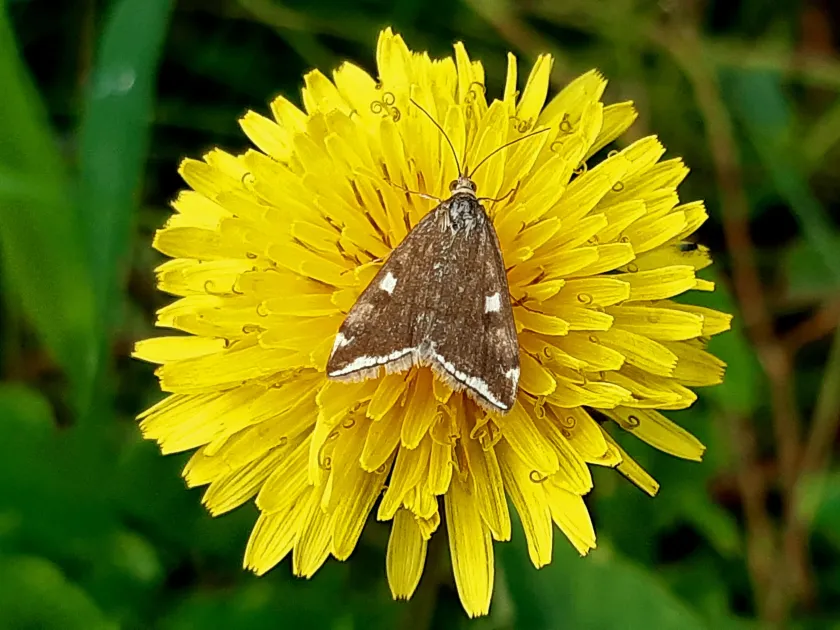
The beet webworm belongs to the Crambidae family. The adult moth has a wingspan of approximately 26 mm, featuring greyish-brown forewings with distinct dark markings and a pale fringe along the edges, typical of many pyralid moths.
The larva, or caterpillar, reaches up to 35 mm in length. Its body is usually olive-green or greyish-brown with a light stripe running along the back. A key identifying feature is the dark brown or black head capsule.
Pupae are about 12 mm long and dark brown. They develop inside tough, silken cocoons that the mature larvae construct vertically within the top layer of the soil to protect themselves during overwintering.
The insect undergoes a complete metamorphosis consisting of egg, larva, pupa, and adult stages. Depending on local climate conditions, the species can complete one to three generations throughout the growing season.
Adult moths are primarily active at dusk, feeding on floral nectar from weeds and nearby plants. This additional energy source is critical for them to reach sexual maturity and start laying eggs on host plants.
What it damages
This species is a highly polyphagous pest capable of attacking over 200 plant species. It poses a significant threat to sugar beets, sunflowers, corn, and various legumes like soybeans and peas.
The caterpillars are voracious feeders. In severe outbreaks, they can strip entire fields of vegetation, consuming leaves and leaving only the vascular veins behind, which severely impairs the plant's photosynthesis.
Vegetable crops, including potatoes and cabbages, are also prone to infestation. Larvae can cause complete defoliation, leading to stunted growth, reduced yields, or total crop failure if the plants are young.
Weeds serve as the primary host plants early in the season. Once the initial population builds up on weeds, the larvae migrate to cultivated crops, turning the infestation into an economic emergency.
Beyond leaf consumption, the larvae may feed on blossoms and tender stems. This shift to reproductive parts of the plant often causes direct loss of harvest volume and marketability.
When it appears
Beet webworms overwinter as mature larvae inside cocoons located in the soil. Pupation begins in the spring as soil temperatures rise above 10-12 degrees Celsius, facilitating the emergence of the first generation of adults.
The timing of adult emergence is often spread out, depending on the availability of nectar sources and prevailing humidity levels. A warm, humid spring provides ideal conditions for rapid multiplication.
Eggs are typically deposited in clusters on the undersides of leaves. Upon hatching, the young larvae immediately begin feeding, moving through several instars before reaching maturity.
Subsequent generations develop during the summer months. These later generations often coincide with the most vulnerable stages of grain and industrial crop development, causing the most significant damage.
As daylight hours decrease and temperatures drop in late summer or autumn, the final generation of larvae will seek out suitable spots in the soil to form cocoons and enter diapause for the winter.
Signs of infestation
One of the earliest signs of infestation is the appearance of light webbing on the undersides of leaves. The larvae use this silk to create shelters, protecting themselves from predators while feeding.
The damage pattern is distinct; it is characterized by the skeletonization of leaves, where only the skeletonized vein network remains. Affected fields may appear scorched or heavily damaged in patches.
A sudden presence of moths flying up in large numbers as one walks through a field or overgrown roadside is a major indicator of an active population spike.
Small dark pellets of larval excrement (frass) found on leaf surfaces or beneath the plants are a clear sign that active feeding is occurring and that larvae are likely present nearby.
Rolled or tied leaves are another common symptom. Caterpillars use silk to pull leaf edges together, creating a protected micro-environment where they feed safely throughout the day.
Control measures
Cultural control via deep autumn plowing is highly effective for reducing the overwintering population. Tilling destroys the cocoons and exposes the larvae to cold temperatures and natural predators.
Rigorous weed management is essential. By eliminating weed reservoirs on field edges and within the crop, farmers can significantly reduce the initial population size available to migrate into their fields.
Chemical control involving insecticides from the pyrethroid, organophosphate, or neonicotinoid families is required when larval counts exceed the established economic threshold.
Biological control methods, such as the application of microbial pesticides (e.g., Bacillus thuringiensis), are most effective against young larvae and help mitigate environmental impacts.
- Implementation of pheromone traps for early population monitoring.
- Timely spraying during the early instar stages for maximum effect.
- Adhering to crop rotation schedules to break the pest cycle.
- Encouraging the presence of natural enemies and beneficial insects.
Taxonomy
- Latin name
- Loxostege obliteralis
- Order
- Lepidoptera (butterflies)
- Family
- Crambidae
- EPPO code
- LOXOOB
Discussion
No discussions yet — be the first.