
Beet webworm
Loxostege bifidalis
Description
How to identify
The beet webworm (lat. Loxostege bifidalis, often classified within the Loxostege sticticalis complex) is a major polyphagous pest belonging to the Crambidae family.
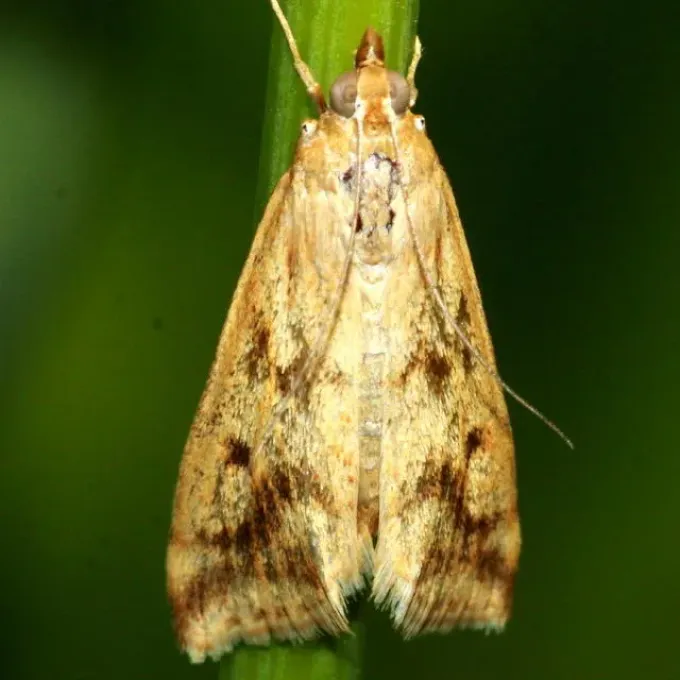
The adult is a moth with a wingspan of 26–30 mm, characterized by grayish-brown wings adorned with distinct dark spots and pale cross-bands.
The larvae, known as webworms, grow up to 35 mm in length and exhibit colors ranging from greenish-grey to nearly black with longitudinal light stripes.
The body of the larva is covered with fine setae protruding from dark tubercles, which serves as a primary diagnostic feature for field identification.
Pupation occurs within durable, silk-lined cocoons, which the larvae construct vertically in the topsoil near the base of host plants.
##damage##As a highly adaptable polyphage, the beet webworm poses a significant threat to a wide array of over 200 plant species across various families.
Primary agricultural hosts include sugar beets, sunflowers, legumes, maize, and various horticultural vegetable crops.
During outbreak years, this pest is capable of devastating entire fields by consuming both foliage and stems, leading to severe crop loss.
Infestations typically initiate at field margins before spreading rapidly, often causing complete defoliation of the crop canopy.
The feeding intensity of older instar larvae is particularly high, allowing them to skeletonize large leaf areas within a matter of days.
When it appears
Depending on the climate and regional temperature, the beet webworm completes between one and three generations per growing season.
The emergence of the first generation of moths usually occurs in late spring as air temperatures consistently reach favorable levels.
Adult flight activity often synchronizes with the blooming period of weeds, which provide essential nectar for the reproductive moths.
The life cycle from egg to adult lasts approximately 30 to 45 days, with later generations often causing higher population surges.
The pest overwinters as a mature larva inside a cocoon buried in the soil, which offers protection against harsh winter conditions.
Signs of infestation
The initial sign of an infestation is the presence of adult moths taking flight when the crop canopy is disturbed.
Young larvae display characteristic window-feeding, where they consume the leaf parenchyma while leaving the epidermis intact.
As the larvae mature, they consume entire leaf surfaces, leaving only the primary veins, which significantly impairs the photosynthetic capacity of the plant.
- Presence of silk webbing that larvae use to tie leaf parts together or protect themselves.
- Accumulation of small, dark granular frass on leaves and the surrounding ground.
- Sudden wilting or drying of plant patches within the field.
Early morning or late evening inspections of the underside of leaves are crucial for detecting developing larval populations before they cause major damage.
Control measures
Cultural control measures, such as deep autumn plowing, are highly effective in destroying overwintering cocoons in the soil.
Managing weed growth along field borders and non-cropped areas is vital to reducing the available food source and refugia for the pest.
Chemical control via insecticides is recommended when population thresholds are exceeded, utilizing rotating modes of action to prevent resistance.
Biological control agents, such as formulations based on Bacillus thuringiensis, offer a targeted solution against early-stage larvae.
Implementing pheromone trap monitoring programs allows growers to track flight peaks accurately and optimize the timing of protective interventions.
Taxonomy
- Latin name
- Loxostege bifidalis
- Order
- Lepidoptera (butterflies)
- Family
- Crambidae
- EPPO code
- LOXOBI
Discussion
No discussions yet — be the first.