
Australian webworm
Loxostege affinitalis
Description
How to identify
The Australian webworm (Loxostege affinitalis) is a moth belonging to the family Crambidae. It is a significant agricultural pest that exhibits nocturnal behavior, with adults typically active from dusk and attracted to artificial light sources.
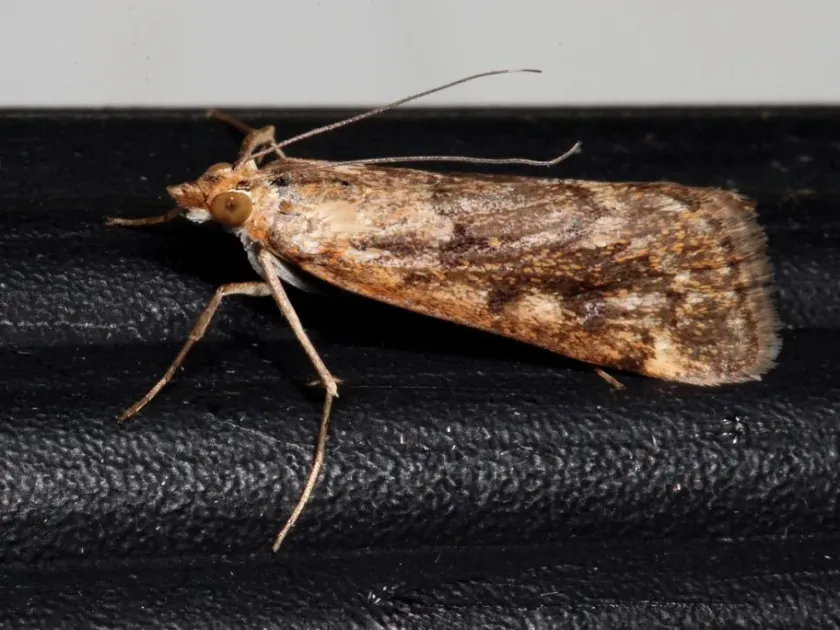
Adult moths have a wingspan of approximately 20–25 mm. Their coloration is generally pale brown or grayish, marked with distinct dark wavy lines that provide effective camouflage against dry foliage and soil surfaces during the day.
The life cycle consists of four distinct stages: egg, larva, pupa, and adult. The larval stage consists of five instars, with the caterpillars changing appearance slightly as they develop from pale green to darker shades with specific markings along the body.
Pupation occurs in silk-lined cocoons embedded within the upper layer of the soil. This underground protection is crucial for the insect's survival, allowing it to withstand harsh environmental conditions and ensuring successful emergence after dormancy.
Identification in the field involves looking for characteristic egg masses laid on the undersides of leaves. Agronomists often rely on pheromone-based monitoring systems to detect the migration and population surges of adults before they lay eggs on crops.
What it damages
The Australian webworm is a polyphagous pest, meaning it feeds on a wide range of host plants. It is particularly notorious for damaging legume crops, such as soybeans, as well as various oilseed crops in its native region of Australia.
Young larvae initially graze on the underside of leaves, creating small, superficial windows in the leaf tissue. This early damage can often go unnoticed but leads to reduced photosynthetic capacity and increased plant stress as the infestation grows.
As the larvae mature to later instars, their feeding habits become more aggressive. They consume entire leaf blades, leaving only the primary veins, which gives plants a skeletonized appearance. This rapid defoliation can kill young seedlings or significantly stunt crop development.
Besides leaf tissue, larvae can also attack flower buds and seed pods. By damaging the reproductive organs of the plants, the pest directly reduces the yield potential, which can lead to significant economic losses for commercial growers.
Widespread infestations often trigger migratory behavior. Large populations of larvae may move across a field in a wave, consuming all green material in their path. This phenomenon requires rapid intervention to prevent complete destruction of the crop acreage.
Control measures
Successful management of the Australian webworm requires an integrated pest management (IPM) strategy. Cultural practices, such as deep tillage after harvest, help disrupt the soil-dwelling pupae, making them vulnerable to environmental factors and predation.
Monitoring is the cornerstone of control. Agronomists should inspect fields regularly for the presence of egg masses and early-stage larvae. Treatment thresholds should be strictly observed to determine the necessity of applying chemical interventions.
Chemical control involves the application of appropriate insecticides during the early larval stages, when the pests are most susceptible to contact and systemic products. Rotation of chemical groups is essential to prevent the development of insecticide resistance.
Biological control agents, including parasitic wasps such as Trichogramma species, can play a significant role in suppressing populations. Encouraging natural predator populations can provide long-term stability in the agroecosystem.
- Regular monitoring with light and pheromone traps.
- Deep tillage for soil pupae destruction.
- Strategic use of insecticides at the Economic Threshold Level.
- Support for natural biological control agents.
Taxonomy
- Latin name
- Loxostege affinitalis
- Order
- Lepidoptera (butterflies)
- Family
- Crambidae
- EPPO code
- LOXOAF
Discussion
No discussions yet — be the first.