
Spruce bark fly
Lonchaea corticis
Description
How to identify
Lonchaea corticis is a species of fly belonging to the family Lonchaeidae in the order Diptera. These small flies are primarily known for their larval stage, which develops beneath the bark of trees.
Adult flies typically display a shiny, dark, or metallic appearance characteristic of the family. The wings are clear with well-defined venation typical of the Lonchaeidae genus.
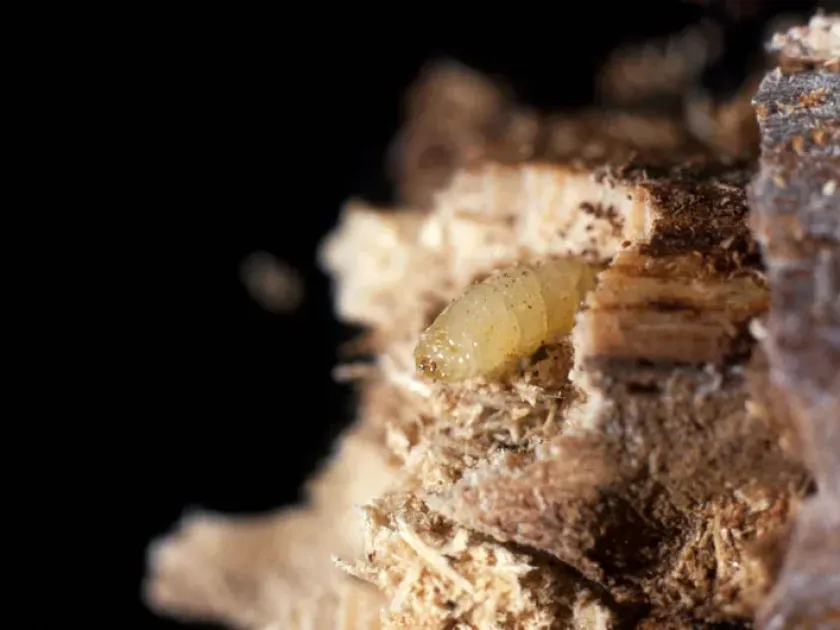
The larvae are legless, maggot-like, and appear whitish or yellowish, reaching lengths of approximately 6-8 mm. The anterior part is narrowed, featuring mouthparts adapted for rasping woody tissues.
Pupae are often found within the feeding galleries of the larvae, possessing a cylindrical shape and encased in a protective layer of compressed bark debris or frass.
Accurate identification of adult specimens often requires specialized entomological equipment, as many species within this family are morphologically similar and require detailed genital examination.
What it damages
The primary host trees for Lonchaea corticis are conifers, with the Norway spruce (Picea abies) being the most frequently cited host.
This pest is often observed occupying bark areas previously colonized by primary wood-boring insects, such as bark beetles, effectively acting as a secondary colonizer.
Larvae feed on the cambium layer and soft inner bark tissues, which disrupts the tree's nutrient transport system and leads to gradual physiological weakening.
High infestation densities can exacerbate the tree's susceptibility to pathogenic fungi, which may cause necrosis and accelerate decay processes under the bark.
The greatest economic and ecological impact is observed in stands already stressed by drought, overcrowding, or active bark beetle outbreaks.
When it appears
Adult flight typically commences in the spring and early summer when ambient temperatures become sufficient for active movement and mating.
Females deposit eggs into bark crevices, preferentially selecting stressed trees that exhibit resin flow or existing mechanical wounds.
Larval development occurs throughout the summer months, with the species potentially completing one or more generations depending on local climate conditions.
The overwintering stage usually consists of mature larvae that reside in deep bark galleries or within the upper layer of soil near the base of the trunk.
Pupation takes place in early spring following the termination of winter diapause, ensuring that the new generation emerges in time for the tree's growing season.
Signs of infestation
Early symptoms of an infestation include the appearance of entry holes accompanied by characteristic dark resin streaks or fine brownish sawdust.
Upon carefully removing a section of the bark, one can observe numerous larvae moving within the phloem, leaving winding, irregular feeding galleries.
Gradual needle desiccation and discoloration of the crown to a grayish-green or yellow hue indicate severe internal damage and disrupted nutrient flow.
The presence of distinct larval frass within the galleries is a diagnostic feature used to distinguish this species' activity from that of larger wood-boring beetles.
- Loss of needle turgor and crown thinning.
- Presence of entry holes with sawdust debris.
- Bark scaling or loosening in infested areas.
- Secondary fungal infections visible on the trunk.
Control measures
The most effective management strategy involves timely sanitary logging, removing infested trees before the emergence of the next generation of flies.
Maintaining forest hygiene by removing slash and logging debris significantly limits available breeding sites for the pest.
The use of pheromone traps, primarily deployed for bark beetle monitoring, can incidentally aid in capturing and surveying populations of Lonchaea corticis.
Preservation of natural enemies, such as insectivorous birds and predatory insects, plays a vital role in keeping pest populations below economic thresholds.
Chemical control via insecticides is rarely feasible in commercial forestry and is generally reserved for high-value ornamental plantings or nursery settings.
Taxonomy
- Latin name
- Lonchaea corticis
- Order
- Diptera (flies)
- Family
- Lonchaeidae
- EPPO code
- LONHCO
Discussion
No discussions yet — be the first.