
Brown's lance fly
Lamprolonchaea brouniana
Description
How to identify
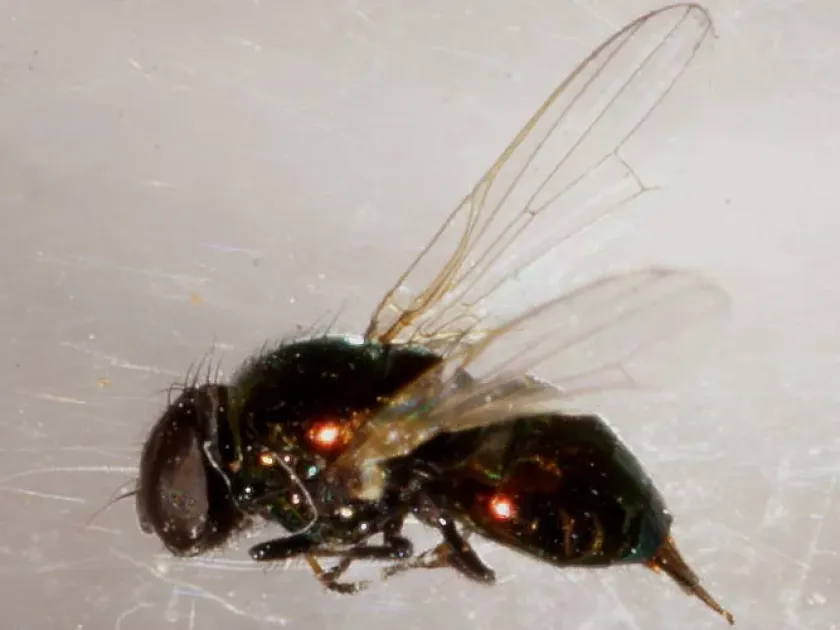
The Brown's lance fly (Lamprolonchaea brouniana) is a member of the Lonchaeidae family within the order Diptera. This small insect is characterized by a shiny black or dark metallic green body, typical of most species in this family.
Adults possess transparent wings and short antennae. The larvae appear as typical legless maggots of a whitish-yellow color, reaching only a few millimeters in length.
Identification in the field is difficult due to their similarity to other lance fly species, often requiring microscopic examination of morphological features for accurate diagnosis.
The female possesses a specialized ovipositor designed for piercing deep into plant tissues to deposit eggs. This biological trait is the source of the "drill" common name in many languages.
This insect thrives in moderately warm climates, and high humidity levels generally favor the survival and reproduction of the population during the growing season.
What it damages
Primary damage is caused by the larvae, which feed on the internal tissues of fruits and stems of various agricultural crops.
The host range includes various vegetable crops, particularly tomatoes, peppers, and other solanaceous plants, as well as several fruit-bearing species.
Larvae create galleries within the fruit, leading to tissue softening and rapid decay caused by secondary pathogens, including various bacteria and fungi.
Damage results in the loss of aesthetic value, reduced crop yields, and direct destruction of fruits while they are still ripening in the field.
In cases of severe infestation, yield losses can be substantial, marking this insect as a target for consistent phytosanitary monitoring.
When it appears
Adult activity occurs during the warm season when temperature conditions become favorable for mating and oviposition.
The life cycle encompasses the egg stage, three larval instars, the pupal stage, and the adult phase, with multiple generations potentially emerging within a single season.
Overwintering typically occurs in the pupal stage within the soil or inside plant debris left in the field after harvest.
The first signs of adult emergence often coincide with the beginning of flowering or fruit set in susceptible crops.
The rate of life cycle development is highly dependent on ambient temperature, meaning hotter years often lead to more pronounced population outbreaks.
Signs of infestation
The first sign of infestation is the presence of small punctures on the fruit surface, created by the female during the egg-laying process.
Around these entry points, premature browning or softening of the skin is often observed, signaling the onset of decay within the fruit.
Dissecting an infested fruit reveals tunnels filled with larval excrement and decaying plant tissues.
Plants infested at early fruit development stages often drop their blossoms or produce deformed, unmarketable fruits.
Recognizing these specific entry holes and soft spots allows agronomists to diagnose the presence of the pest in a timely manner.
Control measures
The primary control method is agronomic, including the mandatory removal of post-harvest crop debris and deep autumn plowing to disturb pupation sites.
Crop rotation and spatial isolation of new plantings from previously infested fields are essential for suppressing population expansion within agroecosystems.
Pheromone traps are highly effective for monitoring adult population density, allowing for informed decisions regarding insecticide application.
Chemical control should be targeted at adults during the egg-laying period, as larvae are protected once they have penetrated the fruit tissue.
Biological control strategies may include the use of natural enemies, such as entomophagous insects that prey on the larvae or pupae located in the soil.
Taxonomy
- Latin name
- Lamprolonchaea brouniana
- Order
- Diptera (flies)
- Family
- Lonchaeidae
- EPPO code
- LAMLBR
Discussion
No discussions yet — be the first.