
Lonchaea
Lonchaea
Description
How to identify
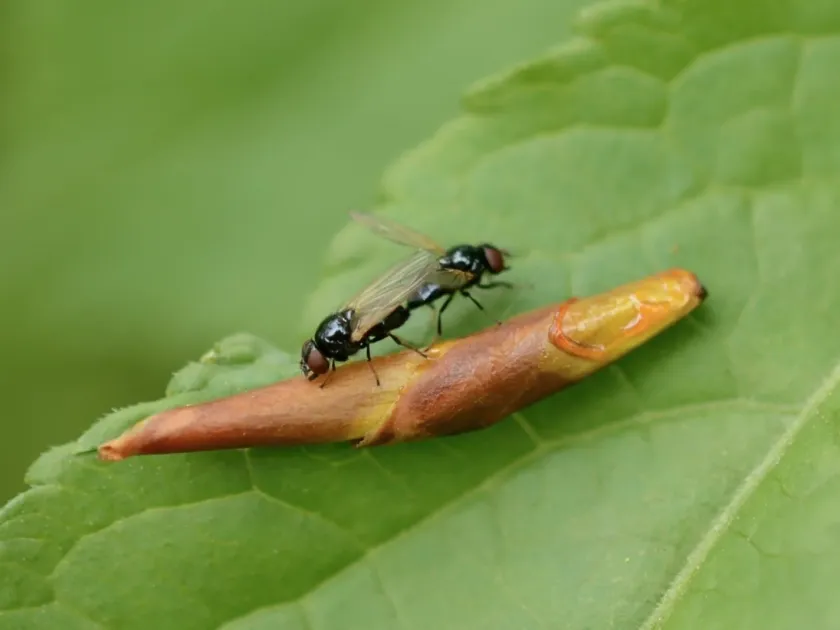
Lonchaea are members of the Lonchaeidae family, belonging to the order Diptera. Adults are small flies, typically characterized by a dark, often metallic or shiny body coloration.
A distinguishing feature of the imago is a short, broad abdomen and a specific wing venation pattern common to this family. When at rest, these flies hold their wings flat and overlapping.
The larvae have a cylindrical shape typical of many fly species, tapering towards the anterior end, and lack a distinct head. They are generally legless and appear whitish or yellowish.
The life cycle includes the egg stage, three larval instars, a pupal stage encased in a puparium, and the adult stage. Depending on the climate, the species may complete several generations per season.
While many species are saprophagous, some representatives of the genus have evolved towards obligate or facultative parasitism, causing damage to living plant tissues.
What it damages
Lonchaea species cause significant damage to a wide range of agricultural and ornamental crops. They frequently attack vegetable crops, including tomatoes, onions, crucifers, and various types of root vegetables.
The pest is also found on fruit crops, where larvae penetrate damaged or weakened fruit, accelerating decay and rendering the produce unmarketable.
Species that infest plant stems are particularly dangerous, as they cause deformation, stunted growth, and tissue necrosis due to the disruption of nutrient transport.
In greenhouse settings, Lonchaea can infest seedlings and young plants, leading to severe yield losses during the early stages of crop development.
Damage is often complex, as the wounds caused by larvae facilitate the entry of secondary bacterial and fungal pathogens, leading to rapid tissue decay.
Signs of infestation
The first sign of a Lonchaea infestation is the wilting of the plant's apex or individual leaves, which is often misidentified as a symptom of water or nutrient deficiency.
Upon inspection of the stems, one may observe areas with softened, darkening bark, containing galleries created by the larvae feeding inside the plant tissue.
When fruit or root vegetables are attacked, exit holes or entry points appear on the surface, surrounded by tissue that softens quickly and begins to rot, often emitting a foul odor.
The presence of small, mobile white larvae within the plant tissues is a direct confirmation of the pest's presence in the field or greenhouse.
- Yellowing and curling of leaves;
- Stunted plant growth and development;
- Softening of stems near the base;
- Rotting spots on fruits and vegetables;
- Death of young plants during the seedling stage.
Control measures
The primary control measure is adherence to crop rotation practices, which prevents the mass buildup of the pest population on the same plots over consecutive years.
Timely disposal and destruction of plant residues are crucial, as larvae and puparia often overwinter within these materials, waiting for the next season.
Using protective netting in greenhouses helps restrict adult access to plants for egg-laying, serving as an environmentally friendly method of population management.
The application of biological agents based on entomopathogenic fungi or the release of natural enemies can effectively reduce the damage caused by Lonchaea without harsh chemicals.
In cases of high pest density, the use of systemic insecticides is justified; however, their application must strictly adhere to pre-harvest intervals to ensure safety.
Taxonomy
- Latin name
- Lonchaea
- Order
- Diptera (flies)
- Family
- Lonchaeidae
- EPPO code
- LONHSP
Discussion
No discussions yet — be the first.