
Satin moth
Leucoma
Description
How to identify
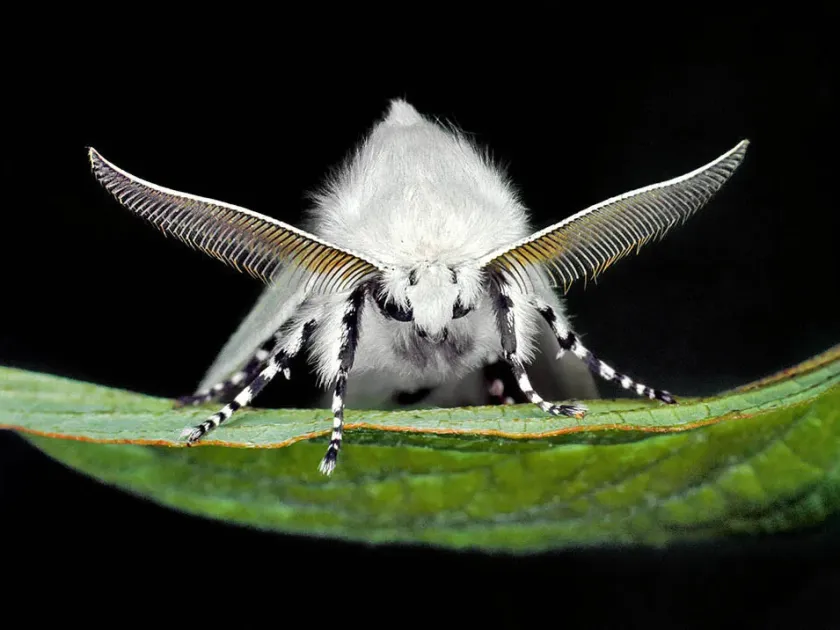
The satin moth (Leucoma salicis) is a member of the Erebidae family. It is a striking, snow-white moth that is recognized as a significant pest of deciduous trees across Europe, Asia, and North America.
Adult moths possess a wingspan ranging from 40 to 55 mm. Their wings are pure white, sometimes with a silky sheen, while the body is covered with dense white hairs. Males are easily distinguished by their feathery antennae.
The larvae, or caterpillars, are distinct in appearance. They grow up to 50 mm in length, featuring a dark grey body with a series of white diamond-shaped or rectangular spots along the back, accompanied by tufts of long hairs.
The pupae are black and protected by a loose, silken cocoon often woven between leaves. The larvae overwinter in small, silken webs called hibernacula, which are tucked into the bark crevices of host trees.
The life cycle typically consists of one generation per year. After emerging in mid-summer, adults mate, and females lay eggs in clusters on the bark, covering them with a white, frothy substance for protection.
What it damages
The satin moth primarily targets members of the Salicaceae family, specifically poplars (Populus) and willows (Salix). These trees often face severe defoliation during peak outbreak years.
Beyond its preferred hosts, the caterpillar can attack aspen and, occasionally, various orchard trees like apple or cherry, especially when their primary food sources are depleted.
Caterpillars cause damage by consuming buds in the early spring, immediately following their emergence from hibernation. This can severely inhibit the tree's growth cycle at a critical time.
As they grow, the larvae consume leaf tissue, often leaving only the midribs and veins behind. This process is known as skeletonization, which progresses to the complete consumption of leaves.
Heavy infestations lead to widespread defoliation of entire stands. Repeated attacks over several seasons can cause branch dieback, reduced vigor, and increased susceptibility to secondary pests and fungal infections.
When it appears
The most critical period for damage is spring (from April to June), when the larvae resume feeding. Adult moths are typically active in flight during the mid-summer months, usually June and July.
Overwintering larvae emerge from their hibernacula as soon as temperatures rise in the spring. By late summer, the new generation of larvae is small and prepares for overwintering, posing minimal threat compared to spring feeding.
Signs of infestation
The presence of overwintering webs on branches is the primary sign during the dormant season. These small, white silken patches are located in the forks of branches or within bark cracks.
In spring and summer, visible signs include ragged or skeletonized leaves and the presence of frass (larval excrement) on leaves and beneath the canopy. Severe cases present as naked branches devoid of foliage.
Control measures
Mechanical control is effective in small areas; this involves pruning and destroying infested twigs that contain overwintering larvae during the winter months.
Biological control methods, such as the application of Bacillus thuringiensis (Bt), are highly effective when applied during the early larval stages, as they target the caterpillars without impacting beneficial pollinators.
In commercial forests or large-scale landscaping, insect growth regulators or targeted insecticides are used to mitigate outbreaks when biological control is insufficient.
Conservation of natural predators is essential. Various species of birds and parasitic wasps play a significant role in keeping satin moth populations below the economic injury level.
- Regular inspection of bark for egg clusters during July and August.
- Installation of light traps for monitoring adult population levels.
- Removing and burning fallen foliage if larvae are present.
Taxonomy
- Latin name
- Leucoma
- Order
- Lepidoptera (butterflies)
- Family
- Erebidae
- EPPO code
- LEUOSP
Discussion
No discussions yet — be the first.