
Giant water bug
Lethocerus distinctifemur
Description
How to identify
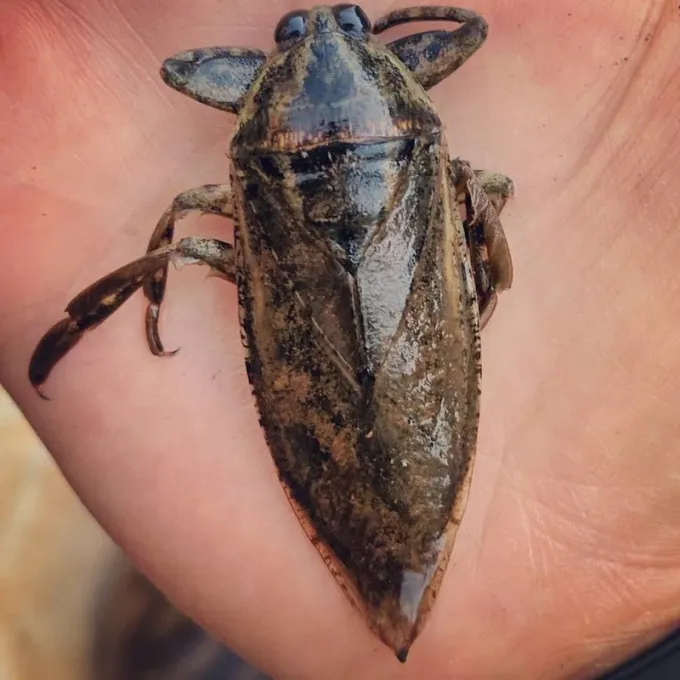
The Lethocerus distinctifemur belongs to the order Hemiptera and the family Belostomatidae. These are among the largest aquatic insects, reaching lengths of up to 12 cm.
They possess a dorsoventrally flattened body and strong raptorial front legs adapted for grasping prey, which are held firmly during the feeding process.
The insect uses its rostrum to inject potent salivary enzymes into its prey, liquifying the tissues before ingestion, which is a highly effective hunting strategy.
The life cycle consists of egg, nymphal stages, and adult. Nymphs closely resemble adults but are wingless and must undergo several molts to reach maturity.
Adults are capable of long-distance flights, allowing them to colonize new flooded areas like rice paddies and aquaculture ponds with significant ease.
What it damages
The primary agricultural impact of this species is its aggressive predation on small fish fry, causing significant losses in aquaculture and fish farms.
In rice cultivation, they disrupt the local food web by predating on beneficial organisms that naturally regulate other rice pest populations.
Large populations of these bugs can deplete the food sources for commercially valuable fish species, directly affecting the yield and profitability of the farm.
Although they do not feed on plant tissue, their burrowing and movement in the water can physically disturb the roots of young rice seedlings.
Their painful bite also poses a nuisance risk to farm workers who manually maintain the irrigation systems during the peak activity season.
Control measures
Effective management includes mechanical weeding of irrigation canals to remove aquatic vegetation that the bugs use for egg-laying sites.
Installing fine-mesh screens at water inlets effectively prevents adult bugs from entering ponds and paddy fields from external water sources.
Light traps deployed at night are a highly effective method for capturing adult bugs during their migration flights, significantly lowering the breeding population.
Maintaining balanced predator populations, such as herons and larger predatory fish, can help keep the bug population within manageable levels.
- Periodic drying of fields to disrupt the life cycle of the insects.
- Monitoring egg masses on aquatic plants and manually destroying them.
- Strategic water management to minimize stagnant areas.
Taxonomy
- Latin name
- Lethocerus distinctifemur
- Order
- Hemiptera (bugs, aphids, leafhoppers)
- Family
- Belostomatidae
- EPPO code
- LETHDI
Discussion
No discussions yet — be the first.