
Giant water bug
Lethocerus
Description
How to identify
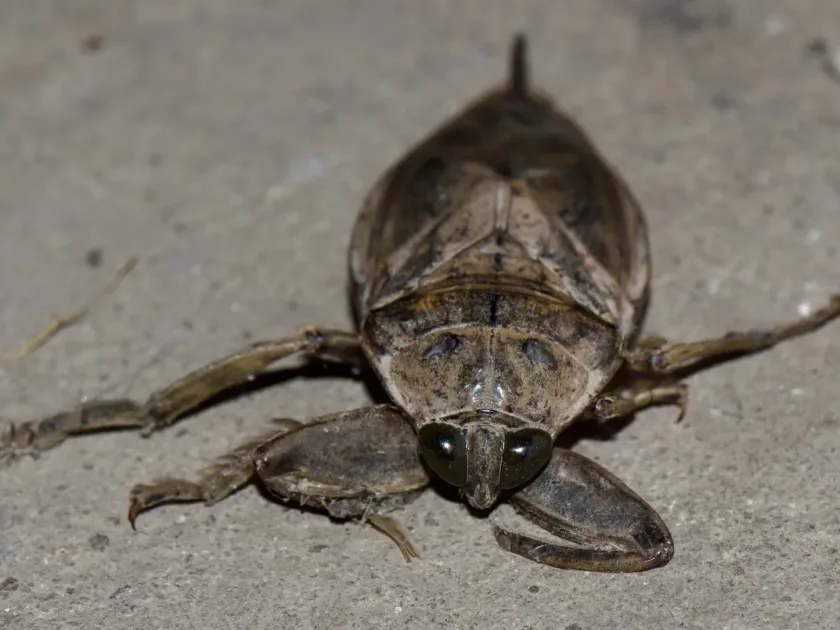
The giant water bug (genus Lethocerus) belongs to the order Hemiptera and the family Belostomatidae. These are some of the largest aquatic insects globally, reaching sizes of up to 10–12 centimeters.
Their bodies are flattened and oval-shaped, typically colored in shades of brown, which provides excellent camouflage against the bottom of ponds and among aquatic vegetation.
The front legs are modified into powerful raptorial limbs used specifically to seize and hold prey. They possess a short, sturdy rostrum capable of piercing prey and injecting digestive enzymes.
They are strong fliers, often moving between different water bodies at night, and are known to be attracted to artificial light sources.
The life cycle involves incomplete metamorphosis (hemimetabolism), consisting of eggs, nymphs, and adults, with the unique behavior of males guarding the egg clutches.
What it damages
While they are not traditional agricultural crop pests, giant water bugs can cause significant economic damage in aquaculture and fish farming facilities.
They are formidable predators that feed on fish fry, tadpoles, and small amphibians, potentially decimating the population of young fish in a nursery pond.
In high densities, these insects can severely reduce the survival rates of stocked fish, leading to direct losses for aquaculturists.
Beyond direct predation, their presence can alter the trophic structure of a pond, as they compete with other predators and influence the diversity of small aquatic organisms.
In natural habitats, they serve as top predators in small, stagnant water bodies, maintaining the ecological balance by controlling various aquatic prey populations.
When it appears
Their activity begins in early spring as water temperatures rise, triggering the start of the breeding season and increased metabolic activity.
The peak of their life cycle occurs during the summer months, providing the warmth necessary for nymphs to develop and grow rapidly.
During the autumn, as temperatures drop, adult bugs prepare for overwintering, often migrating to deeper water bodies that do not freeze completely.
Overwintering usually takes place in the substrate at the bottom of ponds, where the bugs enter a state of dormancy until the return of favorable weather.
The seasonal population dynamics are heavily dependent on food availability and the temperature profiles of the aquatic environment throughout the year.
Signs of infestation
The primary indication of their presence is the unexplained loss or damage of fish fry within a pond, often marked by visible bite wounds on the fish.
Visual identification can be performed at night by using flashlights along the pond edges, as they are often active hunters under the cover of darkness.
Finding egg masses attached to emergent plants or debris near the water line is a clear sign that a breeding population is established in the area.
Observing the surface of the water, one may see the tip of the bug's abdomen protruding, which it uses to breathe air while remaining partially submerged.
They are frequently captured in nets during regular pond maintenance or fish harvesting activities, where they are found clinging to prey or tangled in debris.
Control measures
Manual removal using nets or seines is the most effective approach for managing populations in small, controlled fish farming environments.
Installing light traps can help capture adult bugs during their nocturnal flight phase, preventing them from colonizing new ponds.
Clearing excessive aquatic vegetation helps by removing both the shelter they require for hunting and the surfaces they need for laying eggs.
Encouraging natural predators such as waterfowl or larger fish can help keep the bug population in check without the use of harmful substances.
Chemical control is generally avoided in aquaculture to protect the health of the fish and maintain the overall biological equilibrium of the pond ecosystem.
Taxonomy
- Latin name
- Lethocerus
- Order
- Hemiptera (bugs, aphids, leafhoppers)
- Family
- Belostomatidae
- EPPO code
- LETHSP
Discussion
No discussions yet — be the first.