
Giant water bug
Belostoma
Description
How to identify
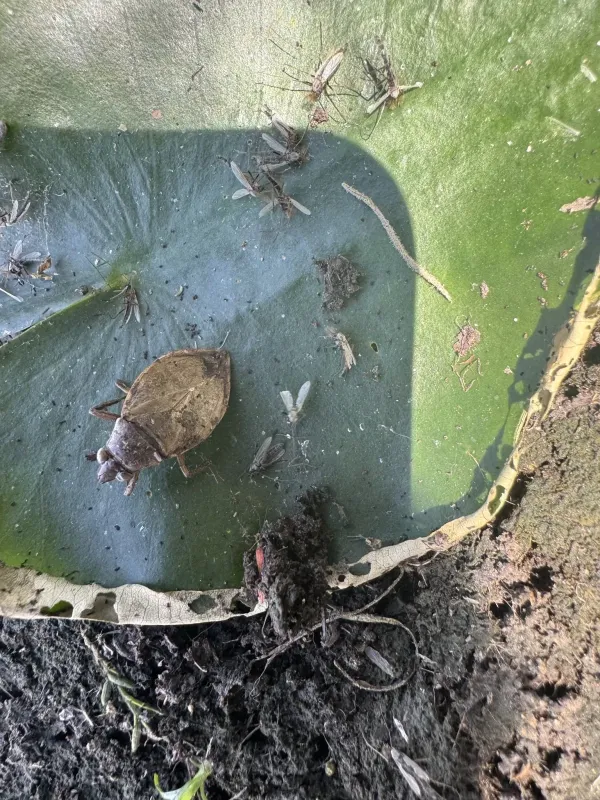
The giant water bug (family Belostomatidae) is a massive aquatic insect that can grow up to 10–12 centimeters in length. Its body has an oval, flattened shape with brown coloration, providing camouflage on the muddy bottom of water bodies.
A notable feature of this species is its powerful front legs, which are modified into raptorial claws to capture prey. At the end of the abdomen, there are respiratory siphons that allow the insect to breathe atmospheric air while submerged.
Systematically, these insects belong to the order Hemiptera. They exhibit distinct parental care: the female deposits eggs on the back of the male, who carries them until they hatch into nymphs.
Adults have developed wings and are capable of nocturnal flights between bodies of water, often attracted by artificial lights. Their mouthparts form a sharp rostrum, used to pierce prey and inject digestive enzymes.
Nymphs resemble adults but are smaller and lack fully formed wings. The life cycle consists of the egg stage, five nymphal instars, and the adult stage, all occurring in aquatic environments.
What it damages
The primary crop affected is rice (Oryza sativa) in flooded fields, along with other aquatic crops. The pest attacks both small fish in aquaculture and the tender shoots of young plants.
For rice fields, the bug is destructive because it feeds on the base and stems of young seedlings. The mechanical injury caused by the rostrum leads to wilting and eventual death of the plants.
During mass outbreaks, the bug population can significantly reduce plant density, directly impacting total yield. Damage is often exacerbated by the insect's stealthy behavior, making it difficult to detect until clusters of damaged plants appear.
In aquaculture, the bug acts as a predator, consuming fish fry. This makes it a significant management target for both crop production and fisheries.
Beyond direct feeding, the punctures made by the bug serve as entry points for pathogens, causing secondary infections and stem rot. This weakens the plant's immune system during the early development phase.
When it appears
The activity of the giant water bug is directly correlated with water temperature and climate. The most intense life cycle progression occurs during the hot summer months, facilitating rapid nymph growth.
In spring, as temperatures rise, adults emerge from hibernation in bottom sediments or aquatic vegetation. They migrate to flooded fields to begin the reproduction cycle.
Peak damage coincides with the active growth phase of young rice plants. During this time, the bugs are highly active, requiring close monitoring by agronomists.
As autumn approaches and water temperatures drop, activity levels decrease. The insects enter a state of diapause, burrowing into the mud to survive the colder season.
The number of generations per season depends on the geographic zone; in tropical regions, multiple generations can occur, complicating control efforts.
Signs of infestation
A key sign of infestation is the appearance of yellowing patches or bare spots in rice fields. Closer inspection reveals mechanical puncture wounds at the base of the stems.
In the early morning or evening, the insects may be seen rising to the surface to breathe. At night, they can be detected by their movement through the water column.
Empty egg clusters on plants are a reliable indicator of active breeding. This serves as a warning that immediate management steps should be taken.
A characteristic symptom is the rapid wilting of young plant tops. Punctures from the bug's rostrum are clearly visible upon close examination of the stem.
Large bugs may also cause other aquatic life to behave erratically, as they actively avoid the hunting zones of this predator.
Control measures
The primary control method is careful water management, including periodic drainage of fields, which disrupts the bug's breeding cycle and destroys its habitat.
Biological control, such as encouraging natural predators like birds and larger fish, helps maintain the population at a manageable level.
In cases of economic threshold breach, the use of insecticides approved for aquatic environments is permitted, though careful selection is required to protect beneficial fauna.
Physical light traps at night are effective for monitoring and reducing adult populations, providing a sustainable way to manage localized infestations.
Cultural practices, such as removing weeds from irrigation canals, eliminate shelter and egg-laying sites, which is essential for long-term population suppression.
Taxonomy
- Latin name
- Belostoma
- Order
- Hemiptera (bugs, aphids, leafhoppers)
- Family
- Belostomatidae
- EPPO code
- BELSSP
Discussion
No discussions yet — be the first.