
Chilean leaf-footed bug
Leptoglossus chilensis
Description
How to identify
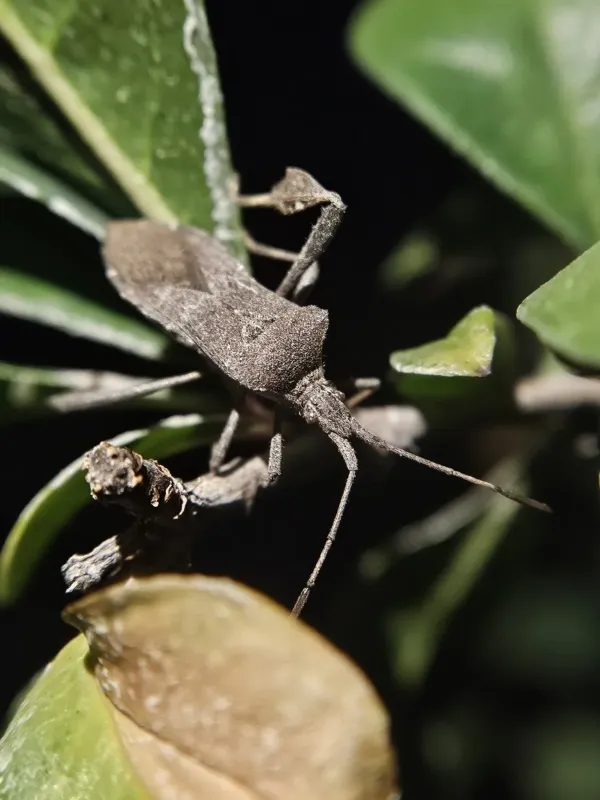
The Chilean leaf-footed bug (Leptoglossus chilensis) is a member of the Coreidae family, known for the leaf-like expansions on its hind tibiae. This morphological feature is the most reliable way to identify this species.
Adult insects typically measure about 15–20 mm in length. They exhibit a dark brown or reddish-brown coloration, often accompanied by a light-colored, zigzag pattern across the wings, providing camouflage against bark and plant stems.
Nymphs of this species go through several developmental stages. While they resemble adults, they lack fully developed wings and often display brighter reddish or orange hues during their early life stages.
They are primarily native to South America. As hemipterans, they are well-adapted to surviving in diverse environments, utilizing their ability to remain motionless to evade detection by predators or observers.
These bugs possess specialized scent glands located on the thorax. When threatened, they release a pungent odor, which is a common defensive mechanism among many species within the Coreidae family.
What it damages
The Chilean leaf-footed bug acts as a polyphagous pest, meaning it feeds on a wide variety of plant species. Their primary targets include fruit trees, vines, and several vegetable crops found in commercial and private gardens.
Equipped with piercing-sucking mouthparts, they penetrate the epidermis of fruits and young stems. As they feed, they inject digestive enzymes into the plant tissue, which causes localized cell death and fluid liquefaction.
This feeding behavior results in severe physiological damage. Fruits often develop deep depressions, necrotic spots, or corky tissue, rendering them unmarketable and susceptible to rot.
Young shoots and buds can become stunted or deformed if subjected to repeated feeding. In many cases, the damage leads to premature fruit drop, which significantly reduces the total harvest yield.
The damage caused by these bugs is often compounded by secondary infections, as the puncture wounds provide easy entry points for various bacterial and fungal pathogens common in fruit crops.
When it appears
The life cycle of this pest is highly seasonal. Adults overwinter in protected areas, such as piles of plant debris, cracks in tree bark, or sheltered areas near fences and structures.
In spring, as temperatures rise, adults emerge to feed on developing buds and tender leaves. This period is critical, as early feeding can compromise the structural integrity of the plant for the entire season.
During summer, the bugs enter their primary reproductive phase. Eggs are laid in clusters, often on the undersides of leaves, and the subsequent emergence of nymphs leads to peak damage throughout the growing season.
As autumn approaches, the population stabilizes as individuals prepare for diapause. They begin moving away from open feeding areas toward sheltered locations to survive the coming winter months.
In warmer climates, the development cycle can be accelerated, potentially allowing for multiple generations per year. This necessitates vigilance from late spring through to the early harvest season.
Signs of infestation
The most immediate sign of an infestation is the presence of the bugs themselves, often found resting on stems or fruits. They are generally solitary or found in small, loose clusters.
Punctured fruit surfaces are a clear indicator of feeding activity. These injuries appear as tiny, dark dots surrounded by small depressions, which may darken further as the fruit continues to grow.
Plants under heavy pressure may exhibit signs of stress, including yellowing leaves, curling foliage, and the aforementioned premature dropping of immature fruits.
- Characteristic necrotic spots on harvested fruits.
- Shed exuviae (cast skins) left behind on leaves or stems.
- A distinct, unpleasant odor when the insects are disturbed.
Regular inspections, particularly during the fruit enlargement phase, are essential to catch the presence of these pests before they inflict widespread damage across the entire orchard.
Control measures
Integrated Pest Management (IPM) for this species begins with sanitation. Removing leaf litter and weeded areas around the base of trees significantly reduces the available overwintering sites for adults.
Encouraging natural predators is an effective long-term strategy. Promoting the presence of predatory wasps, spiders, and birds can help maintain the bug population at manageable levels without chemical intervention.
If population thresholds are exceeded, targeted insecticidal treatments may be necessary. Use products that are effective against coreid bugs and ensure they are applied in a way that minimizes impact on pollinators.
Monitoring using visual inspection or pheromone-based lures helps track the arrival of adults in the orchard, allowing growers to intervene early with spot treatments rather than broad-spectrum spraying.
Cultural practices, such as proper pruning for airflow and adequate plant nutrition, can strengthen crops, making them less attractive and better able to withstand the stress of minor pest infestations.
Taxonomy
- Latin name
- Leptoglossus chilensis
- Order
- Hemiptera (bugs, aphids, leafhoppers)
- Family
- Coreidae
- EPPO code
- LEPLCH
Discussion
No discussions yet — be the first.