

Pest · Coleoptera (beetles) · affects Winter wheat, Winter rapeseed, Winter barley
Cereal leaf beetle
Lema
Description
How to identify
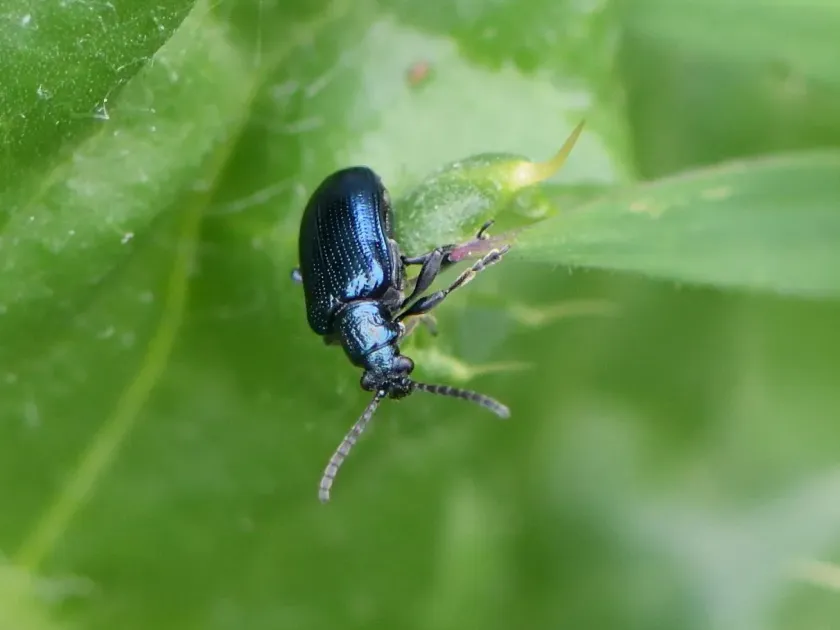
The cereal leaf beetle (Latin Lema, specifically Oulema melanopus) belongs to the order Coleoptera and the family Chrysomelidae. Adults are small, about 4–5 mm long, with a metallic blue or green body and reddish-orange legs.
The larvae are easily distinguished by their appearance: they are covered in a layer of mucus and their own fecal matter, which makes them look like small black slugs or leeches.
The eggs are small, cylindrical, and initially yellow, eventually turning dark brown or black just before the larvae hatch. They are typically laid on the upper leaf surface along the veins.
The life cycle consists of the egg stage, four larval instars, a pupal stage in the soil, and the adult stage. In most temperate regions, there is only one generation per year.
Adults overwinter in the surface layer of soil, under crop residues, or in grassy areas, becoming active in the spring as temperatures rise consistently above 10-12 degrees Celsius.
What it damages
The cereal leaf beetle is a specialized pest of small grain crops. It primarily attacks winter and spring wheat, barley, oats, rye, and some wild grass species.
The larvae are the most destructive stage. They feed on the leaf tissue, consuming the upper and middle layers while leaving the bottom epidermis intact, which eventually turns into holes.
Heavy infestations can lead to significant physiological stress in the plants, reducing photosynthesis and preventing proper grain filling in the wheat ears.
Yield losses can be substantial if the infestation occurs during the flag leaf development stage, as the damage directly impacts the plant's ability to produce quality grain.
Both adults and larvae feed on the plants, but the larval feeding pattern is much more aggressive and responsible for the majority of the economic loss in the field.
When it appears
Adult beetles emerge from overwintering sites in early spring, synchronized with the green-up of winter wheat and the emergence of spring cereal crops.
Egg-laying usually occurs during the crop's tillering and stem elongation stages. This timing is critical, as it determines when the larvae will be most active.
The larval stage lasts for about 2 to 3 weeks. After reaching full maturity, the larvae burrow into the soil to pupate at a depth of a few centimeters.
New adults emerge in mid-summer, usually just before the harvest. They feed briefly on succulent grasses or late-maturing cereals before moving to their wintering sites.
The rate of development is heavily dependent on weather conditions, particularly temperature. Warm, dry springs often favor faster development and higher survival rates of larvae.
Signs of infestation
The most common sign of infestation is long, narrow white stripes on the leaves. These occur because adults feed by stripping away the top layers of the leaf epidermis.
Larval feeding creates distinct "window-pane" patterns where the leaf is eaten in lines, leaving behind a thin, translucent layer of plant tissue that eventually dries out.
Dark, sticky, fecal mounds on the leaf surface are a definitive indicator of cereal leaf beetle presence. These mounds protect the larvae from heat and predators.
A quick field check can be done by looking for the metallic beetles on the leaves. They are sensitive to vibration and will often drop to the ground when approached.
In cases of severe damage, the entire field may appear brownish or scorched, similar to the damage caused by drought or frost, due to the total destruction of leaf chlorophyll.
Control measures
Cultural control methods include deep tillage to destroy pupae in the soil and using crop rotation to interrupt the life cycle and reduce population density.
Maintaining clean field edges and removing volunteer cereals is essential, as these areas serve as primary overwintering and early feeding sites for the adult beetles.
Chemical control is warranted when the population density reaches the economic threshold, which is typically one larva per flag leaf or per stem, depending on the crop's growth stage.
Approved insecticides from the pyrethroid or neonicotinoid groups are highly effective when applied correctly during the peak of larval activity.
Regular scouting using an insect sweep net is recommended to monitor beetle numbers and ensure that insecticide applications are timed for maximum efficacy before significant damage occurs.
Content graph
Connections · Cereal leaf beetle
Most often together:
Nutrient elements
1 contact
Marketplace
Products · 2

Biology
Taxonomy
- Latin name
- Lema
- Order
- Coleoptera (beetles)
- Family
- Chrysomelidae
- EPPO code
- LEMASP
Community
Discussion
No discussions yet — be the first.