
Fungus beetles
Latridius
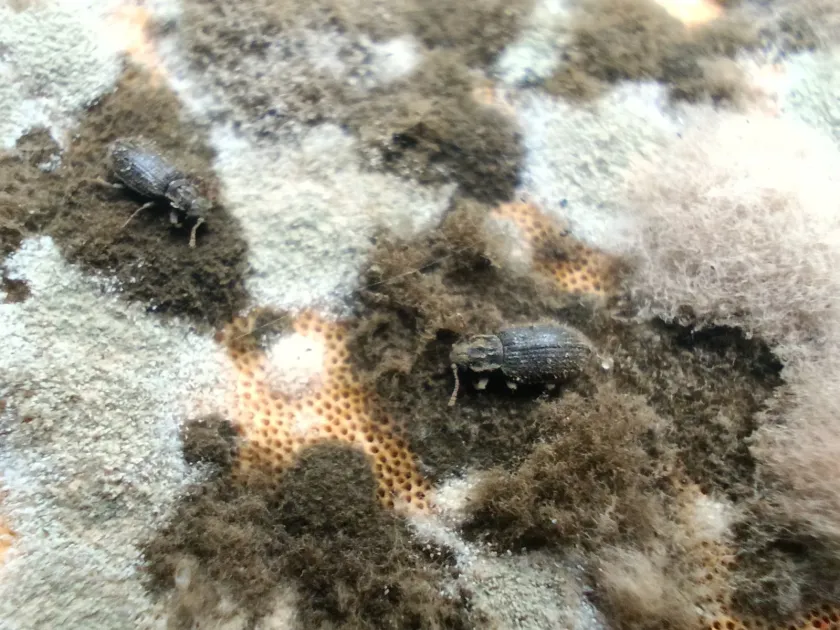
Description
How to identify
The genus Latridius belongs to the family Latridiidae, commonly known as minute brown scavenger beetles or fungus beetles.
These insects are very small, typically measuring between 1 and 3 mm in length, making them difficult to detect without careful inspection.
The adult beetles have an elongated or oval body shape with a brownish to black color and distinct punctation on their wing covers.
The larvae are also microscopic, usually whitish, and possess a highly specialized anatomy that allows them to thrive in fungal growth environments.
Identification often requires magnification to examine the specific structure of the pronotum, which features characteristic ridges used in species classification.
What it damages
Latridius beetles are primarily pests of stored products, especially those that have been affected by damp conditions and subsequent mold growth.
They feed extensively on the spores and mycelium of various molds, which is why they are frequently referred to as fungus beetles.
While they are not primary pests of dry, healthy grain, they cause significant secondary damage by spreading fungal spores throughout the storage facility.
Massive infestations lead to severe product contamination, rendering grain or food supplies unfit for human consumption or animal feed.
Their presence is a strong indicator of poor storage conditions, specifically high humidity, which leads to the rapid degradation of stored assets.
When it appears
In temperature-controlled warehouses, Latridius beetles can complete multiple generations throughout the year if moisture conditions remain high.
Their activity peaks during periods of high humidity and moderate temperatures, which are ideal for the growth of their primary food source, mold.
The lifecycle from egg to adult is relatively fast, often taking less than a month under optimal environmental conditions of warmth and moisture.
These beetles are highly mobile and tend to colonize new areas of a warehouse where condensation or water leaks have created moist spots.
They can survive in various micro-environments, making them persistent pests that can hide in cracks, under pallets, or within damaged packaging.
Signs of infestation
A musty or moldy odor emanating from stored grain or commodities is often the first warning sign of a Latridius infestation.
Visual detection involves finding small, moving beetles on the surface of stored goods, particularly near areas where moisture has accumulated.
The presence of mold growth on the grain or surrounding surfaces is almost always associated with the activity of these scavenger beetles.
Sifting grain samples through fine-mesh screens will typically reveal the presence of both the adults and the larvae in the sample.
Contaminated products may show discoloration or a gritty texture, which is a result of the beetles' feeding activities and their excrement.
Control measures
The most important control measure is maintaining grain moisture content below 13%, which effectively inhibits the growth of the mold that these beetles feed on.
Rigorous warehouse sanitation is essential to remove grain dust, spills, and debris that act as breeding sites for the fungus beetles.
Proper aeration and ventilation systems should be used to prevent condensation and keep the moisture levels in the storage environment stable.
In cases of significant infestation, chemical control through space fumigation may be necessary to eliminate the pest population.
- Regular moisture monitoring of all stored bulk products.
- Physical exclusion by sealing cracks and gaps in storage structures.
- Use of sticky traps for monitoring beetle population trends.
- Disinfection of empty storage bins before introducing new stock.
Taxonomy
- Latin name
- Latridius
- Order
- Coleoptera (beetles)
- Family
- Latridiidae
- EPPO code
- LATISP
Discussion
No discussions yet — be the first.