
Clover stem borer
Languria mozardi
Description
How to identify
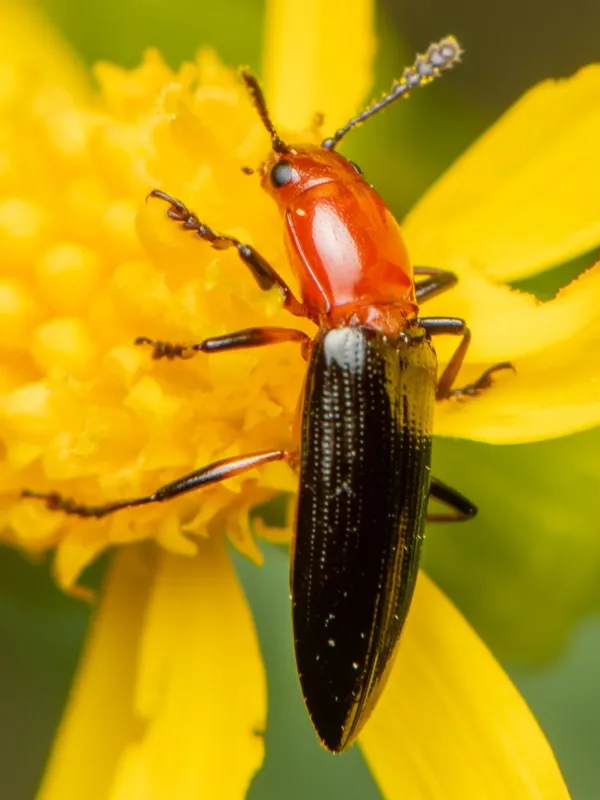
The clover stem borer (Languria mozardi) is a beetle belonging to the family Languriidae. Adults are slender, typically 5–7 mm long, characterized by shiny dark blue or black wing covers and a distinctive red prothorax.
The life cycle consists of four stages: egg, larva, pupa, and adult. Adults overwinter in plant debris or soil, emerging in the spring when temperatures consistently rise, marking the beginning of their active season in clover fields.
The larvae are yellowish-white with a dark head. They develop exclusively inside the stems of host plants, which makes them protected from many environmental factors and standard insecticide applications for a significant portion of their life.
The pupal stage also occurs within the stem. The larva prepares a chamber, often severing the vascular tissues of the stem to facilitate its transformation, which causes significant physiological damage to the host plant.
Depending on the region, there can be one or multiple generations per year. Warm climates significantly accelerate the life cycle, leading to higher population density and increased pressure on leguminous crops throughout the growing season.
What it damages
The primary host for Languria mozardi is red clover, but it also infests alfalfa, sweet clover, and other legumes. The damage is primarily caused by larvae feeding on the internal tissues of the stems.
Larval feeding creates tunnels within the stem, which disrupts the transport of nutrients and water. This results in stunted plant growth, loss of vigor, and reduced biomass, which is particularly detrimental to hay and forage production.
The weakening of the stems often leads to lodging, especially under windy conditions or during harvesting. This not only complicates mechanical operations but also increases the risk of secondary infections by pathogens entering through the bored holes.
In seed production, the pest reduces both the quality and quantity of seeds, as the damaged plants have limited energy reserves to support reproductive development. This leads to yield gaps and lower economic returns.
Severe infestations can result in the premature death of stems, which can be observed across large patches in the field. Effective management is essential to prevent these localized infestations from becoming systemic throughout the farm.
Signs of infestation
The most common sign of infestation is the yellowing and wilting of individual stems. Affected plants may appear sickly compared to the healthy green canopy, even when moisture levels in the soil are adequate.
Inspecting the stems reveals small entry holes bored by the larvae. Upon splitting a stem lengthwise, one can see internal tunneling filled with frass, which is the most definitive diagnostic feature of this specific pest.
Lodging or bent stems are common indicators of the borer's presence, as the structural integrity of the plant is compromised by the interior tunneling. This is often more noticeable after heavy rain or wind events.
Adult beetles can be spotted using sweep nets during the warmer months. They are active during the day and are often found resting on the terminal leaves or flowers of the host plants.
The presence of emergence holes near the base of the stem towards the end of the season indicates that a new generation of adults has successfully completed its development and is preparing to overwinter.
Control measures
Cultural control is the most effective approach for managing the clover stem borer. Frequent and timely harvesting of clover crops effectively removes the larvae from the field before they reach the pupal stage, thus breaking their life cycle.
Crop rotation is a vital strategy to prevent the buildup of the pest population. Moving leguminous crops to different fields each year reduces the likelihood of adults colonizing the new crop from previous year's residues.
Sanitation practices, including the removal of volunteer legumes and weeds along field edges, help eliminate overwintering sites for the adults. Deep plowing of crop residues post-harvest can also help reduce the overwintering survival rate.
Chemical control is rarely the primary solution but can be considered if the population density exceeds economic thresholds. If applied, insecticides should be timed to target adults before they lay eggs on the stems.
- Timely harvesting to remove larvae.
- Strategic crop rotation.
- Control of weed hosts.
- Monitoring with sweep nets.
Taxonomy
- Latin name
- Languria mozardi
- Order
- Coleoptera (beetles)
- Family
- Erotylidae
- EPPO code
- LANGMO
Discussion
No discussions yet — be the first.