
Cryptophilus integer
Cryptophilus integer
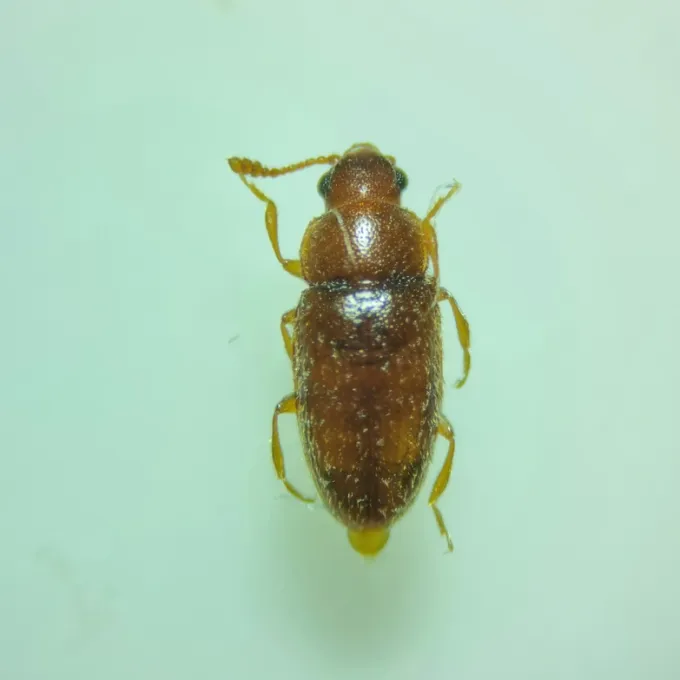
Description
How to identify
Cryptophilus integer belongs to the Cryptophagidae family, order Coleoptera. These are small beetles, typically measuring between 2 and 3 millimeters in length.
The insect's coloration ranges from light brown to a reddish-brown hue. They possess an elongated, slightly flattened body, which is a common characteristic for many members of this family.
Adult beetles have well-developed wings, enabling them to actively disperse over significant distances in search of suitable substrates for feeding and reproduction.
The larvae are worm-like in appearance, white or yellowish, and develop inside organic debris, which makes them very difficult to detect in the early stages of infestation.
Correct identification often requires microscopic examination, as the adults look very similar to many other small beetles found in stored products.
What it damages
This species is classified as a secondary pest, most frequently infesting grain and seeds that are already damaged or contaminated by fungi and mold.
Cryptophilus integer thrives in storage facilities for grain, flour, bran, and oilseeds, provided that conditions are sufficiently humid.
In the field, these beetles feed on various plant debris, fungal spores, and mold, preferring environments where decaying organic material is present.
Damage is caused not only by direct consumption of the product but also by contamination with excrement, which reduces the overall quality and commercial value of the commodities.
The presence of this beetle in grain stocks is often a strong indicator of poor storage management and a failure to maintain proper sanitary conditions.
When it appears
The activity levels of Cryptophilus integer are directly dependent on the ambient temperature and the moisture content of the substrate.
In controlled storage environments, the pest can reproduce year-round if favorable conditions, such as warmth and available food, are maintained.
During the spring, as temperatures rise, the beetles begin to fly, moving from overwintering sites to new breeding locations, including fields and storage complexes.
Population growth is most intense during the summer and early autumn months, when high temperatures facilitate rapid life cycle completion.
Overwintering occurs at the adult stage, with the insects hiding in cracks, crevices, plant residues, soil, or within storage facility structures.
Signs of infestation
The primary method of detecting an infestation is by sifting grain samples through fine-mesh sieves to identify the presence of adult beetles or larvae.
A characteristic sign of infestation is the emergence of a specific musty odor, which intensifies as fungal growth accompanies the pest population.
Infested grain often loses its natural luster and may show signs of "hot spots" within the bulk storage due to increased moisture and pest activity.
The grain surface may appear contaminated with beetle excrement and fine webbing if other stored product pests are also present in the storage facility.
- Presence of dust-like residues in grain bags or silos.
- Temperature spikes within the stored grain mass.
- Visual detection of adults on packaging or storage surfaces.
Control measures
The most important control measure is the strict adherence to sanitary and hygiene protocols during the harvesting, transport, and storage of agricultural products.
Monitoring grain moisture is critical, as high moisture levels serve as the main catalyst for Cryptophilus integer reproduction.
Regular cleaning of storage facilities is essential to remove spilled grain, debris, and dust, which can serve as reservoirs for future infestations.
In cases of heavy infestation, fumigation of storage rooms or grain batches using approved chemical pesticides is required to eliminate the pest.
Preventive aeration and cooling of the grain mass help maintain low temperatures, which effectively hinders pest development and prevents further commodity spoilage.
Taxonomy
- Latin name
- Cryptophilus integer
- Order
- Coleoptera (beetles)
- Family
- Erotylidae
- EPPO code
- CRYFIN
Discussion
No discussions yet — be the first.