
Languria
Languria
Description
How to identify
The genus Languria belongs to the family Languriidae, often referred to as lizard beetles. These insects are primarily found in North America and are recognized by their elongated body shape and striking coloration.
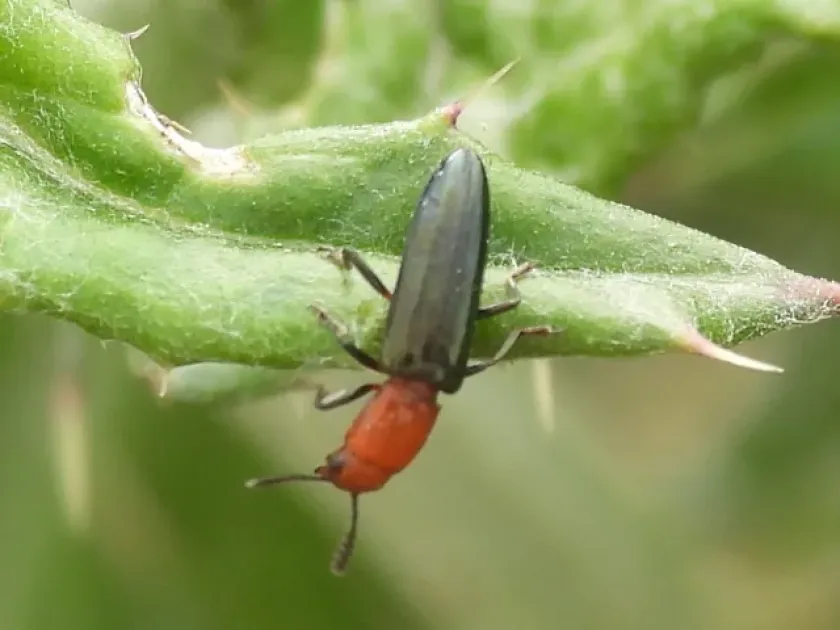
Adult beetles typically feature a bright orange or red pronotum contrasted with shiny dark elytra. They measure between 4 to 8 millimeters in length, making them visible to the naked eye during field inspections.
The larvae are cream or yellowish in color, cylindrical, and possess three pairs of thoracic legs. They remain hidden within plant stems for their entire development, which complicates early detection.
Systematically, this genus falls under the order Coleoptera. The clover stem borer (Languria mozardi) is the most economically significant species, known to affect various leguminous and grain crops.
Adults can be identified by their steady movement along stems during the day, particularly when temperatures are warm, as they are most active on the plant canopy.
What it damages
Languria primarily targets leguminous crops, including clover, alfalfa, and various vetches. They are also known to occasionally inhabit grain crops and certain wild weeds within the Asteraceae family.
The primary damage is caused by larvae that bore into the center of the stem. By feeding on the internal tissues, they disrupt the transport of nutrients and water, severely weakening the plant.
While adult beetles feed on the leaves, their impact is usually considered minor compared to the structural damage caused by the larval stage developing inside the plant.
Infected stems often show stunted growth and decreased vigor. In severe cases, the structural integrity of the plant is compromised, leading to stem breakage and significant yield loss.
- Red clover
- Alfalfa
- Grasses
- Wild legumes
When it appears
The life cycle of Languria is closely linked to the growing season of its host plants. Adults overwinter in plant debris or soil, emerging in the spring once temperatures stabilize.
Mating and oviposition occur from late spring to early summer. Females lay eggs inside the stems of young plants, where the larvae will subsequently develop and feed.
Depending on the region, there may be one or multiple generations per year. Warmer climates allow for a more rapid life cycle, leading to higher population pressures mid-season.
The peak activity of adults usually coincides with the rapid vegetative growth phase of clover or alfalfa. This is the optimal window for scouting and population assessment.
As autumn approaches, the final generation of adults enters dormancy, seeking shelter in soil or crop residue to survive the winter months.
Signs of infestation
The first signs of infestation often include yellowing or premature wilting of specific stems. A close inspection reveals small entry holes bored by the females for egg-laying.
Splitting an infested stem often exposes internal tunnels filled with larval frass. These tunnels are the primary indicator of larval presence within the plant structure.
Infested plants become structurally fragile. Strong winds or mechanical harvesting can easily cause breakage at the weakened sites, leading to the loss of the canopy.
A noticeable delay in the development of certain plants within a stand, compared to their neighbors, is a strong indicator of localized Languria activity.
The observation of adult beetles on the leaves during the flowering stage serves as a reliable warning that the current season's infestation has been established.
Control measures
Crop rotation is the most effective cultural practice for managing Languria, as it prevents the continuous buildup of pest populations in a specific field.
Timely harvesting or mowing of the forage crop before the larvae complete their development can significantly disrupt their life cycle and reduce the emergence of the next generation.
Post-harvest sanitation, including the removal of crop residues and deep tillage, helps to destroy overwintering sites and reduces the overwintering survival rate.
Chemical control is generally only effective against adults during the pre-oviposition period. Once larvae are inside the stems, contact insecticides are ineffective.
Integrated pest management (IPM) strategies, including the use of yellow sticky traps for monitoring, are essential for making informed decisions regarding potential control interventions.
Taxonomy
- Latin name
- Languria
- Order
- Coleoptera (beetles)
- Family
- Erotylidae
- EPPO code
- LANGSP
Discussion
No discussions yet — be the first.