
Kermania
Kermania
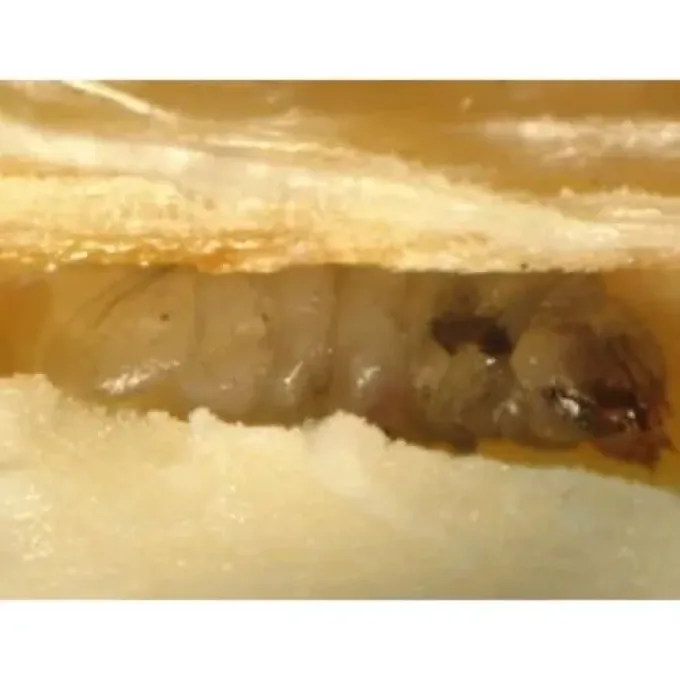
Description
How to identify
Kermania (lat. Kermania pistaciella) belongs to the Tineidae family, commonly known as fungus moths or clothes moths. The adult is a small moth with narrow wings typical of this family.
The larvae of this pest possess specific anatomical structures allowing them to penetrate deep into plant tissues. During their development, they pass through several instars, increasing significantly in size.
The coloration of the adult moth is usually gray to brown, making it almost invisible against the bark of trees. The wingspan measures only a few millimeters.
Identification is difficult because the pest spends most of its life hidden inside branches. Adults can only be detected during their flight period using pheromone traps.
Species diagnosis requires expert entomological knowledge, as the moth looks similar to many other micro-Lepidoptera species.
What it damages
The primary host for Kermania is the pistachio tree (Pistacia vera). This pest causes significant economic damage to commercial pistachio orchards.
Larvae infest young shoots and branches. They tunnel deep into the woody tissue, which disrupts the normal sap flow within the plant.
As a result of larval activity, branches become brittle and easily break under the weight of the crop or during windy conditions.
Severe infestations lead to the dieback of entire scaffold branches, significantly reducing the overall productivity of the pistachio orchard.
Gradual wilting and tree decline due to vascular system damage can eventually lead to the death of the tree if left unmanaged.
When it appears
The life cycle of Kermania is closely tied to the phenological stages of the pistachio tree. Adult flight typically occurs in the spring, coinciding with flowering and early fruit formation.
Females lay eggs directly on the bark of young shoots or at the base of buds, providing the emerging larvae with immediate access to food.
After hatching, the larvae immediately bore into the plant tissue, where they spend most of their life cycle until pupation.
The larval feeding period is extended, lasting throughout the entire active growing season of the tree.
Pupation occurs within the tunnels, and adults emerge from the wood to mate and begin a new generation.
Signs of infestation
The first sign of an infestation is the presence of small entry holes in the bark of shoots through which the larvae entered the branches.
Frass (larval excrement) is often visible on the surface of branches near the entry points, ejected by the larvae while tunneling.
Yellowing and premature wilting of leaves on specific branches are strong indicators that wood-boring activity is occurring inside.
When an infested branch is cut open, one can observe long, winding galleries filled with brown frass and debris from the pest's activity.
Dieback of shoot tips without obvious signs of fungal pathogens is a classic symptom of Kermania damage.
Control measures
The foundation of control is strict sanitary pruning and the destruction of infested branches containing larvae or pupae.
The use of pheromone traps is essential to monitor adult flight and determine the precise timing for protective measures.
Systemic insecticide applications are most effective at the moment of larval hatch, before the insects bore deep into the woody tissue.
Maintaining high tree vigor through proper irrigation and balanced mineral fertilization plays a critical role in pest resilience.
Chemical methods should be integrated with biological control tactics, such as the conservation of natural predators, particularly parasitic wasps.
Taxonomy
- Latin name
- Kermania
- Order
- Lepidoptera (butterflies)
- Family
- Tineidae
- EPPO code
- KERASP
Discussion
No discussions yet — be the first.