

Description
How to identify
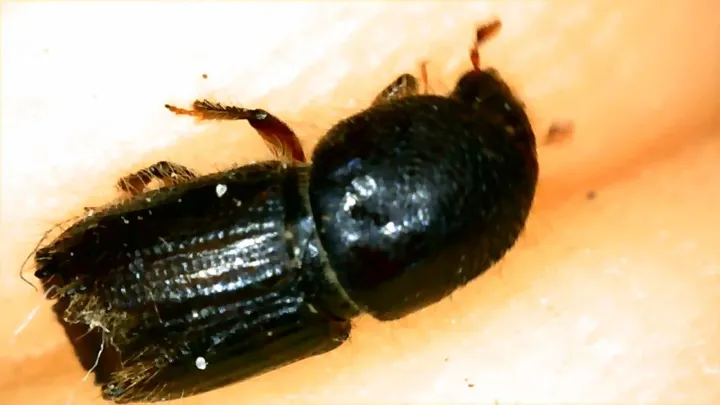
The European spruce bark beetle (Ips typographus) is a beetle of the Curculionidae family. Adults are small, cylindrical, and dark brown, typically measuring 4.5 to 5.5 mm in length.
A distinctive feature of this species is the declivity at the end of the elytra, which features four pairs of teeth. This structure acts as a tool for the beetle to eject frass from its galleries.
Larvae are legless, white, and grub-like with a brownish head. They feed under the bark, carving out intricate patterns that eventually lead to the death of the host tree.
The life cycle involves complete metamorphosis, consisting of eggs, larvae, pupae, and adults. Depending on temperature, there can be up to three generations in a single year.
Beetles overwinter as adults, primarily in the leaf litter near the base of the tree or within the lower bark, providing them with protection against severe winter temperatures.
What it damages
Ips typographus primarily targets the Norway spruce (Picea abies). During population outbreaks, it may also attack other conifer species that are stressed due to drought or damage.
The pest specializes in attacking the stem of the tree. By tunneling into the phloem and cambium layers, the beetle destroys the tree's vital conductive tissues, effectively cutting off sap flow.
Healthy trees usually resist attack by producing large amounts of resin to expel the beetles. However, during mass attacks, the combined number of beetles overcomes the tree's natural defense mechanism.
Infestation leads to rapid decline, resulting in needle yellowing and tree mortality within a short period. This makes the spruce bark beetle one of the most destructive forest pests in Europe.
The economic impact is profound, as it ruins timber quality and necessitates large-scale forest harvesting, potentially destroying entire stands of mature spruce trees.
When it appears
The swarm phase typically begins in spring when ambient temperatures reach 15–18°C. Males are the first to emerge, seeking suitable trees to establish nuptial chambers.
Throughout the summer, the beetle remains active, with the speed of development closely tied to warmth. Hot, dry summers are optimal for the beetle, often leading to rapid population growth.
By late autumn, the beetles migrate to their winter hibernation sites. This movement is triggered by the cooling of the atmosphere and shorter daylight hours.
Understanding the swarming period is crucial for foresters, as it allows them to time the placement of pheromone traps and carry out necessary sanitation measures.
Severe drought conditions often act as a catalyst for outbreaks, as the weakened trees become highly vulnerable to mass colonization by the pest.
Signs of infestation
The most visible sign of an attack is the presence of brown boring dust (frass) around the base of the tree. This material accumulates in bark crevices or at the tree's root collar.
Resin flows or "pitch tubes" on the trunk are common defense reactions, but they also serve as a diagnostic sign that the tree is currently being challenged by the beetles.
Crown discoloration is a late-stage symptom. As the tree's nutrient transport is disrupted, the needles turn yellow, then brown, and eventually drop off, leaving the branches bare.
Evidence of woodpecker activity is a strong indicator of an advanced infestation. Woodpeckers strip away flakes of bark to reach the larvae, creating visible bare patches on the stem.
- Accumulation of boring dust at the base of the trunk.
- Appearance of small resin tubes on the bark.
- Gradual yellowing and shedding of needles.
- Bark loosening and falling off.
- Increased bird activity, particularly woodpeckers, on the tree.
Control measures
Sanitation logging is the primary method of control. Removing infested trees while the brood is still under the bark prevents the adult beetles from emerging and colonizing new trees.
Pheromone traps are used to attract adult beetles to designated points, helping to monitor population density and provide a measure of control in sensitive areas.
Trap trees—freshly felled spruce logs—are utilized to draw in beetles. Once these logs are heavily colonized, they are debarked or removed from the forest to kill the developing brood.
Biological control, such as encouraging natural predators and parasitoids, plays a role in keeping beetle populations in check within balanced forest ecosystems.
Promoting forest resilience through diverse planting strategies is the best long-term preventive measure against massive spruce bark beetle outbreaks.
Reference
Connections · European spruce bark beetle
Most often together:
Marketplace
Products · 1
Biology
Taxonomy
- Latin name
- Ips typographus
- Order
- Coleoptera (beetles)
- Family
- Curculionidae
- EPPO code
- IPSXTY
Community
Discussion
No discussions yet — be the first.