
Grape clearwing moth
Ichneumenoptera chrysophanes
Description
How to identify
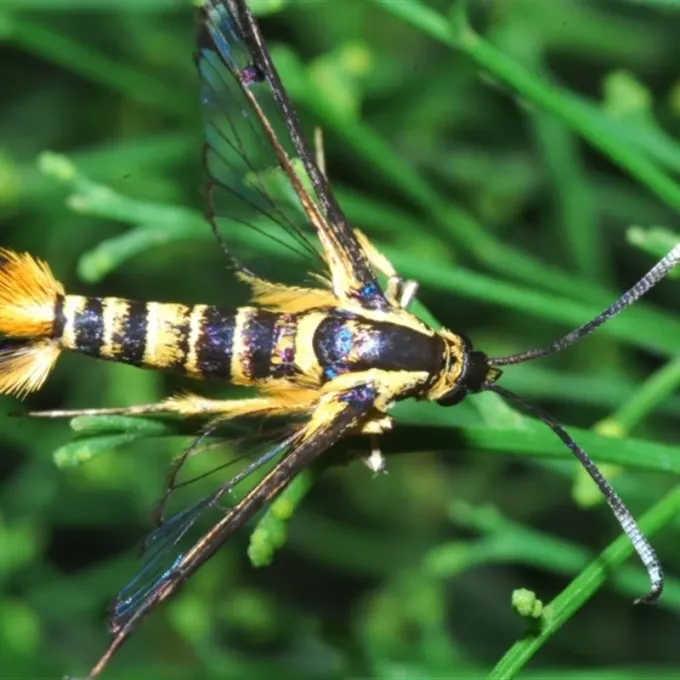
The Grape clearwing moth (Ichneumenoptera chrysophanes) belongs to the Sesiidae family of the order Lepidoptera. Adults mimic wasps or hornets, featuring transparent wings and distinct yellow bands on their abdomen, which provides effective camouflage in the vineyard environment.
The adult moth has a slender body with a forewing length of approximately 10–12 mm. There is visible sexual dimorphism: males have comb-like antennae, while females possess club-shaped antennae, helping in their identification.
Larvae are creamy-white with a brown head capsule and reach a length of 20–25 mm. They spend their entire developmental cycle hidden within the woody tissues of the grapevine, which makes them very difficult to spot during routine inspections.
Pupae develop inside the vine stem. Before the adult emerges, the pupa partially pushes itself out of the exit hole. These empty pupal skins are often found protruding from the vine, serving as a clear indicator of successful pest development.
This species is a specialized wood-boring pest that is primarily a concern in established vineyards, where it can remain undetected for several years before causing visible damage to the plant structure.
What it damages
The primary damage is caused by larvae feeding on the heartwood of the vine. They bore longitudinal galleries through the pith and internal tissues, disrupting the vascular system that transports water and nutrients.
This disruption leads to the weakening of the vine, often resulting in reduced vigor, poor fruit set, and premature wilting of specific shoots. In severe cases, entire arms or canes may dry out and die completely.
Larval activity often causes localized swellings or gall-like growths on the vine stems. These areas become structural weak points, making the vine susceptible to breakage during harvest or heavy wind events.
The galleries created by the larvae provide entry points for secondary pathogens, including fungi and bacteria, which can cause wood decay and further complicate the health status of the infected vine.
Young vines are particularly vulnerable; an infestation can lead to stunted growth or even the total death of the grapevine if the larvae girdle the main trunk or primary cordon.
When it appears
Adult moths typically emerge in early summer, often coinciding with the bloom period of the grapevine. The flight period usually spans from June to July, depending on the climatic zone and temperature.
After mating, females deposit their eggs on the bark of the vine, often targeting existing cracks, buds, or areas previously damaged by mechanical tools. A single female is capable of laying numerous eggs.
The life cycle of the moth is univoltine, meaning there is one generation per year. Larvae overwinter within the vine's woody tissues, protected from harsh environmental conditions by the outer layer of the stem.
Pupation occurs in the spring, typically lasting for several weeks inside the larval tunnels. The temperature inside the vine wood plays a crucial role in regulating the exact timing of adult emergence.
Monitoring the flight of adults using pheromone traps is the most reliable way to track population density and determine the critical window for implementing control measures.
Signs of infestation
One of the most visible signs of an infestation is the presence of small, circular exit holes (3–4 mm in diameter) on the bark of the cordons or trunks, often accompanied by piles of sawdust-like frass.
Sudden wilting or chlorosis of leaves on individual shoots during the summer is a strong indicator of larval boring activity within that specific cane, which restricts the flow of essential sap.
Irregular swellings or deformities on the vine branches are characteristic of chronic, long-term colonization by the larvae. These areas are typically brittle and show signs of necrosis when cut.
Poor vine growth and reduced productivity in specific sections of the vineyard compared to neighboring healthy vines often signal an underlying borer problem that requires immediate investigation.
During winter pruning, one should look for discolored bark and probe any suspected swollen areas. If the wood feels soft or hollow, it is highly likely that larvae have been present.
Control measures
The primary control strategy involves the systematic removal and destruction of infested wood through pruning. All pruned material containing signs of larval activity must be burned to break the pest's cycle.
Maintaining strong vineyard hygiene and avoiding mechanical damage to the vines during cultivation is essential, as wounds on the vine are primary sites for egg-laying by female moths.
Chemical control should be applied during the adult flight period, targeting the moths before they successfully lay eggs. Systemic insecticides may offer some protection if applied at the correct developmental stage.
Biological control methods, such as the use of entomopathogenic fungi or bacteria, are being explored as sustainable alternatives to reduce population levels with lower environmental impact.
Consistent monitoring with pheromone traps enables viticulturists to make informed decisions about when to apply treatments, ensuring that control efforts are effective and minimize harm to beneficial organisms.
Taxonomy
- Latin name
- Ichneumenoptera chrysophanes
- Order
- Lepidoptera (butterflies)
- Family
- Sesiidae
- EPPO code
- ICHMCH
Discussion
No discussions yet — be the first.