
Clearwing moth of the genus Ichneumenoptera
Ichneumenoptera
Description
How to identify
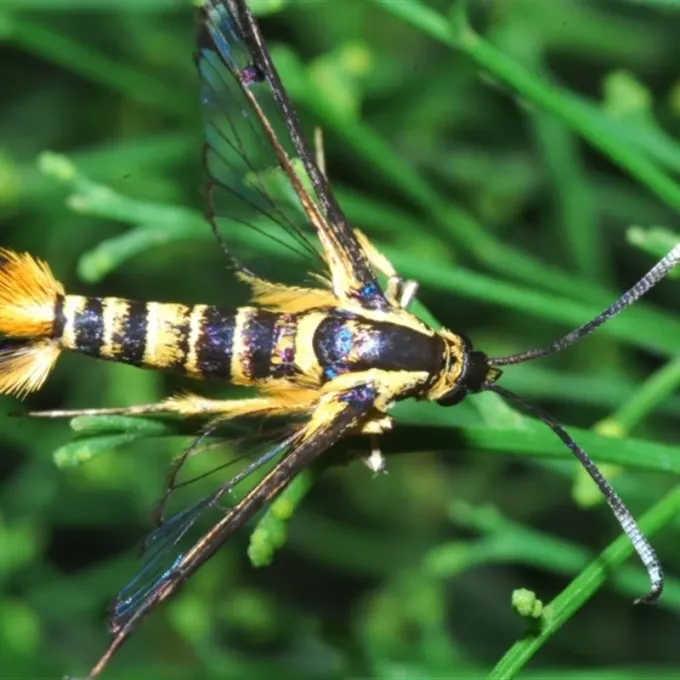
Clearwing moths of the genus Ichneumenoptera belong to the family Sesiidae (order Lepidoptera). They are notable for their strong resemblance to wasps, serving as a classic example of Batesian mimicry.
The wings of these moths lack scales, making them appear transparent, which is the origin of their common name. Their bodies are slender and usually feature yellow or orange bands.
The larvae are typically whitish or cream-colored with a brown head. They are concealed feeders, living deep within the woody tissues of their host plants, which makes them difficult to spot.
The life cycle involves complete metamorphosis: egg, larva, pupa, and adult. The adults are day-flying insects and are particularly active during warm, sunny weather conditions.
Accurate species identification often requires specific pheromone traps or morphological examination, as many clearwing species share very similar appearances.
What it damages
Species in this genus primarily affect a variety of woody plants and shrubs, including poplar, willow, and various fruit-bearing tree species.
Larvae bore into the bark and wood of trunks and branches. This tunneling disrupts the plant's vascular system, hindering the transport of water and nutrients.
The resulting wounds provide entry points for secondary infections, such as fungal pathogens and bacterial rots, which often exacerbate the overall damage.
In orchards, heavy infestations can lead to significant yield losses, stunted tree growth, and in severe cases, the death of the entire tree or shrub.
Young saplings are at the highest risk, as larval feeding can girdle the trunk, causing the upper portion of the tree to die or break off under high winds.
When it appears
The adult flight period generally occurs in late spring or early summer, though exact timing varies based on local climatic conditions and regional temperatures.
Females deposit eggs in bark crevices or near existing mechanical wounds on the tree. Embryonic development usually takes about two weeks under favorable conditions.
Upon hatching, larvae immediately bore into the bark. They spend most of their developmental phase feeding inside the wood, where they also eventually overwinter.
Pupation occurs inside the larval tunnels during the spring. Before the adult moth emerges, the pupa partially pushes itself out of the exit hole created by the larva.
The life cycle may take one or two years to complete, depending on the species and environmental factors, requiring long-term monitoring strategies.
Signs of infestation
The most reliable sign of an infestation is the presence of frass (wood dust mixed with excrement) accumulating at the base of the tree or around exit holes.
Small, circular exit holes on the bark are clear indicators that adult moths have successfully emerged from the wood after completing their development.
Sticky sap or gum exudation on the trunk or branches often indicates that larvae are actively feeding within the wood tissues below the surface.
Yellowing leaves, premature leaf drop, or the dieback of individual branches are signs that the tree's vascular system has been compromised by larval feeding.
Peeling bark reveals elaborate tunneling systems packed with brownish frass, confirming the active presence of clearwing moth larvae within the woody host.
Control measures
Maintain tree health through proper horticultural practices, such as judicious pruning and sealing any mechanical wounds on the trunk with tree dressing.
Use pheromone traps to monitor adult moth populations, which helps determine the exact timing for targeted insecticide applications against young larvae.
Prune and destroy heavily infested branches to reduce the pest population density and prevent the spread to healthy trees within the orchard or garden.
Biological control agents, including entomopathogenic nematodes or Bacillus thuringiensis, can be effective when applied during the larval hatching period.
Apply systemic insecticides during the peak adult flight period or when larvae are newly hatched and have not yet penetrated deeply into the woody tissue.
Taxonomy
- Latin name
- Ichneumenoptera
- Order
- Lepidoptera (butterflies)
- Family
- Sesiidae
- EPPO code
- ICHMSP
Discussion
No discussions yet — be the first.