
European tree frog
Hyla arborea
Description
How to identify
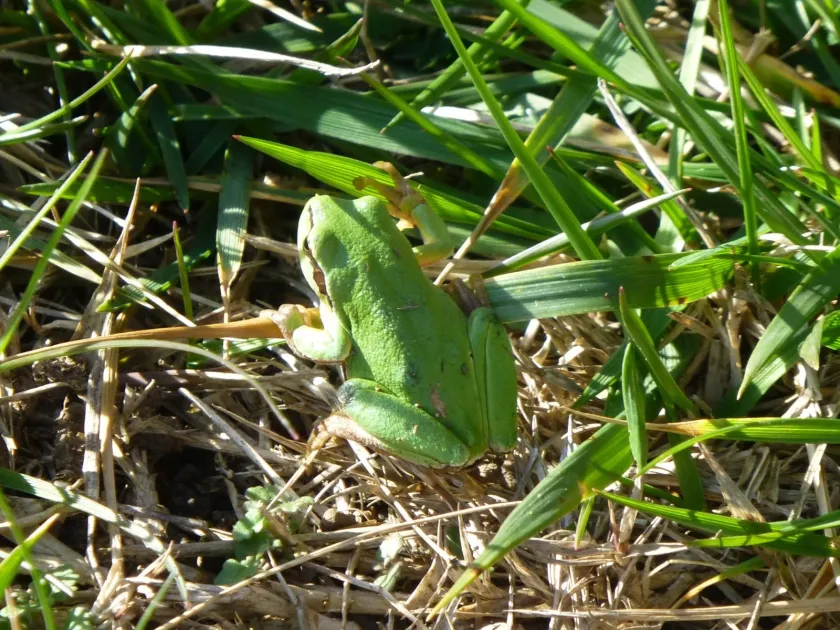
The European tree frog (Hyla arborea) is a small amphibian belonging to the order Anura and the family Hylidae. It is recognized by its bright green skin, which can vary in hue, and the adhesive toe pads that allow it to climb plants.
These frogs typically measure between 3 and 5 cm in length. Their skin is smooth and bright, serving as camouflage among leaves, stems, and trees, making them masters of concealment during the daylight hours.
The species is mostly nocturnal. During the night, they emerge from their hiding spots in dense vegetation to hunt for small invertebrates and communicate using distinct, resonant mating calls.
Their life cycle involves a metamorphosis phase in water, where larvae (tadpoles) develop before transitioning to a terrestrial, arboreal existence in gardens, meadows, and forest edges.
Being cold-blooded creatures, they are highly sensitive to environmental changes and their presence often indicates a healthy, undisturbed habitat free from heavy chemical contamination.
What it damages
From an agronomic perspective, the European tree frog is not a pest. It is a strictly carnivorous predator that feeds on insects and other small arthropods rather than plant tissues.
They provide valuable ecosystem services by predating on various flies, mosquitoes, beetles, and moth larvae that would otherwise damage crops. They act as natural insect controllers in agricultural landscapes.
These frogs do not cause physical damage to fruit, vegetables, or ornamental plants. Their presence in the garden or greenhouse is beneficial rather than detrimental to the harvest.
The classification of the tree frog as a pest is scientifically incorrect. They do not consume leaves, gnaw stems, or suck plant sap, and they are completely harmless to all agricultural produce.
In fact, modern organic and integrated pest management systems often encourage the presence of amphibians to reduce reliance on chemical pesticides by fostering a natural balance of predators.
Control measures
Since the European tree frog is often a protected species and an ally in pest control, no lethal control measures should be undertaken against it under any circumstances.
If they are unwelcome in specific sensitive areas, simple environmental modification is sufficient. Keeping vegetation trimmed and preventing excessive water pooling will naturally encourage them to move to more suitable areas.
Using fine-mesh netting on greenhouse or storage facility openings is the most effective and humane way to prevent accidental entry of these small animals.
Avoid broad-spectrum pesticide applications, as these chemicals are toxic to amphibians and eliminate the beneficial predatory functions that tree frogs provide to your garden.
The best practice for any agronomic site is to support biodiversity. By allowing the European tree frog to reside on your land, you utilize free biological protection for your crops.
Taxonomy
- Latin name
- Hyla arborea
- Family
- Hylidae
- EPPO code
- HYLIAR
Discussion
No discussions yet — be the first.