
Capybara
Hydrochoerus hydrochaeris
Description
How to identify
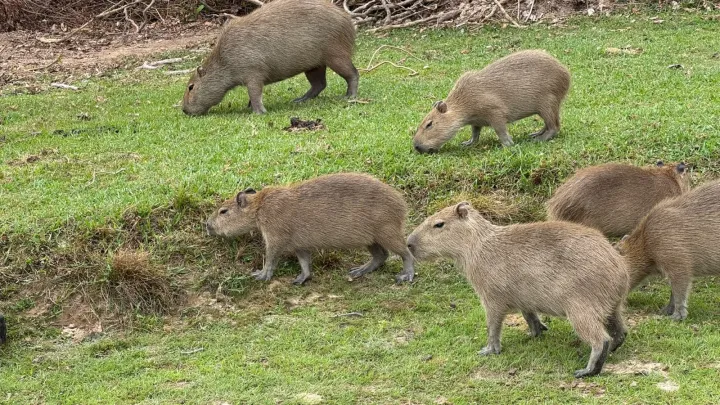
The capybara (Hydrochoerus hydrochaeris) is the world's largest living rodent, belonging to the family Hydrochoeridae within the order Rodentia.
These semi-aquatic mammals are characterized by their barrel-shaped bodies, blunt heads, and coarse brown fur, often reaching weights of up to 65 kg.
They are highly social animals that live in groups, which allows them to overwhelm and consume large quantities of vegetation in agricultural areas quickly.
Their anatomy, including webbed feet and semi-aquatic habits, makes them perfect candidates for living in riparian zones that are often used for crop production.
As herbivores, their dietary needs are vast, leading them to exploit high-energy crops whenever natural aquatic vegetation becomes scarce or less nutritious.
What it damages
Capybaras frequently target high-value crops such as rice, sugarcane, corn, and various cereals, causing significant yield losses for farmers.
They are also notorious for causing damage to melon and gourd plantations, where they consume young fruits and destroy the surrounding plants by trampling.
The extent of the damage is often exacerbated by their social behavior, as they tend to feed in groups, quickly clearing areas of young, tender plant material.
Besides feeding, their movement across fields causes severe soil compaction and physical destruction of the delicate root systems of young seedlings.
In regions where agricultural expansion overlaps with their natural habitat, capybaras can become a constant threat that requires ongoing management strategies.
Signs of infestation
The most visible signs of a capybara presence are large, distinct footprints found near irrigation canals or wet, muddy areas within the agricultural field.
Crop damage often appears as clean, angled incisions on plant stalks, resulting from the sharp incisors used by the animals to shear off vegetation.
Distinctive barrel-shaped fecal pellets are frequently found along the trails the animals create between their resting sites near water and the crop fields.
Well-worn paths through tall crops, known as game trails, show where the animals repeatedly traverse the area to reach their food source.
Damaged fencing or tunnels dug under barriers indicate a persistent effort to gain access to the palatable and lush crops inside the fenced areas.
Control measures
Effective control usually involves the installation of robust physical barriers, such as buried wire mesh fences, to prevent entry into agricultural plots.
Electric fencing, specifically designed for large rodents, is highly effective in discouraging capybaras from entering fields without causing them undue harm.
Maintaining clear buffer zones between the water source and the crop areas can reduce the attractiveness of the field for the animals.
In cases of severe infestation, farmers may need to work with local wildlife management agencies to relocate groups or manage population numbers ethically.
- Regular inspection of perimeter fences.
- Use of motion-activated light or sound deterrents.
- Strategic clearing of dense vegetation near fields to remove hiding spots.
Taxonomy
- Latin name
- Hydrochoerus hydrochaeris
- Order
- Rodents
- Family
- Caviidae
- EPPO code
- HYUSHY
Discussion
No discussions yet — be the first.