
Mountain guinea pig
Cavia tschudii
Description
How to identify
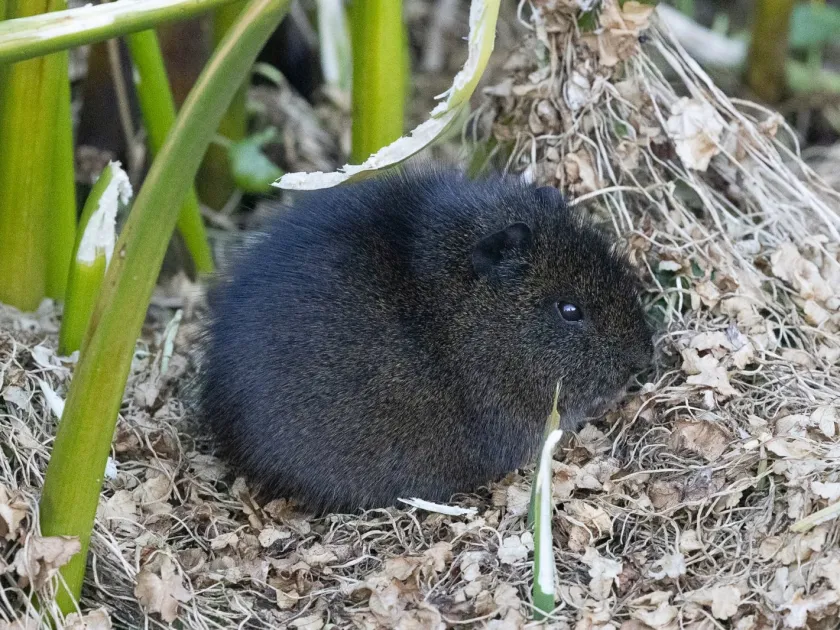
The mountain guinea pig (Cavia tschudii) is a wild rodent species belonging to the Caviidae family, native to the Andean highlands. Adults typically measure between 20 and 35 cm in length and possess a sturdy, tailless body.
Their fur displays a range of brownish and grey tones, providing effective camouflage against rocky terrain and wild grasses. This protective coloration makes them difficult to spot in their natural high-altitude environment.
Primarily diurnal or crepuscular, these animals reside in burrows or rock crevices. They are cautious, social animals that live in small colonies, often establishing complex networks of paths within their territory.
Taxonomically, they are classified under the order Rodentia. Their physiology is specifically adapted to the low oxygen levels and cold temperatures typical of their mountain habitat.
Breeding occurs throughout the year if the food supply is adequate. This reproductive strategy allows local populations to increase rapidly, posing a significant risk to nearby agricultural fields.
What it damages
Mountain guinea pigs feed on a variety of agricultural crops, with a particular preference for cereals, maize, and potatoes. They consume both the green vegetative parts and the energy-rich tubers.
During the early stages of plant growth, they can be devastating by cutting down stems near the base. This kills the plant outright, leading to significant gaps in row crops.
They are particularly notorious for digging up potato crops. By exposing and gnawing on the tubers, they render the yield unmarketable and susceptible to rot from exposure to the elements.
Their presence on pastures causes loss of biomass as they compete with livestock for grazing areas. Large colonies can denude a field of vegetation, leaving only bare soil behind.
The economic impact is concentrated in regions adjacent to natural rock formations or slopes where the colonies nest. Farmers often suffer cumulative losses as the rodents repeatedly revisit the same crop areas.
Signs of infestation
The most reliable sign of an infestation is the presence of well-worn runways through the vegetation. These paths lead directly from their burrows to the crop fields, indicating regular traffic.
Fecal droppings, often found near burrow entrances or along feeding trails, serve as clear evidence of their occupancy. Fresh excavations or dirt mounds near field borders are also common indicators.
Visual inspection of the crops reveals diagonal bite marks on the stems of corn or wheat. The precision of these marks is a hallmark of rodent activity, distinguishing them from larger pests.
- Diagonal bite marks on crop stems.
- Exposed and gnawed potato tubers.
- Clear, beaten-earth runways in fields.
- Freshly dug burrows near property edges.
- Presence of droppings in high-activity feeding zones.
A sudden decline in crop vigor near field edges, combined with the presence of trails, suggests the mountain guinea pig is likely the primary culprit.
Control measures
Physical barriers are the most effective preventive measure. Fencing, especially if buried slightly below ground level, creates a formidable obstacle that discourages the rodents from accessing the fields.
Vegetation management is a key cultural control practice. Clearing weeds, brush, and tall grass from field margins destroys the protective cover that these animals rely on to feel safe.
Biological control, by maintaining or encouraging local predator populations (such as birds of prey), helps to naturally regulate the population density of the rodents in agricultural zones.
Ultrasonic deterrent devices can be utilized in small-scale gardens or greenhouses to discourage habitation. These tools leverage the sensitive hearing of the rodents to create an uncomfortable environment.
In cases of severe infestation, targeted chemical control via baiting stations may be necessary, provided that safety protocols are strictly followed to protect non-target species and livestock.
Taxonomy
- Latin name
- Cavia tschudii
- Order
- Rodents
- Family
- Caviidae
- EPPO code
- CAVICU
Discussion
No discussions yet — be the first.