
Guinea pig
Cavia
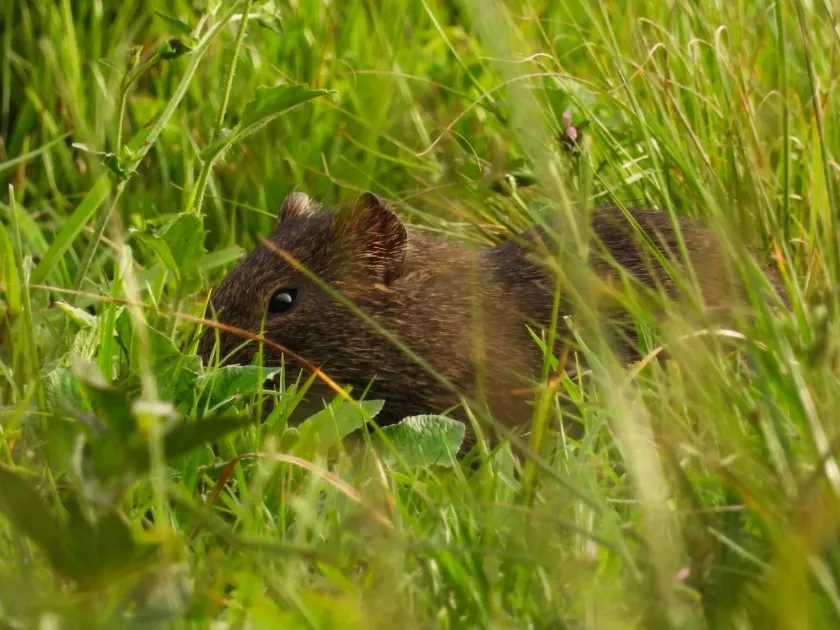
Description
How to identify
The genus Cavia, belonging to the family Caviidae and order Rodentia, includes species that can become significant pests in agricultural environments in their native South American regions.
These rodents are characterized by a stocky build, a large head, and the absence of a visible tail. Adults measure between 20 and 40 centimeters, equipped with strong teeth adapted for cutting tough vegetation.
Their biology demonstrates high adaptability to various landscapes, including agricultural land, where they can survive in human-altered ecosystems by finding shelter in dense vegetation or burrows.
They are primarily crepuscular, meaning they are most active during dawn and dusk, which makes them difficult to observe and track within large fields during standard daylight working hours.
With a high reproductive rate, a female can produce multiple litters per year, enabling the population to recover quickly even after localized control measures have been implemented.
What it damages
As generalist herbivores, guinea pigs consume a wide variety of plant material, making them potential threats to commercial farming operations and small-scale vegetable production.
They cause significant damage to grain crops, legumes, and root vegetables by consuming foliage, stems, and fruits, often targeting plants near the ground level.
Beyond direct consumption, the rodents cause mechanical harm to soil structure and root systems while digging burrows or creating paths through crops, which can stress young plants.
During dry seasons, when natural vegetation quality declines, these animals frequently migrate to irrigated agricultural fields in search of fresh, succulent forage, causing rapid crop destruction.
Economic losses arise not only from reduced yields but also from the degradation of produce quality and the potential for spreading plant pathogens through their feeding and digging activities.
When it appears
The activity of these rodents is heavily influenced by regional climate conditions, with their impact often persisting throughout the year in tropical and subtropical areas.
The peak period of agricultural activity, particularly during crop growth and maturation phases, coincides with the most significant risk of damage to vulnerable young plants.
Springtime often sees a surge in damage to early-season vegetable crops, as these provide a vital source of energy and hydration after the cooler seasons have ended.
In autumn, increased foraging activity is common as rodents look to accumulate fat reserves, leading to heightened damage to root vegetables that remain buried in the soil.
Fluctuations in soil moisture levels drive the movement of these animals, causing them to concentrate around irrigation channels and water sources where crops are most abundant.
Signs of infestation
The most reliable sign of Cavia presence is the appearance of distinct teeth marks on stems and leaves close to the ground, indicative of their feeding habits.
Identifying well-worn paths or runways through thick grass or crop rows is a crucial step in mapping the location of their nests or burrow entrances.
Droppings, typically elongated and oval-shaped, are frequently found along these travel routes and near feeding sites, serving as a clear indicator of population density in an area.
- Evidence of grazed foliage with clean, angled cuts from rodent incisors.
- Patches of disturbed or unearthed soil around root-bearing plants.
- Burrow entrances roughly 10–15 centimeters in diameter hidden in vegetation.
- Characteristic rustling sounds heard in fields during dusk and dawn.
Extensive feeding can lead to noticeable bald spots or clearing within a crop field, which typically expand in size as the local rodent population continues to forage.
Control measures
Managing guinea pig populations in an agricultural setting requires a multi-faceted strategy that combines preventive agronomic practices and physical exclusion methods.
Sanitation is a primary defense, which involves clearing weeds and debris from field perimeters to eliminate the natural cover and nesting sites that rodents rely on.
Physical exclusion, such as installing mesh fencing buried 20–30 centimeters into the ground, is the most effective way to prevent these rodents from accessing high-value plots.
Acoustic deterrents using ultrasonic technology can serve as a temporary measure in small areas, though their efficacy may diminish over time as animals habituate to the stimulus.
Chemical control via rodenticides should only be considered as a last resort, strictly adhering to local environmental regulations to prevent harm to non-target wildlife and ecosystem balance.
Taxonomy
- Latin name
- Cavia
- Order
- Rodents
- Family
- Caviidae
- EPPO code
- CAVISP
Discussion
No discussions yet — be the first.