
Capybara
Hydrochoerus
Description
How to identify
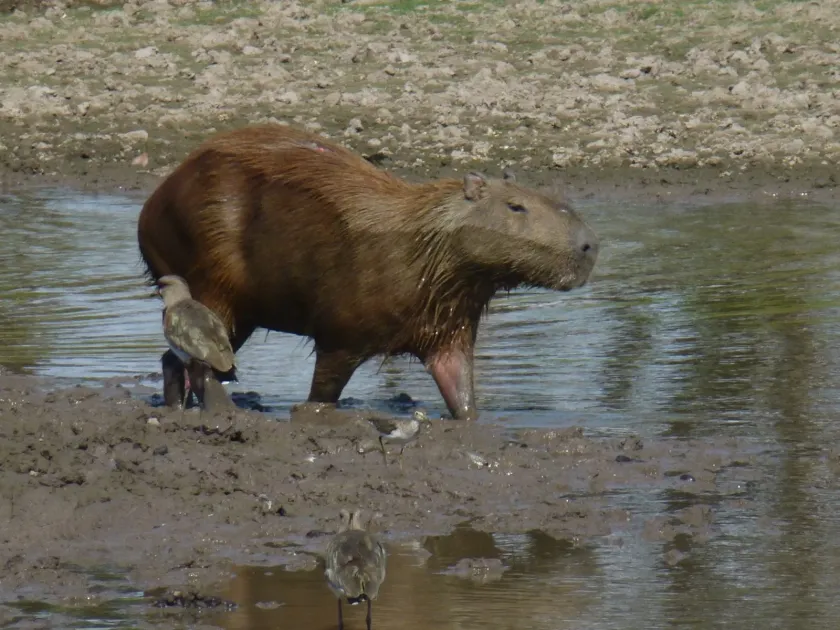
The capybara Hydrochoerus hydrochaeris is the world's largest living rodent, belonging to the family Hydrochoeridae. Adults can weigh up to 65 kg and measure over a meter in length, making them massive enough to cause significant structural damage to crops.
Morphologically, they are characterized by a barrel-shaped body, the absence of a tail, and webbed feet, which facilitate their semi-aquatic lifestyle. Their large, square-shaped heads with high-placed eyes and ears are adapted for keeping watch while partially submerged.
The coarse, sparse coat ranges from reddish-brown to grayish. This specialized fur dries quickly, allowing the animal to move efficiently between aquatic refuges and terrestrial feeding grounds without losing body heat.
Capybaras are highly social animals that live in organized groups. This communal structure allows them to exploit food resources on farmland systematically, often leading to rapid depletion of specific crops within a single night.
They are highly intelligent and adaptable to anthropized landscapes. Once a population identifies a reliable food source near their waterway, they demonstrate persistent behavior in bypassing simple physical barriers to access the field.
What it damages
Capybaras are opportunistic herbivores that target high-moisture crops. Agricultural fields of sugarcane, rice, maize, and various melon species are particularly vulnerable to their feeding habits during the growing season.
Damage is twofold: first, they directly consume large quantities of succulent plant material, including stalks and leaves. Second, the heavy physical weight of a capybara group causes significant soil compaction and mechanical damage to crop rows.
Vegetable gardens and melon plantations suffer the most, as capybaras feed on fruits for their water content. They often hollow out melons or tear up entire vine systems, rendering the remaining produce unsellable.
Young plants are frequently pulled up by the roots or cut down at the base, leading to complete loss of sections within a field. This necessitates expensive replanting and interferes with scheduled harvest cycles.
In addition to crop loss, they act as competitors to livestock by grazing on high-quality pasture grasses. This reduces the available fodder for cattle, increasing the operational costs for farmers who must compensate with supplemental feed.
When it appears
Activity levels are heavily influenced by environmental conditions and seasonal food availability. During the dry season, when natural forage in wild habitats becomes scarce, capybaras shift their focus to irrigated agricultural fields.
Conversely, in the wet season, when native aquatic vegetation is abundant, their pressure on commercial crops may decrease. However, they remain a potential threat throughout the year if the farm is located within their home range.
Capybaras follow a strict circadian rhythm, being primarily crepuscular and nocturnal. They spend their daylight hours in the water or thick riparian vegetation, making them difficult to detect until the damage is already done.
Breeding is not restricted to a specific season, but populations often peak during months with optimal food availability. This results in larger family groups and increased foraging pressure on farmland during those periods.
Juvenile capybaras become independent feeders within a few months, and the addition of these active, growing individuals to the foraging group leads to a noticeable increase in the severity of crop consumption.
Signs of infestation
The most prominent sign of a capybara infestation is the presence of well-worn trails leading from water bodies into the fields. These paths are usually stripped of vegetation and show signs of heavy, repetitive trampling.
Footprints are a reliable identification marker. The front feet have four toes, while the hind feet have three, with distinct webbing and claw impressions visible in soft, moist soil near irrigation ditches.
Look for angled, jagged cuts on stalks of corn or sugarcane, which are indicative of the powerful, self-sharpening incisors of the rodent. Vegetation might appear sheared at a height consistent with a standing or crouching animal.
Droppings are found in clusters or scattered along paths and feeding areas. They are oval-shaped, approximately 2–3 cm in diameter, and have a fibrous texture reflecting a diet rich in grass and plant matter.
Auditory evidence is another clue. During the night, groups communicate with a series of sharp whistles, grunts, and barks. If these sounds are heard frequently near the farm perimeter, active feeding raids are likely occurring.
Control measures
Physical barriers are the most effective deterrent. Robust fencing, such as high-tensile woven wire, is required. It is essential to bury the bottom edge at least 30 cm underground to prevent the animals from digging underneath.
Electric fencing, known as an electric fence system, is highly successful when properly maintained. A multi-strand configuration, with the bottom wire placed close to the ground, provides a strong psychological deterrent.
Technological interventions such as motion-activated lights, strobes, or sound cannons can discourage capybaras, though they are most effective when used in combination with physical barriers to prevent habituation.
Riparian zone management plays a role in prevention. Clearing dense brush and invasive vegetation near water sources can reduce the suitability of the area for daytime shelter, pushing the population further away from the fields.
In regions where crop damage is extreme, professional management involving live trapping and relocation is recommended. Always ensure that such activities comply with local wildlife protection laws and ecological regulations.
Taxonomy
- Latin name
- Hydrochoerus
- Order
- Rodents
- Family
- Caviidae
- EPPO code
- HYUSSP
Discussion
No discussions yet — be the first.