
Saunders' case moth
Hyalarcta huebneri
Description
How to identify
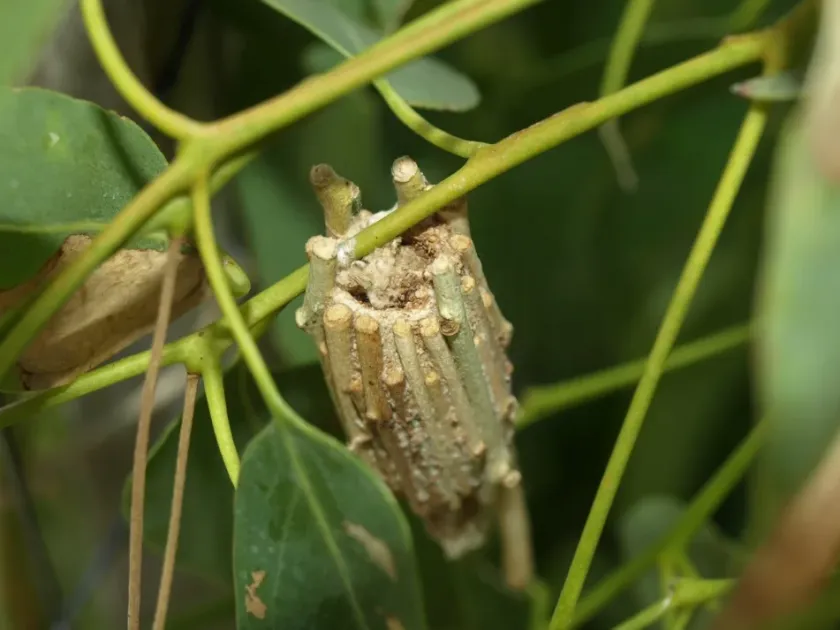
The Saunders' case moth (Hyalarcta huebneri) belongs to the Psychidae family of moths. Its most prominent feature is the bag or case that the larva constructs from silk and fragments of its host plant, providing a mobile shelter.
Adult males are winged, free-flying moths, while adult females are wingless and stay inside the larval case for their entire adult life to attract mates and lay eggs.
The larvae, or caterpillars, are rarely seen fully exposed because they remain inside their protective cases. The case is reinforced with leaf bits, twigs, or bark, making it perfectly camouflaged on trees.
As the caterpillar grows, it enlarges the case by adding new material, so the size of the bag corresponds to the instar of the larva, which can reach several centimeters in length.
The identification process relies heavily on spotting these unique structures hanging from branches, which are often mistaken for dead leaves or natural tree debris by inexperienced gardeners.
What it damages
This species is a polyphagous pest, capable of damaging a wide range of woody plants, shrubs, and ornamental trees, including popular garden species like acacia and eucalyptus.
The larvae feed on the foliage of host plants, consuming the leaf tissue. This activity often leads to skeletonization, where only the veins are left behind, reducing the plant's photosynthetic capability.
In cases of severe infestation, the pest can cause significant defoliation, weakening the tree, causing branch dieback, and potentially leading to the death of the plant if left unchecked.
Beyond leaf consumption, the attachment of the cases to the bark and young shoots can physically damage the outer tissue layers, potentially stressing the plant further.
While a few cases may not cause critical damage, a high population density can quickly turn a healthy shrub or tree into a skeletonized, struggling specimen within a single season.
When it appears
The activity of Hyalarcta huebneri is closely linked to the seasonal cycle. Larvae are typically most active in their feeding stages during the warmer months of spring and summer.
Lifecycle completion takes time, with larvae increasing their feeding rate as they reach the final instars. After feeding, they secure their cases firmly to a branch to undergo pupation.
Dispersal occurs when the newly hatched larvae leave the parental case, using silk threads to catch the wind and travel to new host plants, often establishing a new generation in adjacent areas.
Overwintering usually occurs in the egg stage or as young larvae inside the protective cases, which are highly resistant to adverse weather conditions and seasonal temperature drops.
Monitoring should be continuous, but pay extra attention during the spring when young caterpillars begin their first feeding cycles and are most vulnerable to control efforts.
Signs of infestation
The primary sign of an infestation is the presence of the characteristic bags attached to the stems and branches of trees, which seem to appear from nowhere.
- Presence of cone-like or bag-like structures made of leaf bits on twigs.
- Irregular holes or skeletonized patches on the foliage.
- General decline in tree vigor or stunted growth without obvious fungal disease.
- Small silk threads visible on branches, used by larvae for movement.
- Clusters of cases concentrated on specific areas of the tree crown.
If you observe a bag slowly moving along a branch or changing position, it is a definitive sign of an active infestation by the Saunders' case moth.
Control measures
Physical removal is the most reliable control method for smaller trees. Simply picking the cases off the branches and destroying them during winter is highly effective and safe.
For larger infestations, targeted insecticide applications during the period when young larvae are active can significantly reduce populations and prevent long-term damage.
Biological control using Bacillus thuringiensis (Bt) is recommended as it effectively targets the larvae while having a minimal impact on beneficial insects in the garden ecosystem.
Proper garden maintenance, including pruning and the removal of heavily infested dead wood, helps reduce the available microhabitats for the larvae and limits their spread.
Encouraging natural predators such as birds and parasitic wasps can help keep the case moth population at a manageable level without the need for intensive chemical interventions.
Taxonomy
- Latin name
- Hyalarcta huebneri
- Order
- Lepidoptera (butterflies)
- Family
- Psychidae
- EPPO code
- HYACHU
Discussion
No discussions yet — be the first.