
Bagworm moth
Hyalarcta
Description
How to identify
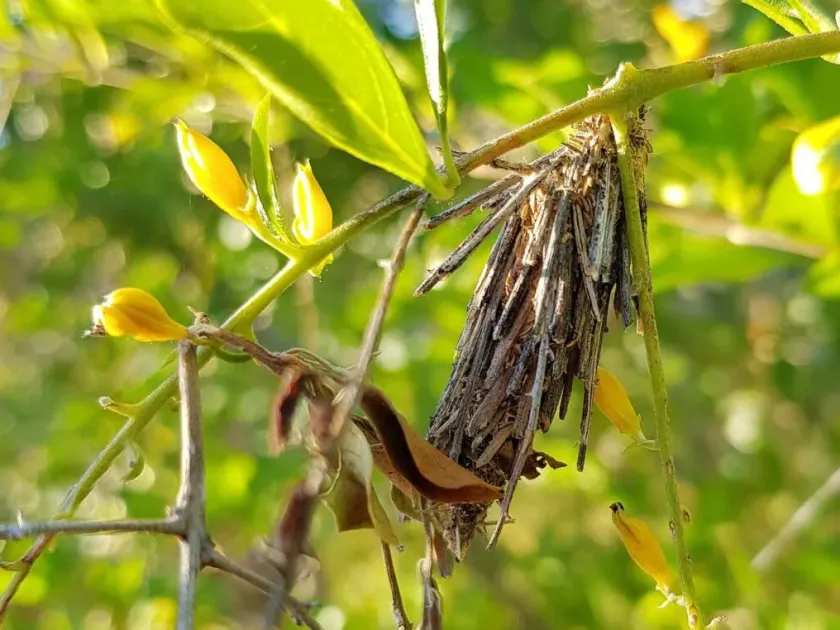
The bagworm moth (Hyalarcta) belongs to the Psychidae family. Both adults and larvae of this species are easily identified by their unique protective casing, known as a bag.
Males are small, winged moths capable of active flight to locate a mate. Their coloration typically ranges from gray to dark brown, allowing them to blend into bark or foliage.
Females of this species are wingless and never leave their cocoons, retaining a maggot-like body shape throughout their lives. This is a key biological trait of these insects.
During their growth, larvae construct a sophisticated protective bag using silk threads, incorporating bits of bark, twigs, leaves, and other plant debris for camouflage.
Hyalarcta huebneri is the most recognized species within this genus, frequently found infesting garden trees and forest plantations in Australia and other regions.
What it damages
This pest is a polyphage, meaning it feeds on a very wide range of plant species. Broad-leaved trees, fruit orchards, and ornamental shrubs are the most common hosts.
The list of host plants includes various Eucalyptus species, Rosaceae fruit crops, and many ornamental conifers where bagworms build their characteristic cases.
Severe damage occurs during outbreaks when the pest population can completely defoliate a young tree, causing significant physiological stress to the plant.
Beyond the direct destruction of leaf mass, feeding injuries can weaken the plant's immune system, making it susceptible to secondary infections and other pests.
In nurseries and public parks, the presence of these pests ruins the aesthetic and market value of the plants, causing considerable economic loss.
When it appears
The lifecycle of the bagworm is closely tied to regional climate conditions, with the peak of larval activity usually occurring during the spring and summer months.
Eggs overwinter inside the female's case, as the female often dies after oviposition. Larvae hatch as temperatures rise and immediately begin constructing their first small cases.
Depending on the climatic zone, one or two generations may develop per season, necessitating consistent monitoring of the tree canopy.
Active larval feeding continues throughout the growing season until the insect reaches the pupal stage, securely attaching itself to a branch.
The flight period of male moths typically occurs in late summer or early autumn, marking the time for mating and egg-laying for the following season.
Signs of infestation
The primary sign of an infestation is the presence of distinctive cone-shaped or elongated bags hanging from branches, which often resemble natural plant growth.
Upon closer inspection, one may observe skeletonized leaves, where only the veins remain, or leaves that have been completely eaten from the edges.
The accumulation of large amounts of excrement (frass) under the tree is also an indirect sign of high larval population activity in the canopy.
At the points where the cocoon is attached to the branch, localized constriction may occur if the larva fixed it too tightly, sometimes leading to the death of the twig above the attachment site.
- Deformation and partial loss of leaf blades.
- Presence of mobile or stationary silk-and-debris cases on shoots.
- Silk threads used by larvae to anchor themselves to branches.
Control measures
The most effective method for private gardens is manual collection and destruction of the cases, as they are easily spotted on branches during winter or early spring.
The use of biological insecticides based on Bacillus thuringiensis allows for effective suppression of young larval populations without harming beneficial insects.
In cases of high infestation, systemic chemical insecticides are employed, as they penetrate leaf tissues and eliminate the pest upon ingestion.
Maintaining tree health, including regular fertilization and watering, is a crucial defensive measure that increases plant resilience against bagworm attacks.
Encouraging natural entomophagous insects (parasitic wasps) and insectivorous birds in the garden helps naturally keep bagworm numbers below the economic threshold.
Taxonomy
- Latin name
- Hyalarcta
- Order
- Lepidoptera (butterflies)
- Family
- Psychidae
- EPPO code
- HYACSP
Discussion
No discussions yet — be the first.