

Pest · Lepidoptera (butterflies) · affects Sunflower, Common sunflower, Winter rapeseed
Sunflower moth
Homoeosoma electellum
Description
How to identify
The sunflower moth (Homoeosoma electellum) is a member of the Pyralidae family and a major pest of the sunflower crop. The adult moth has a wingspan of approximately 20–25 mm. Its forewings are grayish-brown with distinctive darker spots, providing excellent camouflage against the sunflower head.
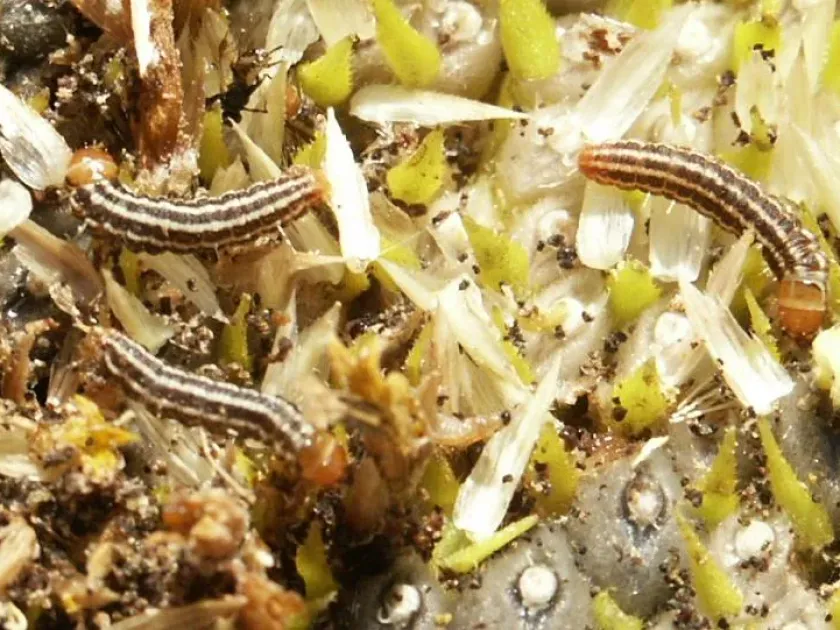
The larvae progress through five larval instars. A mature caterpillar is about 15–18 mm long. The body color varies from light green to brown, with dark longitudinal stripes along the back. The head capsule is typically dark brown or black, serving as a key diagnostic feature for field identification.
The life cycle depends heavily on temperature and moisture levels. In most regions, there are multiple generations per year. The insect overwinters as a mature larva in the soil, encased within a tough, silk-lined cocoon, which allows it to survive harsh winter conditions.
Adult moths are nocturnal. They typically emerge in early summer, coinciding with the flowering period of sunflowers. This timing is critical, as females seek out blooming heads to deposit their eggs directly on the florets.
The severity of an infestation is often linked to environmental factors. Dry conditions can trigger mass emergence, and since females are prolific egg-layers, a single field can see a significant population spike within a few days during the peak flowering window.
What it damages
The primary damage is caused by the larvae feeding on sunflower structures. Early-stage caterpillars feed on pollen and floral parts. As they develop, they migrate toward the base of the floret, boring into the developing seeds and destroying them from the inside.
The loss of seeds directly translates to reduced yield and lower oil content. In cases of high infestation, caterpillars can hollow out a large percentage of seeds, leaving behind empty husks filled with larval waste (frass), which significantly degrades the crop's market value.
Secondary damage is often more severe than direct feeding. Larval tunneling creates entry points for fungal pathogens, such as Rhizopus (head rot). These fungi spread rapidly throughout the head, often causing the entire head to rot before harvest.
The economic impact includes not only yield reduction but also increased costs for cleaning and drying the harvested grain. Damaged heads are more susceptible to sprouting and mold growth during storage, which can lead to complete loss of a batch.
Scouting for this pest is vital during the budding and flowering stages. Assessing the number of moths per plant and the presence of eggs is essential for making informed decisions regarding potential insecticide applications.
Control measures
Cultural practices form the foundation of management. Planting resistant sunflower hybrids with high head density (tighter florets) provides a physical barrier that prevents larvae from burrowing easily into the seed head, significantly reducing success rates for the pest.
Crop rotation and field hygiene are crucial. Deep plowing of fields after harvest helps destroy overwintering cocoons in the soil. Controlling volunteer sunflowers and weeds related to the Asteraceae family around field margins also reduces alternative food sources.
Chemical control should be employed only when economic thresholds are met. Timing is everything; treatments must be applied at the onset of bloom to protect the crop while the plant is most attractive to female moths, ensuring high efficacy.
Biological control, such as the release of Trichogramma wasps, can be highly effective. These parasitoids lay their eggs inside the moth's eggs, preventing the larvae from ever hatching. This method is an excellent component of an integrated pest management program.
- Monitor moth populations using pheromone traps.
- Use selective insecticides to minimize harm to pollinators.
- Remove and destroy crop debris post-harvest to disrupt the cycle.
Content graph
Connections · Sunflower moth
Most often together:
Marketplace
Products · 48


Biology
Taxonomy
- Latin name
- Homoeosoma electellum
- Order
- Lepidoptera (butterflies)
- Family
- Pyralidae
- EPPO code
- HMOEEL
Community
Discussion
No discussions yet — be the first.