
Hodotermes
Hodotermes
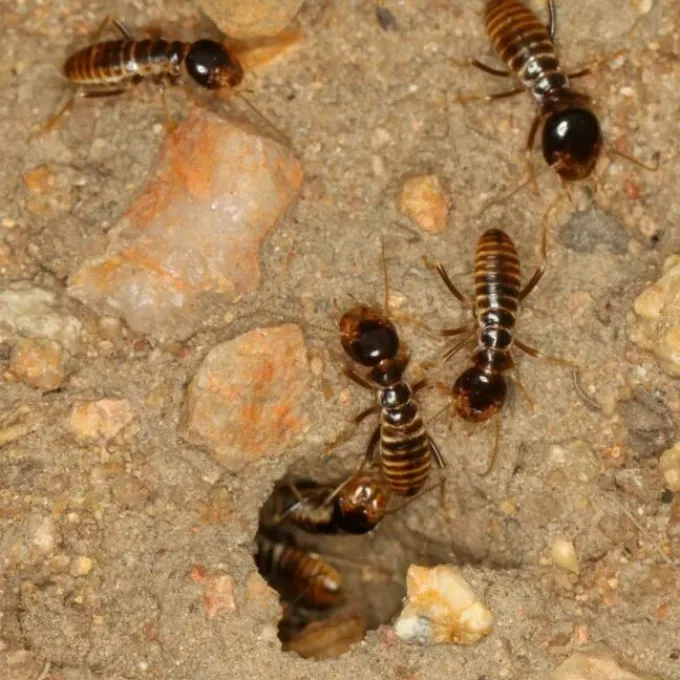
Description
How to identify
Hodotermes is a genus of termites belonging to the family Hodotermitidae, known for their unique foraging behavior.
Unlike most termites, these insects leave their subterranean nests to forage for plant material in the open during the day.
The colony structure includes castes of workers, soldiers, and reproductive individuals, all adapted for life in arid environments.
Workers are typically light brown with powerful mandibles capable of cutting tough grass blades and cereal stems.
They possess an advanced communication system based on pheromones, which allows them to coordinate their foraging and defense activities.
What it damages
They predominantly attack grasses, cereals like wheat and maize, and various types of pasture vegetation.
The insects sever stems near the soil level and transport the plant parts into their deep underground tunnels.
This feeding behavior can cause significant economic loss, especially when entire crop stands are stripped bare by the colony.
Damage to roots is also common, particularly in young plants, leading to rapid wilting and plant death.
They also consume dry crop residues, which would otherwise improve soil health through decomposition.
When it appears
Activity levels are highly influenced by temperature and moisture availability in the soil surface layers.
Foraging typically peaks after rainfall events when the soil becomes more workable and new plant growth appears.
In extremely hot conditions, these termites adjust their behavior, becoming active during cooler times of the day to avoid desiccation.
The life cycle is hemimetabolous, meaning nymphs undergo several molts until they reach the adult stage without entering a pupal phase.
During colder months, the colony retreats to deeper soil horizons to maintain thermal stability and survive winter conditions.
Signs of infestation
Small, clean-cut sections of plants found near the ground are a classic diagnostic sign of a Hodotermes infestation.
Well-defined foraging trails on the soil surface where termites travel back and forth are often visible to the observant grower.
Piles of excavated soil or tiny mounds near the base of plants indicate the presence of tunnel entrances.
Patches of withered or dead vegetation within an otherwise healthy field are often indicators of subterranean feeding activity.
Digging around the roots of affected plants will often reveal worker termites or chambers filled with gathered leaf and stem debris.
Control measures
The most effective strategy involves the use of slow-acting toxic baits that are carried deep into the nest to eliminate the queen.
Soil-applied systemic insecticides at the time of planting can provide a protective barrier for emerging seeds and seedlings.
Deep tillage of the soil is an effective physical control method that disrupts tunnel systems and kills the termites.
Biocontrol agents, specifically entomopathogenic fungi, are being researched as a sustainable alternative to chemical pesticides.
Maintaining proper field sanitation and avoiding continuous cropping of susceptible varieties can help reduce the attractiveness of the land to termite colonies.
Taxonomy
- Latin name
- Hodotermes
- Family
- Hodotermitidae
- EPPO code
- HODOSP
Discussion
No discussions yet — be the first.