
Turkestan termite
Anacanthotermes turkestanicus
Description
How to identify
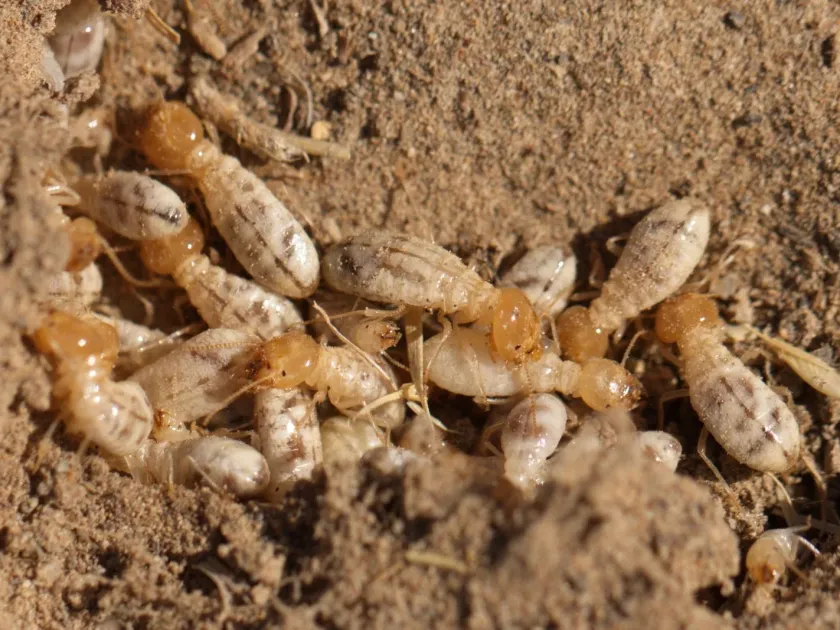
The Turkestan termite, Anacanthotermes turkestanicus, belongs to the order Isoptera, family Hodotermitidae. These insects undergo incomplete metamorphosis and lead a cryptic lifestyle within soil and wood.
Individuals are divided into castes: workers and soldiers possess yellowish-brown bodies up to 10 mm long, while winged reproductive individuals are larger with two pairs of long wings.
A unique characteristic of this species is its ability to damage both dead and dry wood, as well as various plant residues, which is rare for the region.
Colonies reside deep underground, building extensive networks of tunnels that can reach depths of several meters, making their detection extremely difficult.
For colony development, specific soil moisture levels are required, which is why they are most frequently found in oases and irrigated zones of Central Asia.
What it damages
Significant damage is inflicted upon structural elements, residential buildings, storage facilities, and outbuildings constructed from wood.
In agriculture, this pest causes damage to wooden fence posts, vineyard supports, and the dry stems of various field crops.
Termites are capable of destroying stockpiles of hay, straw, and grain if these are stored in non-airtight wooden containers or on earthen floors.
They pose a particular threat to the root systems of young tree saplings, feeding on their bark and roots underground, which leads to plant desiccation.
Under arid conditions, the pest shifts its focus to consuming any cellulose-containing materials, including paper, cardboard, and even fabrics of plant origin.
When it appears
The activity of the Turkestan termite continues throughout the warm season of the year when the soil temperature at their depth exceeds the critical minimum.
Mass flights of winged individuals for reproduction and dispersal typically occur in the spring, often following atmospheric precipitation that increases soil moisture.
During the winter period, the insects retreat to deeper soil horizons where the temperature remains stable, entering a state of reduced activity.
The spring awakening of the colony coincides with the beginning of active sap flow in woody plants, stimulating workers to search for new food sources.
The period of greatest damage to agricultural objects occurs during the summer months when termites expand their foraging tunnels in search of cellulose.
Signs of infestation
The presence of characteristic earthen trails or galleries, which termites build on the surface of wooden structures to move safely, indicates an infestation.
The appearance of small piles of granules (fress) near damaged wood sections points to the ongoing active life of the colony.
A telltale sign is the hollowed-out state of wood while the outer surface remains seemingly intact, which can be easily detected by tapping.
- Observation of winged individuals near buildings in spring.
- Earthen deposits on foundations and walls.
- Sounds or rustling coming from inside wooden beams.
Sudden flooring subsidence or the loss of structural stability in wooden supports are signs of advanced material degradation.
Control measures
The primary method of protection involves the use of wood preservatives and specialized chemical treatments that render the material unsuitable for consumption.
When constructing new buildings or planting, it is recommended to create protective sand or gravel barriers through which termites cannot tunnel.
The application of chemical insecticides is effective in the form of soil barriers around objects or by injecting formulations directly into the colony tunnels.
It is essential to conduct timely clearing of the area from plant residues and deadwood, which serve as the primary food base for the termites.
In cases of large-scale colony detection, professional pest control services should be contacted for soil or building fumigation using certified chemicals.
Taxonomy
- Latin name
- Anacanthotermes turkestanicus
- Family
- Hodotermitidae
- EPPO code
- ANKTTU
Discussion
No discussions yet — be the first.