
Transcaspian termite
Anacanthotermes ahngerianus
Description
How to identify
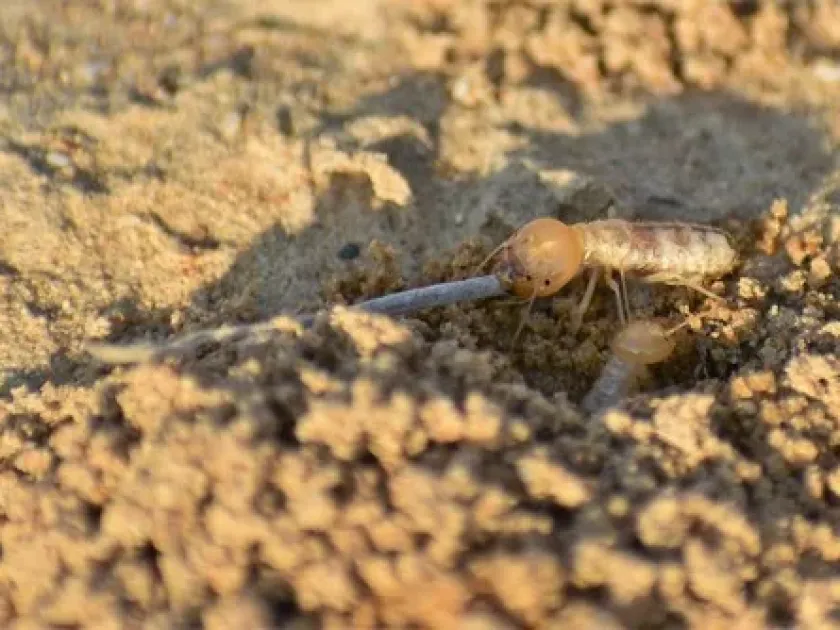
The Transcaspian termite (Anacanthotermes ahngerianus) belongs to the order Isoptera and the family Hodotermitidae. It is a highly social insect living in complex underground colonies.
Workers are typically 7-10 mm long, with a greyish-yellow body. They lack wings and are primarily responsible for foraging, feeding the colony, and building galleries.
Soldiers are distinguished by their larger heads and powerful mandibles, which are essential for defending the colony against ants and other predators.
The colony structure is subterranean, often extending several meters deep to provide stable environmental conditions in arid, desert-like climates.
Unlike some other termite species, this termite is known for frequently foraging on the soil surface, making it particularly visible under specific conditions.
What it damages
This pest is highly destructive to both infrastructure and agricultural crops, as it feeds extensively on cellulose-rich materials.
In agriculture, it attacks the root systems of cotton, various cereals, and fruit trees, often causing the sudden death of young plants.
Wooden structures, fence posts, and utility poles are prone to damage, with termites hollowing out the interior while leaving the exterior surface intact.
The economic impact is significant in arid regions where wood is a vital material, and crops are susceptible to below-ground destruction.
- Destruction of wooden building foundations.
- Feeding on crop roots leading to plant wilting.
- Damage to stored agricultural products and timber.
When it appears
Termite activity is heavily regulated by soil temperature. They typically emerge for surface foraging during the spring as the ground warms up.
In the peak of summer, activity is often restricted to cooler hours to avoid desiccation, and termites may retreat to deeper, moister soil layers.
During autumn, the colony focuses on transporting organic matter into underground storage chambers to ensure food availability during the dormant period.
Winter is spent in deep soil profiles, where the colony remains inactive in a diapause-like state to survive cold temperatures near the surface.
The life cycle is long-term, requiring several years for a colony to become fully mature and begin producing winged reproductive individuals.
Signs of infestation
Surface foraging tunnels made of soil and saliva are the most prominent signs of an active Transcaspian termite presence in an area.
Sudden, unexplained wilting of healthy plants is a primary indicator that the root system has been compromised by termite feeding.
Hollowed-out wood that shows no outward damage until it collapses under pressure is a classic symptom of hidden termite infestation.
The swarming of winged reproductives is a clear signal that a mature, established colony is nearby and prepared for expansion.
Small piles of granular excrement found near infested wood or within galleries serve as a diagnostic feature for the pest's presence.
Control measures
Chemical soil treatment using systemic insecticides is the most common method to prevent termites from accessing crops or buildings.
Deep mechanical cultivation of the soil disrupts foraging tunnels and destroys nesting sites, which helps in controlling local populations.
Treating timber with professional-grade wood preservatives is necessary to protect structures from subterranean termite attacks.
Biological control, utilizing specific fungal pathogens that target termite colonies, provides an environmentally sustainable approach to management.
Regular surveillance using bait stations allows for early detection and targeted intervention, reducing the need for widespread pesticide application.
Taxonomy
- Latin name
- Anacanthotermes ahngerianus
- Family
- Hodotermitidae
- EPPO code
- ANKTAH
Discussion
No discussions yet — be the first.