
Cabbage webworm
Hellula
Description
How to identify
The Cabbage webworm (Hellula undalis) is a moth belonging to the Crambidae family, known as a significant pest of cruciferous crops globally.
The adult moth has a wingspan of approximately 20 mm, with greyish-brown forewings decorated with distinct dark zigzag patterns and light-colored lines.
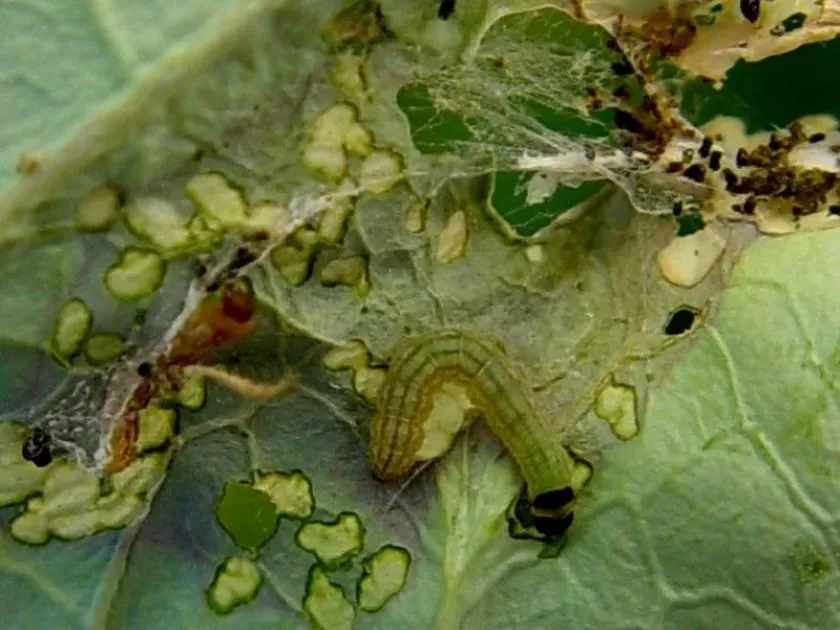
The larvae, or caterpillars, reach about 15-20 mm in length and possess a yellowish-green body with five prominent dark longitudinal stripes along the back.
Their head capsule is characteristically dark brown to black, making them relatively easy to identify during routine field inspections of vegetable fields.
The insect undergoes complete metamorphosis, and its developmental speed is highly dependent on ambient temperatures, thriving in warm, dry climates.
What it damages
Cabbage webworms primarily infest members of the Brassicaceae family, including cabbage, cauliflower, broccoli, radish, turnip, and mustard crops.
The larvae are notorious for feeding on the apical meristem or "growing point" of young plants, which often causes the plant to stunt or die completely.
On more mature plants, the caterpillars bore into the stems or enter the head of the cabbage, creating tunnels that destroy the product's marketability.
Feeding damage often leads to the secondary colonization by bacteria and fungi, causing soft rot and total loss of the affected vegetable parts.
Under heavy infestation, the cumulative damage can result in complete crop failure, especially in seedling trays or young field transplants.
When it appears
This pest is most active during warm weather and typically reaches peak population levels during the summer months in temperate regions.
Adult moths are nocturnal and deposit their eggs singly or in small clusters on the undersides of host leaves or near the base of the plant.
The life cycle is remarkably rapid, sometimes taking less than 20 days from egg to adult in conditions where temperatures remain high and constant.
In tropical and subtropical zones, the Cabbage webworm can reproduce continuously throughout the year if host plants are readily available.
During cooler seasons, the population usually declines, but they can persist in protected environments such as greenhouses or polytunnels year-round.
Signs of infestation
One of the earliest signs of an infestation is the presence of silk webbing, which the caterpillars use to protect themselves while feeding on leaves.
Young larvae initially skeletonize the leaves, creating small translucent spots or "windows" that are easily visible during early growth stages.
Presence of dark, granular frass (excrement) deposited in the leaf axils or among the silken webs is a clear indicator of active larvae.
Distorted or missing central shoots on young cabbages are classic symptoms that indicate the presence of this specific pest.
- Silken webs or "tents" among leaves.
- Skeletonized leaf patches and translucent windowing.
- Accumulation of dark larval frass in plant joints.
- Stunted growth due to damage to the apical growing point.
Control measures
Integrated pest management (IPM) for this species involves rigorous sanitation, including the removal and destruction of all infested crop residues.
Crop rotation is essential; avoid planting Brassicaceae in the same location for at least two years to break the insect's life cycle.
Biological control using microbial insecticides such as Bacillus thuringiensis (Bt) is highly effective against early-instar larvae.
Chemical control can be implemented using selective insecticides, but applications must be timed correctly with the early stages of larval development.
Utilizing row covers during the early planting stages can provide an effective physical barrier against egg-laying adult moths.
Taxonomy
- Latin name
- Hellula
- Order
- Lepidoptera (butterflies)
- Family
- Crambidae
- EPPO code
- HLULSP
Discussion
No discussions yet — be the first.