
Convolvulus moth
Helcystogramma convolvuli
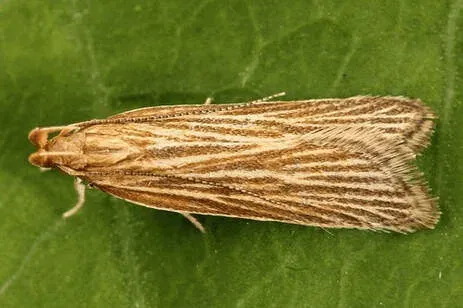
Description
How to identify
Helcystogramma convolvuli belongs to the family Gelechiidae (twirler moths). This small moth is known for its secretive behavior and its ability to blend into the environment.
The adult moth is relatively small, with wings adapted for effective concealment on the foliage of host plants during the daytime.
The larvae, or caterpillars, progress through several instars. They possess strong mandibles, which are essential for feeding on plant tissues throughout their development.
Pupation often occurs within folded leaves or in the upper soil layers, where the insect remains protected while undergoing metamorphosis.
Due to its small size and nocturnal habits, identification often requires examining the characteristic damage patterns on the foliage of host plants.
What it damages
The pest primarily targets plants within the Convolvulaceae family, but it has adapted to feed on various cultivated agricultural crops.
In soybean fields, this insect can cause significant damage by consuming leaf tissue, which reduces the plant's ability to perform photosynthesis efficiently.
Weeds such as field bindweed act as natural reservoirs, allowing the pest population to survive and multiply even in the absence of target crops.
Feeding damage can result in stunted plant growth and reduced yield potential, especially when infestations occur during critical growth stages.
The specialized feeding habits make it a persistent threat in regions where soybean and its host weeds are prevalent simultaneously.
When it appears
Adult moths are typically active during the warm summer months when conditions are optimal for mating and egg-laying on suitable host plants.
The life cycle is closely synchronized with the phenology of the host crops, ensuring that larvae have a continuous food supply during their growth.
In regions with longer growing seasons, the pest may produce multiple generations, increasing the pressure on agricultural production throughout the summer.
The insect typically overwinters as a pupa, hiding in soil debris or protected areas within the field until temperatures rise again in the spring.
The peak of damage usually coincides with mid-to-late summer, corresponding to the period of highest larval activity and feeding requirements.
Signs of infestation
One of the most obvious signs of an infestation is the presence of tightly curled or webbed leaves at the top of the plant canopy.
- Irregular holes or "windows" eaten into the leaf surface by larvae.
- Silk webbing visible between leaves used by the larvae for protection.
- General chlorosis or yellowing of the foliage as the plant suffers from tissue loss.
- Accumulation of larval frass on leaves and around the infested plant parts.
- Premature leaf drop or wilting of the upper branches due to localized feeding.
Control measures
Cultural control strategies, such as deep plowing in the autumn, are crucial for destroying overwintering pupae hidden in the soil.
Effective weed management, especially targeting bindweed, is the most important step to prevent the initial spread of the moth into crop fields.
When the economic threshold is reached, targeted insecticide applications should be used, preferably focusing on early-stage larvae.
Biological control agents, including microbial pesticides, can offer an environmentally friendly alternative for managing localized infestations.
Regular field scouting and the use of pheromone traps allow farmers to monitor moth population levels and time their interventions for maximum efficacy.
Taxonomy
- Latin name
- Helcystogramma convolvuli
- Order
- Lepidoptera (butterflies)
- Family
- Gelechiidae
- EPPO code
- HECYCO
Discussion
No discussions yet — be the first.