
Banana leaf roller
Hedylepta musicola
Description
How to identify
The banana leaf roller Hedylepta musicola belongs to the order Lepidoptera, family Crambidae. This moth is primarily nocturnal and is commonly found in tropical banana-growing regions.
The adult moth has a wingspan of approximately 20–25 mm. The wings exhibit a yellowish-brown or grayish coloration with dark transverse lines, providing excellent camouflage against foliage.
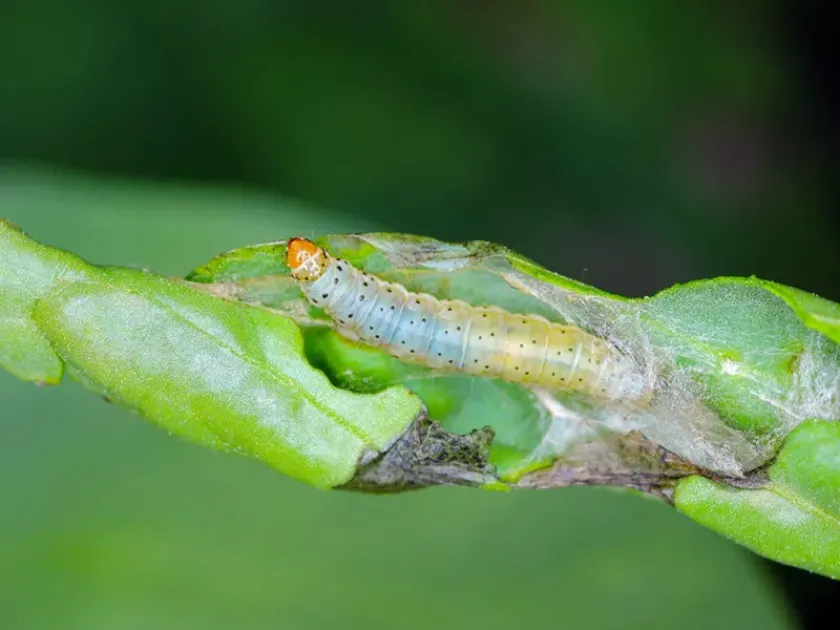
The larvae progress through several instars, changing their body color from a translucent pale green to a deeper green, often with a darker head capsule that is visible during examination.
Pupation occurs within sheltered areas, typically inside a rolled leaf secured with silk. The pupa is brown, making it difficult to spot without close inspection of the infested leaves.
Development time is highly dependent on ambient temperature and humidity levels, allowing for multiple overlapping generations throughout the year in optimal tropical climates.
What it damages
The primary host plants are species within the Musaceae family. The pest causes significant economic losses in commercial banana plantations by targeting the vegetative parts of the plant.
Larvae prefer feeding on young, developing leaves. They consume the leaf tissue while remaining inside a rolled leaf, which protects them from predators and environmental factors.
Heavy infestations lead to significant reduction in the photosynthetic surface area, causing the banana plant to grow slower and potentially reducing both fruit size and total yield.
The damaged leaves lose their structural integrity and are more susceptible to secondary infections from fungi and bacteria, which can cause further tissue necrosis.
Severe defoliation weakens the plant, making it less resilient to drought or other external stresses, which can result in long-term plantation health issues.
Signs of infestation
The most characteristic sign is the presence of leaves rolled along the margins, held together by white silken threads spun by the larvae during their feeding stage.
When unrolled, these shelters typically contain the larva and its dark, pellet-like frass (excrement), which confirms the presence of an active infestation.
Feeding damage manifests as skeletonized patches where the leaf tissue between veins has been consumed, giving the leaves a distinctive, translucent, or window-pane appearance.
Visible yellowing or necrosis of the leaf margins occurs as a result of the damage, leading to early senescence and premature wilting of the foliage on the affected plant.
Small, translucent egg clusters can sometimes be seen on the underside of leaves, usually clustered near the midribs, especially during periods of high adult moth activity.
Control measures
The most effective strategy is the manual removal and destruction of infested, rolled leaves. This mechanical control method prevents the pest from completing its life cycle.
Biological control using Bacillus thuringiensis sprays is highly effective against young larvae and is considered an environmentally friendly alternative to harsh chemicals.
Promoting the population of natural predators and parasitoids, such as Braconid wasps, helps maintain the pest population below the economic damage threshold.
Chemical intervention should be reserved for outbreaks where biological or mechanical methods fail to curb the damage, utilizing targeted applications to minimize impact on beneficial insects.
- Regular field scouting to identify early infestations.
- Monitoring adult flight patterns using pheromone traps.
- Cleaning up plantation debris to reduce overwintering sites.
Taxonomy
- Latin name
- Hedylepta musicola
- Order
- Lepidoptera (butterflies)
- Family
- Crambidae
- EPPO code
- HEDYMU
Discussion
No discussions yet — be the first.