
Haplotinea
Haplotinea
Description
How to identify
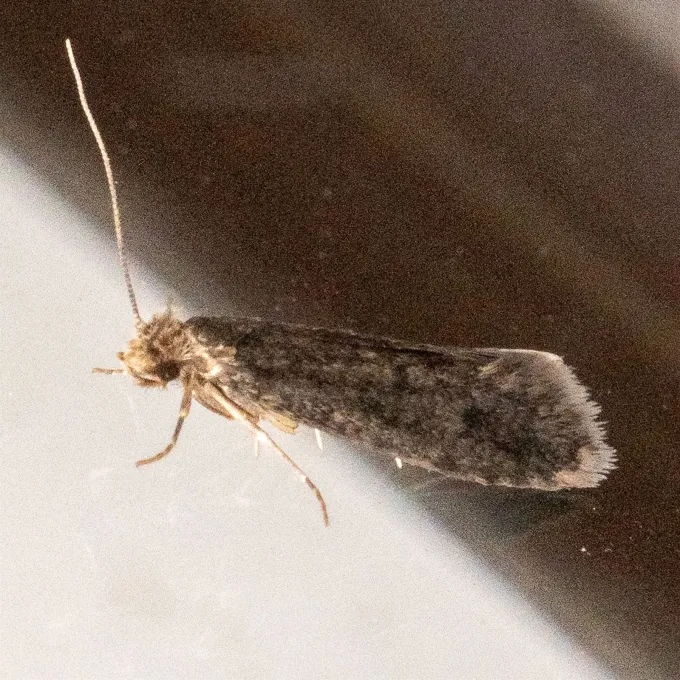
Haplotinea belongs to the family Tineidae (true moths), which are common pests in agricultural and stored product environments. These moths are relatively small, characterized by narrow wings with long fringes, typical of the Tineidae family.
The adult moths are often nocturnal, possessing cryptic coloration that allows them to remain unnoticed against substrates. They have poorly developed mouthparts, as their primary focus is reproduction rather than feeding.
The larvae, or caterpillars, are the destructive stage of this pest. They possess a well-defined head capsule and strong mandibles designed for tunneling through fungal tissue and mushroom compost.
The life cycle undergoes complete metamorphosis, including egg, larva, pupa, and adult stages. Pupation usually occurs within a protective, dense silken cocoon interwoven with substrate debris to evade detection and environmental stress.
Identification often requires examination of the genital structure, as the external appearance of various Tineidae species is remarkably similar, complicating visual diagnosis in the field.
What it damages
Haplotinea primarily infests cultivated mushrooms, most notably the common mushroom (Agaricus bisporus). The larvae feed on both the mycelium within the compost and the fruiting bodies themselves.
When larvae penetrate the fruiting bodies, they create complex tunnel systems. This activity destroys the internal structure of the mushroom, rendering it commercially worthless and unsuitable for human consumption.
In addition to physical destruction, the larvae deposit excrement inside the mushroom tissues. This contamination promotes the development of secondary bacterial rot, which rapidly spreads to adjacent mushrooms.
Mycelial damage is a critical issue as it disrupts the nutrient supply to developing mushrooms. This results in reduced crop yields and the collapse of mushroom clusters, leading to significant economic losses for growers.
Chronic infestations can weaken the entire mushroom block, making it more susceptible to other diseases and environmental stress throughout the production cycle.
When it appears
In controlled mushroom-growing environments, Haplotinea can reproduce continuously throughout the year. The stable, humid, and warm conditions provided for mushroom cultivation are perfect for the moth's development.
The duration of the life cycle is highly dependent on ambient temperature. In favorable conditions, generations can follow one another in rapid succession, often completing a cycle in less than five weeks.
High humidity levels are particularly conducive to the survival of eggs and young larvae. If ventilation is poor, the localized humidity in stagnant air pockets becomes an ideal breeding ground.
Adult moths are most active during evening hours. They can persist between growing seasons by surviving in cracks of the infrastructure or within remaining compost debris if cleaning protocols are not strictly followed.
New infestations are often introduced via contaminated spawning material or imported bulk substrate, allowing the pest to establish itself rapidly in any season.
Signs of infestation
A primary indicator of a Haplotinea infestation is the presence of fine silken webbing on the surface of the mushroom blocks or directly on the mushroom stalks, used by larvae for navigation.
Small holes or entry tunnels observed on the caps or stems of mushrooms are clear signs of larval boring. Splitting open a suspected mushroom usually reveals the larvae or their brownish frass inside.
The presence of adult moths near lighting sources within the growing room serves as a strong warning sign of an established population that requires immediate management intervention.
Accumulation of fine granular frass and discarded substrate particles on the casing soil surface often indicates heavy larval activity in the upper layers of the block.
Stunted growth or deformation of mushrooms often points to significant mycelial damage beneath the surface, where the larvae have been actively feeding on the fungal network.
Control measures
Effective management begins with rigorous hygiene and sanitation. Cleaning and disinfecting growing rooms between crops is the most critical step to break the moth's life cycle.
Proper pasteurization of the substrate is essential to ensure that any eggs or larvae introduced with the raw materials are destroyed before the spawning process begins.
Using pheromone traps helps in monitoring the population of adult moths, while light traps are useful for reducing the number of reproductive individuals in the room.
Biological control agents, such as specific entomopathogenic bacteria, can be used to target larvae without leaving harmful residues on the mushrooms, ensuring product safety.
- Seal growing rooms to prevent entry from outdoor sources.
- Promptly remove and dispose of infected mushroom specimens and debris.
- Maintain optimal ventilation to reduce humidity stagnation.
- Quarantine new batches of spawn and materials before integrating them into the facility.
Taxonomy
- Latin name
- Haplotinea
- Order
- Lepidoptera (butterflies)
- Family
- Tineidae
- EPPO code
- HPTISP
Discussion
No discussions yet — be the first.