
Clymene moth
Haploa clymene
Description
How to identify
The Clymene moth (Haploa clymene) is a member of the Erebidae family and the Arctiinae subfamily, commonly known as tiger moths.
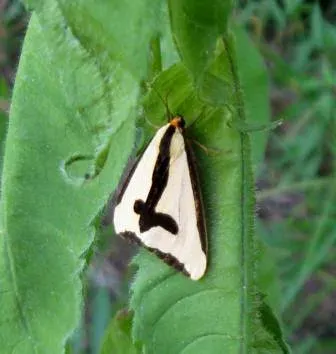
The adult moth is recognizable by its wingspan of about 55–60 mm and a very distinct pattern on its forewings.
The forewings are cream or pale yellow, featuring complex black lines and marks that often form a V-shaped or zigzagging appearance.
The hindwings display a vivid yellow or orange-yellow color with several black spots, serving as a warning to potential predators.
The larvae, or caterpillars, are covered in dense tufts of hair and are typically dark in color with light longitudinal stripes along the body.
What it damages
Clymene moth larvae are polyphagous, meaning they feed on a wide variety of plants, which makes them a concern in agricultural settings.
They are frequently found consuming the foliage of various herbaceous plants, including those in the Asteraceae and Fabaceae families.
In ornamental gardens or vegetable plots, these caterpillars can cause significant defoliation to shrubs, perennials, and occasionally young trees.
By consuming large amounts of leaf tissue, the caterpillars reduce the plant's ability to photosynthesize, thereby stunting its overall growth.
Severe infestations can lead to weakened plants that are more susceptible to secondary diseases and environmental stress during the growing season.
When it appears
The Clymene moth typically completes one generation per year, with the emergence of adult moths occurring in the summer months.
The peak flight activity of adults is usually recorded between June and August, which is when mating and oviposition take place.
The species overwinters as a caterpillar, seeking shelter in leaf litter, debris, or near the base of host plants as temperatures begin to drop.
As spring arrives and temperatures rise, the caterpillars emerge from diapause to resume feeding on fresh vegetation before pupating.
Pupation takes place within a silk cocoon, which the caterpillar spins in a protected area on the foliage or on the ground surface.
Signs of infestation
The first indicator of an infestation is the presence of irregular bite marks or ragged edges on the leaves of host plants.
Progressive feeding often results in skeletonized leaves, where only the veins remain, which is a classic sign of caterpillar activity.
Excrement (frass) left on the foliage or on the ground beneath the plant is a clear indication that caterpillars are present.
Finding the caterpillars themselves is easiest during the early morning or evening hours when they are actively moving on the plant stems.
The presence of silken webbing or cocoons attached to leaves or plant debris indicates that the larvae are preparing for the pupal stage.
Control measures
Cultural control involves removing weeds and cleaning up plant debris, which helps eliminate potential overwintering sites for the larvae.
Maintaining a healthy garden environment with balanced soil nutrients improves the plant's natural resistance to caterpillar feeding.
For small infestations, hand-picking the caterpillars and removing them from the affected plants is an effective and environmentally friendly approach.
Biological control using formulations of Bacillus thuringiensis can be used to target young caterpillars while minimizing impact on beneficial insects.
In cases of heavy infestation, applying approved chemical insecticides should be done according to the manufacturer's label to ensure safety and effectiveness.
Taxonomy
- Latin name
- Haploa clymene
- Order
- Lepidoptera (butterflies)
- Family
- Erebidae
- EPPO code
- HPLOCL
Discussion
No discussions yet — be the first.