
Haemonchus contortus
Haemonchus contortus
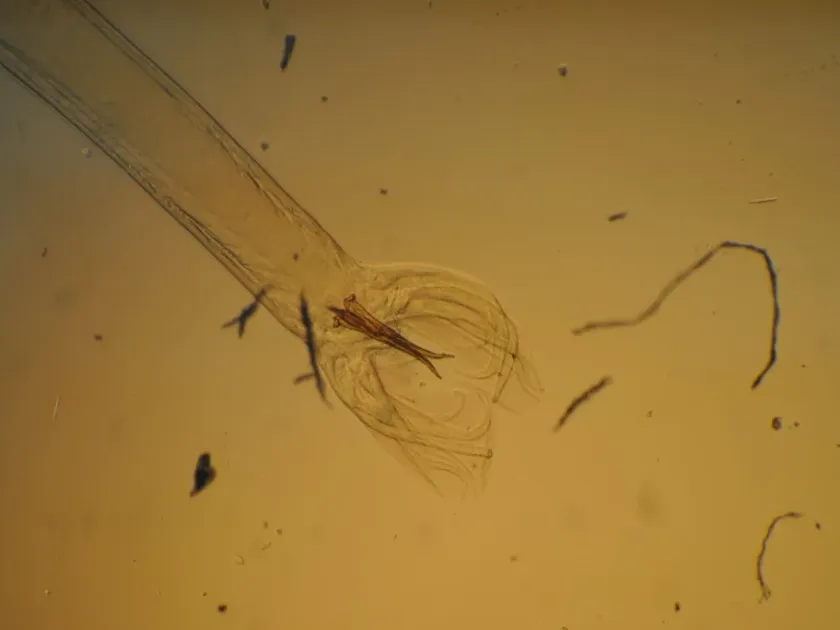
Description
How to identify
Haemonchus contortus, commonly known as the barber's pole worm, is a highly significant parasitic nematode belonging to the family Trichostrongylidae.
This parasite is distinguished by its unique appearance: the female's white ovaries spiral around the blood-filled intestine, creating a pattern reminiscent of a barber's pole.
Adult worms inhabit the abomasum of ruminants, using specialized teeth to puncture the mucosa and feed on the host's blood supply.
The life cycle is direct; eggs are passed in feces, developing into infective larvae in the environment under suitable temperature and moisture conditions.
These larvae are then ingested by grazing animals, eventually maturing into adults inside the abomasum to repeat the cycle.
What it damages
Haemonchus contortus primarily affects sheep, goats, and cattle, causing severe health issues in livestock production systems worldwide.
The primary damage is caused by heavy blood-feeding activity, which leads to acute or chronic anemia in the host animals.
Impact on production includes reduced weight gain, decreased milk and wool production, and significant economic loss due to mortality in young animals.
Affected animals exhibit signs of malnutrition and protein deficiency, making them highly susceptible to secondary infections or environmental stressors.
In addition to physical harm, the parasite's high reproductive rate allows it to quickly overwhelm livestock populations during favorable seasons.
When it appears
The prevalence of this parasite is highly dependent on environmental conditions, peaking during warm, humid seasons which favor larval survival.
In temperate regions, activity is most intense during late spring and summer when temperatures reach the threshold for larval development.
Winter or dry periods may significantly reduce larval survival on pastures, but the parasite can persist within the host through hypobiosis.
Spring is often a critical monitoring time as livestock move to pastures where larvae have accumulated during the warm months.
Predicting seasonal outbreaks is essential for timing anthelmintic interventions to prevent mass infection of the herd.
Signs of infestation
The most clinical diagnostic sign is pale mucous membranes of the eyes and mouth, which is a classic indicator of severe anemia.
Physical appearance often reveals weight loss, lethargy, poor body condition, and a dull, rough coat, especially in young stock.
Submandibular edema, often referred to as "bottle jaw," is a common physical manifestation in advanced stages of infection.
Laboratory diagnosis involves fecal egg counts, which confirm the presence of trichostrongyle-type eggs in the samples.
Clinical observation often shows sudden weakness and respiratory distress in animals during high-intensity periods of grazing.
Control measures
Effective management requires a combination of pharmacological treatment and pasture management strategies to reduce parasite loads.
Anthelmintic therapy remains the primary control method, although producers must monitor for drug resistance in worm populations.
Pasture management, such as rotational grazing, is vital to break the cycle by moving animals away from high-density larval environments.
Selection of resistant or resilient breeds is an increasingly popular approach to mitigate the reliance on chemical control methods.
- Targeted selective treatment of infected individuals.
- Rotation of pastures to reduce exposure.
- Use of nutritional supplementation to improve resilience.
- Regular fecal egg count monitoring.
Taxonomy
- Latin name
- Haemonchus contortus
- Order
- Nematodes
- Family
- Trichostrongylidae
- EPPO code
- HMCHCO
Discussion
No discussions yet — be the first.