
Hog louse
Haematopinus suis
Description
How to identify
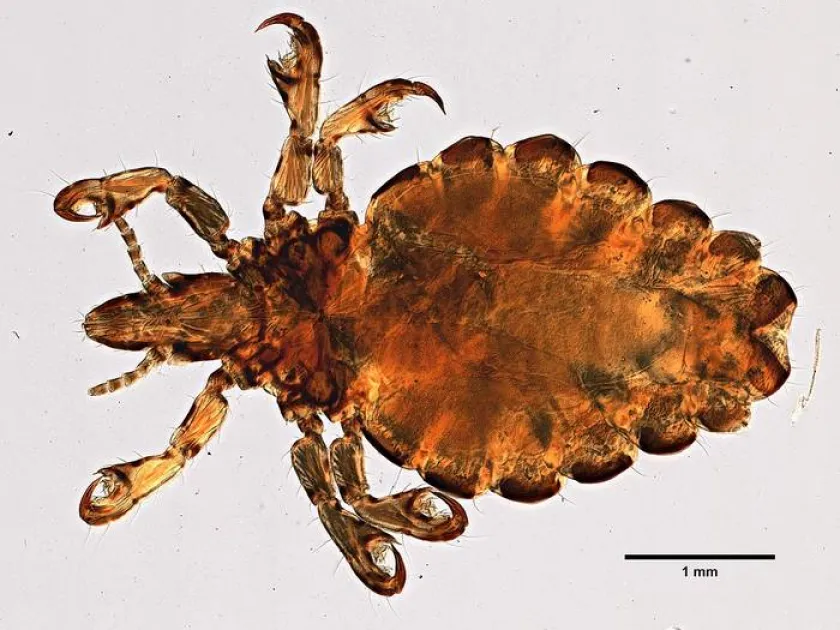
The hog louse (Haematopinus suis) belongs to the order Phthiraptera, family Haematopinidae. It is recognized as the largest louse species infesting mammals.
The adult insect has a flattened body, ranging from 4 to 5 mm in length, with a gray-brown color and distinct dark plates on the edges of the abdomen.
Its head is elongated and equipped with powerful piercing-sucking mouthparts, specifically evolved to feed on the blood of swine.
The legs of the louse feature specialized claws designed to grip the coarse hair of a pig, allowing it to move easily and remain attached to the host.
This is an obligate parasite, meaning its entire life cycle—from egg (nit) to nymph and adult—must occur on the host animal.
What it damages
The hog louse is not an agricultural plant pest; it is a significant veterinary pest that specifically affects domestic and wild pigs.
The presence of this parasite causes haematopinosis, a condition that results in substantial economic loss for swine producers worldwide.
By constantly feeding on blood, the parasites cause anemia, chronic stress, and reduced weight gain in pigs, directly impacting farm profitability.
While the pest does not damage crops, its management is a crucial aspect of farm hygiene and animal welfare, as infestations spread rapidly through a herd.
An untreated infestation leads to secondary skin infections, further lowering the quality of the livestock and increasing veterinary treatment costs.
Signs of infestation
The primary sign of infestation is intense itching, causing pigs to rub repeatedly against stalls, fences, and troughs, resulting in skin abrasions.
Inspection often reveals the insects clustered in protected areas of the skin, such as the neck folds, behind the ears, and the inner thighs.
Nits (eggs) can be seen as small, yellowish-white objects firmly attached to the base of the hair shafts, indicating an established population.
Chronic scratching creates sores and localized dermatitis, which can become portals for secondary bacterial or fungal skin infections.
Restless behavior and reduced feed intake are behavioral indicators that the herd requires professional screening and parasite control.
Control measures
Effective control involves the use of approved insecticides, such as sprays, pour-on treatments, or systemic injectable products like ivermectin.
Treatment must be systematic, usually requiring two applications spaced 10–14 days apart to ensure that newly hatched lice are eliminated before they lay eggs.
Facility hygiene is essential; pens, bedding, and equipment must be cleaned and disinfected to kill any lice that have dropped off the host.
- Treating the entire herd simultaneously to prevent re-infestation.
- Quarantining new animals before introducing them to the main herd.
- Maintaining high standards of pen cleanliness and sanitation.
Continuous monitoring and strategic use of veterinary products are the most reliable methods for maintaining a louse-free swine operation.
Taxonomy
- Latin name
- Haematopinus suis
- Family
- Haematopinidae
- EPPO code
- HAEMSA
Discussion
No discussions yet — be the first.