
Cattle tail louse
Haematopinus quadripertusus
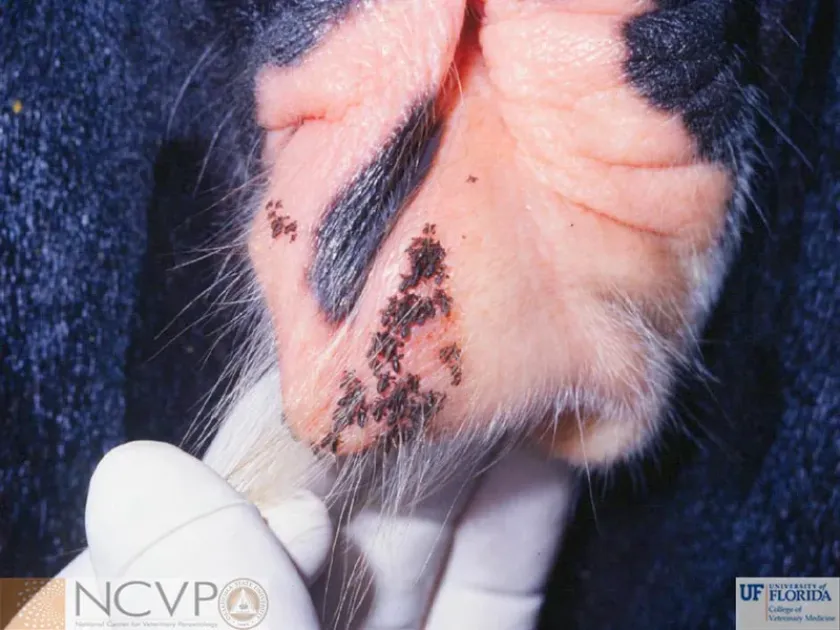
Description
How to identify
The cattle tail louse (Haematopinus quadripertusus) is a parasitic insect belonging to the family Haematopinidae. It is a highly host-specific ectoparasite that feeds exclusively on cattle.
The adult louse measures approximately 3 to 4 mm in length. Its body is dorsoventrally flattened, which allows it to remain firmly attached to the host's hair, even during the animal's movement or when it is rubbing against objects.
The entire life cycle of this parasite occurs on the host. The female lays eggs, known as nits, which are firmly glued to the hair shafts, typically near the skin surface. These eggs hatch into nymphs, which look like miniature adults.
This species is named for its preferred habitat: the tail area. It is most commonly found around the base of the tail, the perianal region, the udder, and the inner thighs, where the skin is thinner and easier to pierce.
Development from egg to adult takes about three weeks. Under stable conditions provided by the host's body temperature, the population can sustain itself and reproduce throughout the year, especially in housed cattle.
What it damages
While the cattle tail louse does not damage crops, it causes significant economic losses in the livestock industry. The primary impact is on the health and productivity of the infested animals.
The louse feeds on blood, and its feeding activity causes intense itching. This leads to constant irritation, causing cattle to rub against fences or buildings, which damages their skin, hair, and even physical structures.
Infested animals suffer from stress and discomfort, which directly affects their feed intake and milk production. Young calves are particularly vulnerable, often suffering from anemia due to significant blood loss from heavy infestations.
Hide quality is severely degraded by the presence of scabs, scars, and areas of hair loss, leading to lower prices for producers in the leather industry. Additionally, the parasite can act as a mechanical vector for various diseases.
Management of the herd becomes more costly due to the need for veterinary treatments and potential loss of growth performance in calves, which directly impacts the profitability of the dairy or beef farm.
Signs of infestation
The most obvious sign of infestation is restless behavior. Cattle will be seen rubbing their tailheads and hindquarters against posts, trees, or stable equipment in a frantic attempt to relieve the persistent itching.
Upon inspection of the tail base, vulva, or udder, clusters of adult lice can be identified. The nits appear as small, whitish oval objects attached to individual hairs and are often mistaken for dandruff, though they remain fixed when brushed.
Skin lesions, including crusts, redness, and inflammation, are common indicators. Chronic cases often exhibit alopecia (hair loss) and skin thickening in the affected areas due to prolonged irritation and self-trauma.
Animals with severe infestations often appear lethargic with a rough, dull coat. Weight loss or failure to gain weight at expected rates is a typical sign that the infestation is depleting the animal's energy reserves.
In high-density indoor environments during winter, the spread of lice is rapid. Routine monitoring of the herd is essential to catch the infestation early before it spreads to the entire population.
Control measures
Effective control relies on the application of approved insecticides. Pour-on formulations, sprays, and dusts are commonly used, with pour-ons being particularly popular for their ease of application along the animal's back.
Treatment timing is critical for success. Since many insecticides do not kill the eggs, a second treatment is usually required 10 to 14 days after the first to kill the newly hatched nymphs before they reach maturity.
New animals introduced to the herd should be quarantined and inspected for lice. Treating new arrivals prevents the introduction of these parasites into an otherwise clean herd, saving costs and labor later.
While environmental hygiene is helpful, the focus must remain on the animals themselves. Regular cleaning of stables and barns can reduce the environment for survival, but the lice life cycle is intrinsically linked to the host.
Systemic treatments, such as injectable macrocyclic lactones, are highly effective as they circulate in the host's blood, killing the lice when they feed. These treatments provide long-term protection and are a cornerstone of modern parasite management.
Taxonomy
- Latin name
- Haematopinus quadripertusus
- Family
- Haematopinidae
- EPPO code
- HAEMQU
Discussion
No discussions yet — be the first.