
Horse louse
Haematopinus asini
Description
How to identify
The horse louse (Haematopinus asini) is a host-specific ectoparasite belonging to the order Phthiraptera, family Haematopinidae. These insects are blood-sucking parasites, reaching approximately 2.5–4 mm in length, with a flat body and a small head designed for piercing the host's skin.
They are wingless and have specialized claw-like tarsi that allow them to move easily through the horse's hair. Their coloration ranges from yellowish-brown to dark gray, providing them with camouflage against the horse's skin and coat.
What it damages
This species exclusively infests equines, including horses, donkeys, and mules. In an agricultural and equestrian context, they are significant pests because they cause severe physical irritation, anemia in cases of heavy infestation, and poor coat condition.
Heavy infestations can lead to substantial loss of condition in working horses. Furthermore, the constant stress and skin irritation caused by the feeding activity of these lice negatively impact the temperament and performance of the animals involved in farm work.
When it appears
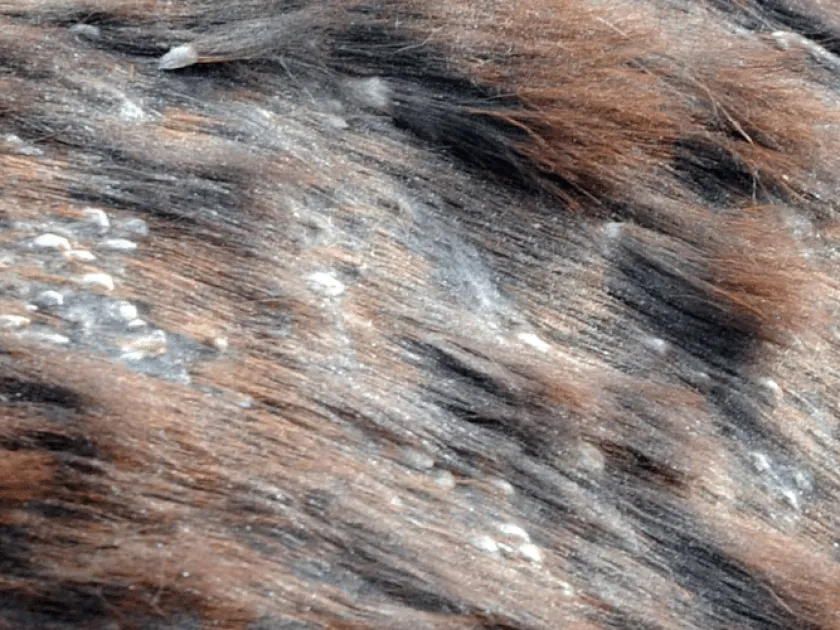
The entire life cycle occurs on the host. Females lay eggs (nits) which are firmly cemented to the hair shafts near the skin, particularly in dense areas of the coat. The transition from egg to adult takes about three to four weeks.
Infestations are most common during the winter months when horses develop a thick winter coat, which provides an ideal environment for lice to thrive. Poor grooming and close contact with other animals facilitate the rapid spread of these parasites throughout the herd.
Signs of infestation
The primary symptom is intense pruritus (itching), which leads the horse to rub against fences, walls, or stable fixtures. This behavior results in localized hair loss, broken hair, and skin abrasions, which can further develop into secondary bacterial dermatitis.
Visual inspection of the mane, forelock, and tail base often reveals adult lice and visible clumps of nits attached to the hair. The skin may appear crusty and irritated, particularly in areas where the hair is thickest or where the horse cannot groom effectively.
Control measures
Treatment involves the use of approved veterinary insecticides, including powders, sprays, or pour-on formulations. It is critical to treat all horses in the herd simultaneously to prevent re-infestation from asymptomatic individuals.
- Apply insecticides following veterinary guidelines for dosage and safety.
- Clean and disinfect tack, grooming tools, and stable environments regularly.
- Implement quarantine protocols for all new horses introduced to the premises.
- Repeat the treatment after 10–14 days to eliminate newly hatched nymphs, as most insecticides do not kill the eggs (nits).
Taxonomy
- Latin name
- Haematopinus asini
- Family
- Haematopinidae
- EPPO code
- HAEMAS
Discussion
No discussions yet — be the first.