
Hog louse
Haematopinus
Description
How to identify
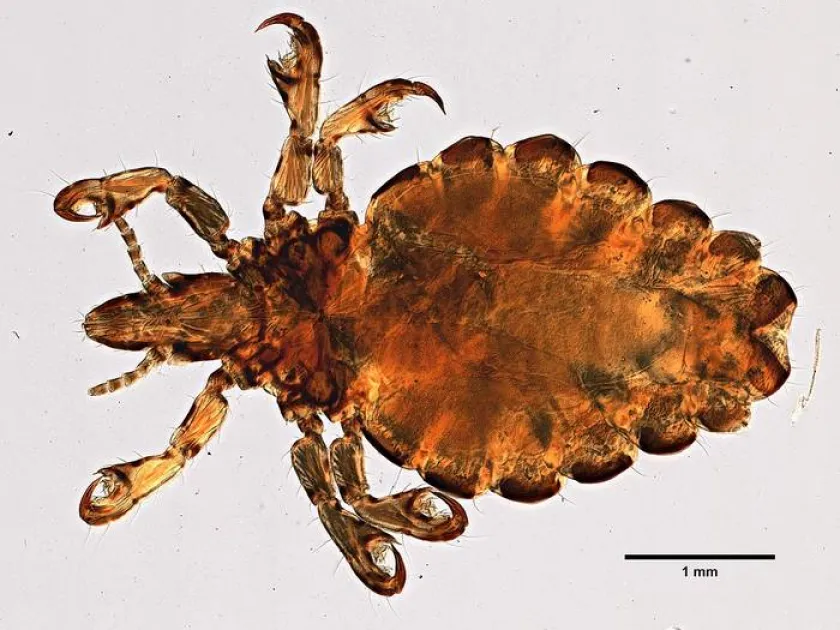
The hog louse (Haematopinus suis) is a host-specific ectoparasite belonging to the order Phthiraptera and the family Haematopinidae. It is the largest louse species known to affect domestic animals, typically measuring between 4 and 6 millimeters in length.
This wingless insect has a flattened, brownish-grey body designed for close contact with the host's skin. Its head is elongated and equipped with a strong, piercing-sucking mouthpart, which it uses to feed exclusively on the blood of its host.
Each of the six legs is equipped with a powerful claw that allows the louse to grip the thick bristles of pigs firmly. This anatomical adaptation enables the parasite to remain attached to the animal even during rapid movement or scratching.
Female lice produce oval-shaped, yellowish-white eggs known as nits. These nits are firmly cemented to the base of the pig's bristles with a waterproof secretion, making them highly resistant to mechanical removal or grooming.
The life cycle involves incomplete metamorphosis, progressing through egg, three nymphal stages, and adult phases. The entire cycle occurs on the host animal and typically lasts about 20 to 30 days under optimal conditions.
What it damages
The hog louse causes a condition known as hematopinosis. By constantly feeding on blood, the parasites cause intense itching and irritation, leading to severe discomfort for the swine and a significant reduction in overall health and productivity.
Persistent scratching and rubbing against feeders or pen walls result in skin lesions, abrasions, and scabs. These wounds serve as entry points for secondary bacterial infections, which can lead to more serious skin diseases or systemic health problems.
In cases of heavy infestation, affected pigs exhibit restlessness and failure to thrive. Young piglets are particularly vulnerable, as significant blood loss can lead to anemia, weakness, and stunted growth, severely impacting feed conversion efficiency.
Furthermore, Haematopinus suis acts as a mechanical vector for several dangerous pathogens, including swine pox virus and the bacteria responsible for swine erysipelas. This makes them a critical biosecurity risk on any pig farm.
The economic impact is multifaceted, encompassing loss of weight gain, damaged hides that lower market value, and the substantial costs associated with repeated veterinary treatments and rigorous facility sanitation.
When it appears
While hog lice can survive throughout the year, infestations often peak during the colder months. When pigs are housed in indoor facilities with high population density, the transmission of parasites between animals occurs rapidly.
The microclimate near the skin of a pig, which provides temperatures between 30 and 35 degrees Celsius, is perfect for the continuous reproduction of lice. High indoor humidity levels during winter further support the survival of nits in the environment.
During the summer, when animals spend more time outdoors or have better access to fresh air, the intensity of the infestation may decrease; however, the parasite is never naturally eradicated from the herd without active control measures.
Infestations often flare up when biosecurity protocols are neglected or when new animals are introduced to a herd without proper quarantine. Crowded housing conditions remain the primary driver for rapid seasonal spread.
Environmental management is essential, as the louse's ability to survive briefly off-host means that dirty bedding and poorly cleaned pens can facilitate re-infestation shortly after treatment.
Signs of infestation
The most prominent sign of infestation is behavioral change. Heavily infested pigs show constant agitation and spend significant time rubbing against structures like fences, posts, and feeders to soothe the irritation.
Visual inspection is straightforward; adult lice can be seen with the naked eye as moving dark specks against the skin. They are most commonly found in skin folds, particularly around the ears, neck, shoulders, and the inner side of the legs.
The presence of nits attached to the base of the hair follicles is a definitive diagnostic feature. Unlike dry skin or debris, these nits are firmly glued to the hair and cannot be easily brushed away.
Skin condition deteriorates significantly, with patches of crusts, redness, and inflammation appearing in areas of intense scratching. In advanced cases, areas of hair loss occur where the skin has thickened due to chronic trauma.
Clinical signs also include pale mucous membranes and skin in severe cases, which are indicative of anemia. Affected animals often appear gaunt and have a rough, unkempt coat due to their inability to perform normal grooming.
Control measures
Effective control requires a two-pronged approach: treating the animals and sanitizing the environment. Insecticidal products such as sprays, topical pour-ons, or injectable systemic agents (like ivermectin) are highly effective.
It is crucial to treat the entire herd simultaneously to prevent re-infestation from asymptomatic carriers. Always follow the manufacturer’s instructions regarding dosage and mandatory withdrawal periods before slaughter.
Facility hygiene is vital. Pens must be thoroughly cleaned of manure and debris before applying residual insecticides to surfaces. This step is necessary to kill nymphs that may have fallen from the host into the bedding.
Strict quarantine measures should be enforced for all new additions to the farm. Every incoming pig should be examined and treated prophylactically before being integrated into the main group.
- Maintain low stocking densities to reduce transmission rates.
- Perform a follow-up treatment 10–14 days later to kill newly hatched lice.
- Ensure adequate nutrition to support the immune system of the pigs.
- Keep monitoring records to track the effectiveness of the control program.
Taxonomy
- Latin name
- Haematopinus
- Family
- Haematopinidae
- EPPO code
- HAEMSP
Discussion
No discussions yet — be the first.