
Sydney funnel-web spider
Hadronyche
Description
How to identify
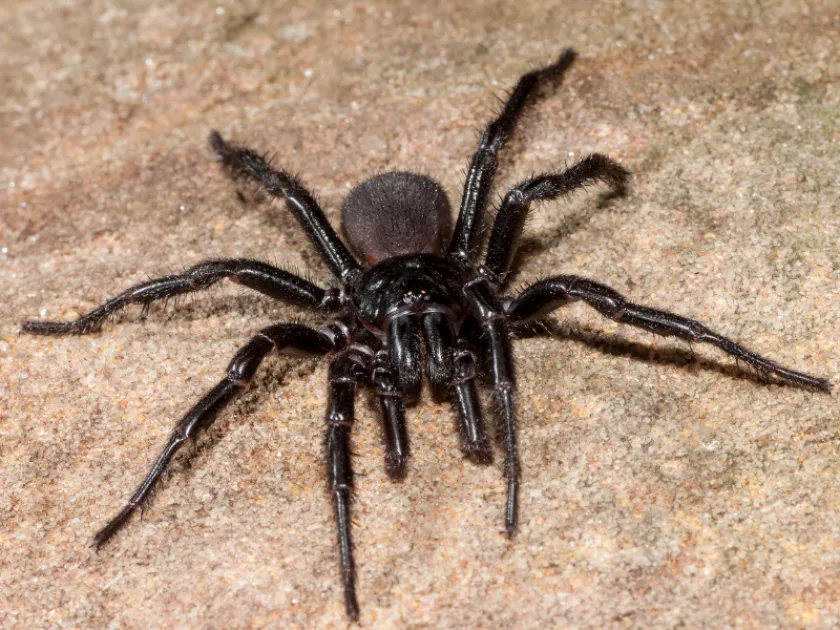
The Sydney funnel-web spider (genus Hadronyche) belongs to the Atracidae family. These spiders are known for their dark, glossy appearance and robust chelicerae.
Males and females exhibit significant differences in size and behavior. Adult specimens typically measure between 2 and 5 centimeters in body length, making them easily identifiable within their native range.
Their bodies are covered in fine hairs that are highly sensitive to soil vibrations. The coloration usually ranges from dark brown to a deep, charcoal black.
A key identification feature is their large, downward-facing fangs, which are powerful enough to penetrate even tough clothing or leather shoes during defensive strikes.
These spiders prefer moist, shaded environments and often construct burrows beneath rocks, logs, or dense vegetation, which is a critical factor for agricultural workers to consider.
What it damages
It is important to clarify that the Sydney funnel-web spider is not an agricultural pest, as it does not feed on crops or plants.
As a predatory species, it plays a role in the ecosystem by hunting insects, worms, and other soil-dwelling invertebrates, potentially acting as a natural regulator of insect populations.
However, from an agronomic perspective, they pose a significant health risk to personnel working in fields or gardens due to their aggressive temperament and highly potent venom.
The primary threat arises from accidental bites occurring during routine tasks like weeding, harvesting, or moving garden equipment, where the spiders may have established their funnel-shaped webs.
Given the medical significance of their neurotoxic venom, the presence of these spiders in working areas requires high levels of caution and hazard mitigation.
When it appears
Activity for this genus typically peaks during warmer, humid months, particularly when males emerge from their burrows to find mates.
This behavior is most frequently observed in the summer, especially following heavy rains which trigger surface movement.
During these times, agronomists and gardeners working in the species' native range should exercise increased vigilance when inspecting the base of plants or root zones.
For the remainder of the year, they lead a cryptic lifestyle, remaining hidden in deep burrows lined with their characteristic funnel-shaped silk webs.
Movement intensity increases significantly during evening and nighttime hours, making field work during twilight or darkness particularly risky for direct contact.
Signs of infestation
The primary sign of a funnel-web spider presence is the distinct silk web spread across the soil surface or the base of tree trunks.
The web is structured as an irregular funnel that leads into a deep subterranean burrow, providing an ideal retreat for the spider.
Surrounding the entrance, one might observe discarded exoskeletons or remnants of prey, indicating an active hunting zone for the spider.
Unlike common cobwebs, the nest of this species appears as a dense, often debris-covered opening that blends into the surrounding landscape.
If these structures are discovered in areas frequented by workers, immediate steps should be taken to clear or cordon off the hazardous zone.
Control measures
Control efforts are focused on risk reduction rather than eradication, specifically around housing and storage facilities where workers spend time.
Maintaining a tidy work environment is essential; this involves removing accumulated garden waste, logs, rocks, and building debris where spiders may seek shelter.
Protective clothing, including thick work gloves and heavy-duty closed footwear, should always be worn during garden maintenance and field operations.
- Implementing general-purpose insecticide treatments to reduce the spider's prey population.
- Physical destruction of identified burrows (must be performed with extreme caution).
- Regular grass trimming to minimize the protective cover available for spider retreats.
In cases where spider density is high near work areas, consultation with professional pest control services is recommended for safe management.
Taxonomy
- Latin name
- Hadronyche
- Family
- Hexathelidae
- EPPO code
- HADRSP
Discussion
No discussions yet — be the first.