
Sydney funnel-web spider
Atrax robustus
Description
How to identify
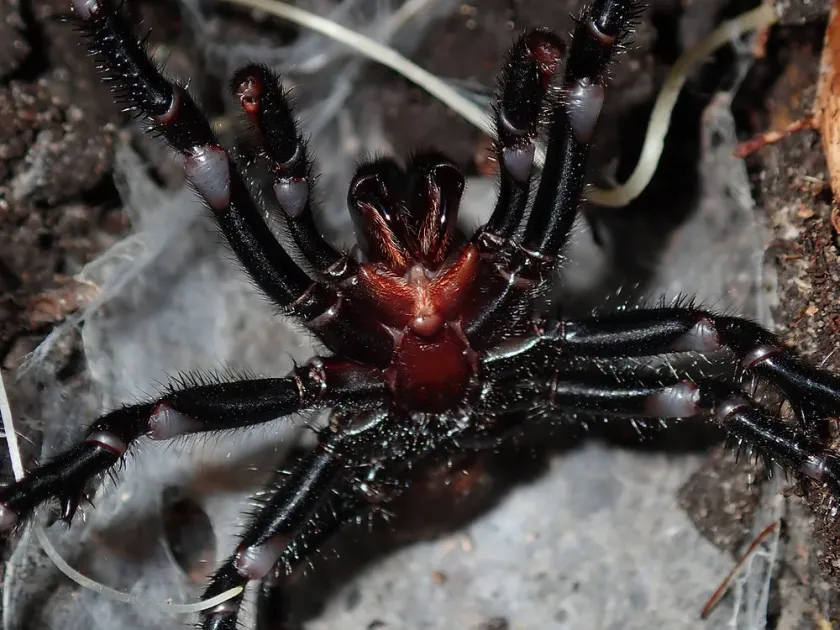
The Sydney funnel-web spider belongs to the Araneae order, family Atracidae. It is a large arachnid with a glossy black body, powerful chelicerae, and aggressive behavior when defending its territory.
Males of this species are significantly smaller than females but possess more potent neurotoxic venom. Adult spiders reach up to 5 centimeters in length, with colors ranging from dark brown to coal black.
They prefer moist and shaded areas, often building burrows in loose soil beneath tree roots or thick organic mulch. Their appearance is characterized by a lack of dense hair on the cephalothorax.
Females spend almost their entire life inside their funnel-shaped burrow, which can reach up to 50 centimeters in depth. Males are prone to wandering in search of mates, making them more visible in gardens and agricultural fields.
It is important to remember that this species is not a specialized agricultural pest; however, its presence in agroecosystems poses a serious risk to field staff and farm workers.
What it damages
Although Atrax robustus does not feed on plant tissue and does not directly damage crops by consuming leaves or roots, it has an indirect impact on agronomy.
The spider actively hunts insects, including beneficial entomophages, which can disrupt the biological balance within the agricultural site.
In regions where they are common, these spiders often settle in the root zones of ornamental and fruit crops, where soil moisture creates ideal conditions for their nocturnal habits.
During manual weeding or harvesting, the presence of these spiders in the soil can lead to bites, making them an object of particular concern regarding workplace safety protocols.
The indirect damage consists of the inability to perform effective manual plant care in infested areas until proper pest control measures are taken.
When it appears
Spider activity is directly related to air temperature and humidity, peaking during the summer months of the Australian season.
The male migration season, during which the risk of encounter increases, occurs during warm periods following rainfall, which encourages them to emerge from their burrows.
During the cold season, spiders enter a state of low activity, remaining deep within their funnel-shaped shelters.
The breeding cycle is spread out over time, but spiders are most active during periods of high humidity and stable warm night temperatures.
For agronomists, the critical periods are the wet seasons, when spiders become highly mobile and may colonize new areas in search of prey.
Signs of infestation
The primary sign of the spider's presence is the characteristic "funnel" of silk located at the entrance to a burrow in the soil or between tree roots.
The spider's web is known for its high durability and often takes the form of an irregular cone that widens toward the ground surface.
Specific signs of activity include neatly excavated burrows approximately 2-3 centimeters in diameter, often found in tree basins.
Nearby the burrow entrance, one can often find chitinous remains of insects, which are the main diet of this arachnid.
Unlike females, males leave traces of their movement along pathways and near farm outbuildings, especially following rain events.
Control measures
The primary protection method involves adhering to safety rules when working with soil in regions where the species resides, including wearing heavy-duty gloves and closed-toe footwear.
Regular clearing of root zones from excessive organic debris and fallen leaves, where spiders find shelter, is strongly recommended.
Applying localized acaricides directly into the burrow entrance can help reduce the population density in a specific area.
- Using physical barriers (mesh, borders) in nurseries.
- Regular inter-row tilling to destroy surface tunnels.
- Training staff on hazard awareness and identification of the species.
Maintaining dryness in root zones where possible is advisable, as high moisture is the main attractant for these spiders.
Taxonomy
- Latin name
- Atrax robustus
- Family
- Hexathelidae
- EPPO code
- ATRXRO
Discussion
No discussions yet — be the first.