

Pest · Coleoptera (beetles) · affects Fodder beet, Ornamental crops, Potato
Especially harmful
Pear blossom weevil
Anthonomus piri
Description
How to identify
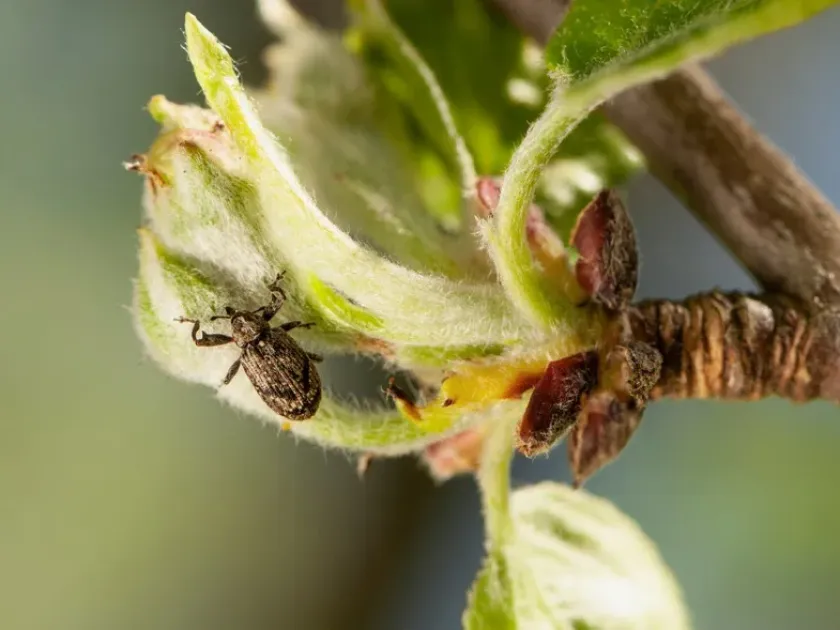
The pear blossom weevil (Anthonomus piri) belongs to the Curculionidae family of the Coleoptera order. It is a small beetle, approximately 3–4 mm long, with a brownish-grey body and a distinct oblique light spot on its elytra.
A key feature of the adult is its long, slightly curved snout (rostrum), which it uses to drill small holes in plant tissues for feeding and laying eggs.
The larva is legless, slightly curved, and cream-colored with a brown head. It develops exclusively inside the flower buds, which protects it from many external environmental factors and treatments.
The pupa is initially white, with free limbs, and gradually darkens as it matures. The entire developmental cycle occurs inside the infested bud.
Adult beetles are capable fliers, which enables them to spread rapidly throughout an orchard once temperatures rise in early spring.
What it damages
The primary host for this pest is the pear tree. During years of high infestation, the beetles may cause damage to other pome or stone fruits, but pear remains the main target.
Both adults and larvae cause significant damage. Adults feed on swelling buds, drilling deep holes that often result in sap exudation, commonly referred to as "weeping buds".
The most severe damage is caused by larvae that feed on the internal parts of the flower buds, including pistils, stamens, and receptacles, leading to the destruction of the flower.
High populations can result in the loss of 80–90% of a tree's generative buds, which can lead to a total crop failure for the season.
Damaged buds often fail to open and remain on the branches as dry, brown caps, which serves as a telltale sign of the presence of the infestation.
When it appears
The weevils overwinter as adults in the soil, under fallen leaves, or within bark crevices. Activity begins in early spring when air temperatures rise above +6...+8 °C.
The mass emergence of beetles coincides with the bud-swelling phase of the pear tree. At this time, they begin feeding and mating actively.
The egg-laying period lasts about 2–3 weeks, depending on weather conditions. Each female can lay dozens of eggs, depositing one inside each selected bud.
Larval development inside the bud lasts for approximately 20–30 days, followed by pupation. New adult beetles emerge from the buds between late May and early June.
After emergence, the beetles feed on leaves for a short period before entering diapause (a summer dormancy) in sheltered areas until the following spring.
Signs of infestation
The first visual sign of infestation is sap leakage from the buds, often observed during a careful inspection of branches in early spring.
Close inspection of the buds reveals tiny, precise holes drilled by the weevil's snout, which the insect uses to access nutrients.
As the larva develops inside, the bud turns brown, stops growing, and gradually withers while remaining attached to the branch.
If an infested dry bud is opened during the blossoming season, a white larva or pupa will be found inside, confirming the presence of the pest.
Massive fruit set drop or a high number of unopened brown buds on the tree are clear indicators of a critical level of infestation.
Control measures
A simple mechanical control method involves shaking the beetles onto a cloth in the early morning hours, when low temperatures make them sluggish and easy to collect.
Using sticky bands on tree trunks can help limit the movement of beetles crawling from their overwintering sites in the soil up into the canopy.
Chemical insecticides are most effective when applied during the period of adult emergence before the buds begin to open. Always follow local regulatory guidelines for pesticide use.
Cultural practices, such as tilling the soil around the trees in autumn and cleaning the trunks of loose, dead bark, reduce the available overwintering sites for the weevils.
- Applying systemic insecticides during the "green tip" phase.
- Manual removal and destruction of withered, brown buds.
- Biological control using natural predators or fungi-based biopesticides.
Content graph
Connections · Pear blossom weevil
Most often together:
Marketplace
Products · 1
Biology
Taxonomy
- Latin name
- Anthonomus piri
- Order
- Coleoptera (beetles)
- Family
- Curculionidae
- EPPO code
- ANTHPY
Community
Discussion
No discussions yet — be the first.