
Cotton aphid
Gossypina
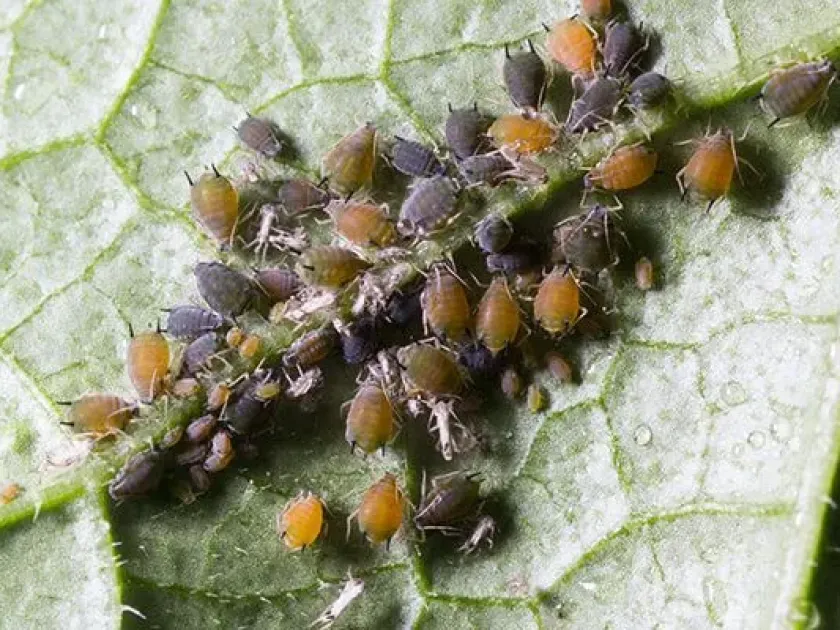
Description
How to identify
The cotton aphid (Aphis gossypii) is a significant agricultural pest belonging to the order Hemiptera and the family Aphididae.
Adults are small, typically measuring between 1.2 and 2.1 mm, and can exist in both wingless (apterous) and winged (alate) forms.
Their coloration varies widely from light yellow to deep green or even black, influenced by the host plant and environmental conditions.
They possess short antennae and distinctive dark cornicles on the abdomen, which serve as key diagnostic features for identification.
The life cycle involves multiple generations per season, with high reproductive rates enabling rapid population explosions under favorable conditions.
What it damages
This polyphagous insect attacks a wide range of crops, most notably cotton, cucurbits (melons, cucumbers, watermelons), and various vegetables.
They feed by extracting sap from the phloem, causing significant stress to the host plant through nutrient depletion and physiological strain.
Severe infestations lead to stunted growth, leaf curling, yellowing, and the premature shedding of buds, flowers, and fruits.
Cotton aphids are primary vectors for several critical plant viruses, which often cause more economic damage than the physical feeding itself.
The secretion of honeydew promotes the growth of sooty mold, which blocks photosynthesis and reduces the market quality of the harvest.
When it appears
Activity generally begins in early spring, as temperatures rise and the overwintering population migrates to host plants.
Peak populations are typically observed during hot, dry summer periods when the aphid's developmental rate is accelerated.
In greenhouse settings, the cotton aphid can remain active and reproduce year-round if temperatures are maintained within their comfort range.
Seasonal migration patterns are tied to the phenology of host crops and the availability of succulent growth on surrounding weeds.
As temperatures drop in autumn, populations transition towards survival stages, including egg-laying on perennial weed hosts to endure winter.
Signs of infestation
The most immediate sign of infestation is the curling and distortion of terminal leaves and young shoots on the host plant.
Visual inspection of the underside of leaves reveals colonies of aphids clustered around the leaf veins and stems.
The presence of a sticky, shiny substance known as honeydew on leaf surfaces and surrounding foliage is a strong indicator of aphid activity.
A black, powdery layer of sooty mold appearing on the foliage indicates that the infestation has been present for a significant duration.
General plant decline, including yellowing leaves and reduced vigor, often follows the onset of heavy aphid colonization.
Control measures
Cultural control measures focus on rigorous weed management to eliminate alternative host plants and reservoir sources for the pest.
Biological control, utilizing natural predators such as lady beetles, lacewings, and parasitic wasps, is highly effective in stable ecosystems.
Monitoring fields regularly is essential to detect outbreaks early before they cross the economic injury threshold.
Chemical intervention involves the use of systemic insecticides, which are applied when threshold populations are exceeded to ensure maximum protection.
Implementing integrated pest management (IPM) strategies, including rotational insecticide use, helps prevent the development of pesticide resistance.
Taxonomy
- Latin name
- Gossypina
- Order
- Hemiptera (bugs, aphids, leafhoppers)
- Family
- Coccidae
- EPPO code
- GOSPSP
Discussion
No discussions yet — be the first.