

Pest · Coleoptera (beetles) · affects Field pea, Winter wheat, Fodder beet
Especially harmful
Pea weevil
Bruchus pisorum
Description
How to identify
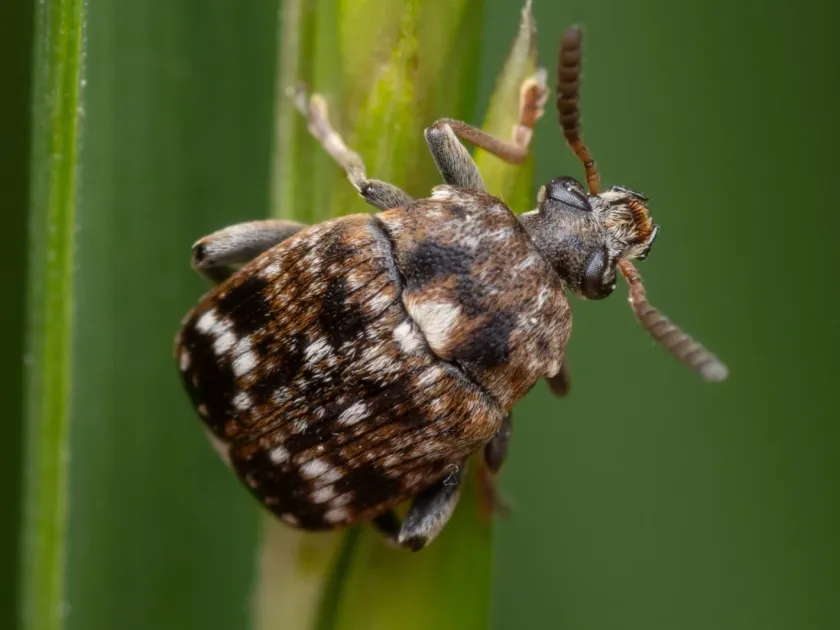
The pea weevil Bruchus pisorum is a member of the seed beetle family (Bruchidae) within the order Coleoptera. Adult beetles are small, measuring 4–5 mm, and possess a mottled brown and gray hairy body.
They can be identified by the prominent white spots on their elytra (wing covers) and the tip of the abdomen, which extends visibly beyond the elytra. Their overall appearance provides effective camouflage.
The larvae are white with small brown heads and are specialized to live and feed entirely within a single pea seed. They are legless and spend their entire developmental phase sheltered inside the grain.
Adult weevils are strong fliers, allowing them to migrate efficiently from overwintering sites, such as granaries or field debris, to flowering pea crops during the spring.
This species is univoltine, meaning it completes only one generation per year. Its biological development is strictly timed with the growth stages of the pea plant.
What it damages
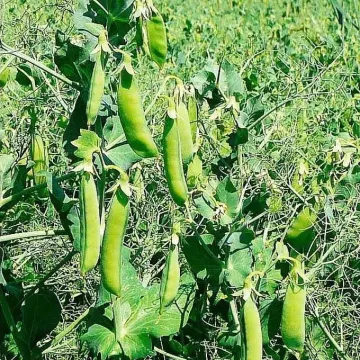
Pea weevils specifically target pea crops (Pisum sativum). It is important to note that other crops mentioned, such as onions, fodder beets, rapeseed, cabbage, peppers, watermelons, melons, and sunflowers, are not affected by this specific pest.
The larva tunnels into the seed, consuming the cotyledon and embryo. This significantly reduces the nutritional value of the pea and renders the seed non-viable for future sowing.
In commercial settings, the internal feeding causes significant weight loss and creates hollow seeds. The presence of insect waste and exit holes makes the crop unsuitable for human consumption or export.
Heavy infestation levels drastically reduce crop quality and marketability. Furthermore, infected seeds are more prone to secondary infections from fungi and bacteria due to the damaged coat.
The economic impact of this pest includes both yield loss and increased costs for grain fumigation and cleaning processes required to maintain export standards.
When it appears
Adult weevils typically overwinter inside infested seeds stored in granaries or within scattered peas left in the field after harvest. They emerge as temperatures rise in the spring.
The critical period for crop infestation coincides with the flowering stage of the pea plant. Beetles feed on pollen and petals while waiting for the young pods to develop.
Females lay eggs on the surface of developing pea pods. These eggs are visible as tiny yellowish spots glued to the pod surface, serving as the start of the next generation.
Once the larva hatches, it bores through the pod wall and enters the seed. The development from larva to pupa and eventually to an adult takes place entirely inside the protected environment of the pea.
Most individuals have matured into adults by the time of harvest. This cycle ensures that the pest is transported along with the harvested grain into storage facilities.
Signs of infestation
Visual inspection of young pods may reveal tiny yellowish eggs attached to the outside. This is the earliest warning sign of potential infestation in a field.
Once the adult beetle exits the seed, it leaves a circular emergence hole. These holes are a clear indicator that the seed has been previously infested by the pest.
When an infested pea is cut open, a cavity containing the larva, pupa, or adult beetle is revealed. The seed itself often feels light and fragile due to the internal loss of material.
During the flowering stage, high numbers of adult beetles may be observed on the blossoms. They are quite active in warm, sunny weather and will fly away quickly if disturbed.
Infested grain lots often release a musty odor, and the presence of dust and empty seed coats during cleaning is a strong indicator of an active or recent infestation.
Control measures
The primary control strategy is the use of certified, clean, and pest-free seeds. Always inspect seeds for emergence holes before sowing to prevent introducing the pest into the field.
Early harvest and rapid threshing are crucial agronomic practices. By harvesting the crop promptly, farmers can prevent adult beetles from exiting the seeds directly onto the field.
Chemical control involving insecticides applied during the flowering period is effective against adult weevils. Applications must be timed before egg-laying becomes widespread.
In storage, fumigation is the standard method for eliminating the pest. This process is necessary to kill larvae and adults residing within the seeds and to maintain food quality standards.
Cultural management, including the use of crop rotation and spatial isolation of new pea fields from storage facilities and previous harvest debris, significantly reduces the infestation pressure.
In brief
24
Damages crops
Content graph
Damages crops · 24
Content graph
Connections · Pea weevil
Most often together:
Marketplace
Products · 73
Biology
Taxonomy
- Latin name
- Bruchus pisorum
- Order
- Coleoptera (beetles)
- Family
- Bruchidae
- EPPO code
- BRCHPI
Community
Discussion
No discussions yet — be the first.