
Dock bug
Gonocerus
Description
How to identify
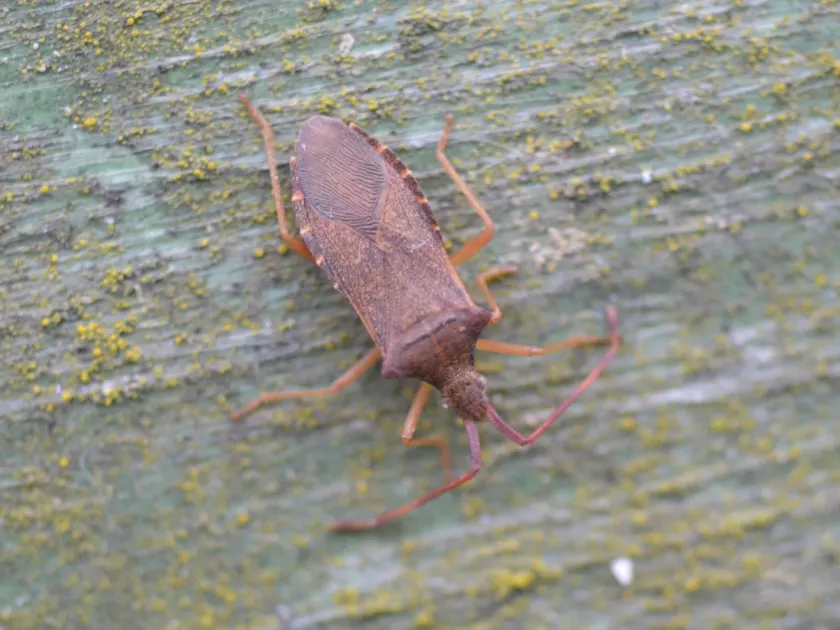
The dock bug (Gonocerus acuteangulatus) is a member of the Coreidae family, commonly known as leaf-footed bugs. Adult insects typically measure between 11 and 15 millimeters in length and possess an elongated, oval-shaped body with a brownish or reddish-brown coloration.
One of the most distinctive features of this species is the presence of sharp, slightly pointed corners on the pronotum, which makes it easily identifiable among other common garden bugs. The body is covered with fine, dense puncturing, and the antennae consist of four segments.
Nymphs resemble smaller, wingless versions of the adults. They undergo several molting stages, gradually increasing in size and developing distinct characteristics of the mature bug, such as the gradual appearance of wing pads.
These insects overwinter as adults in protected locations such as leaf litter, crevices in tree bark, or clumps of dense, dry grass. As temperatures rise in early spring, they emerge from diapause to begin their feeding cycle.
Dock bugs prefer habitats with moderate humidity and abundant host vegetation. They are frequently found on forest edges, in orchards, and in gardens where a variety of host plants provide favorable conditions for their survival and reproduction.
What it damages
This pest is a polyphage, capable of feeding on a wide range of agricultural and wild plant species. It causes significant damage to orchard trees including apples, pears, and hazel trees, as well as various berry-producing shrubs.
True to its common name, the dock bug is often associated with plants in the Polygonaceae family, such as docks (Rumex). However, when in orchards, it readily switches to feeding on young shoots, leaves, and developing fruitlets.
The insect feeds by inserting its proboscis into plant tissue and injecting saliva containing enzymes that digest the cell contents. This process disrupts the plant's normal metabolism and weakens the overall structure of the host plant.
Both adults and nymphs cause damage by feeding on plant juices throughout their development. Widespread infestations can lead to substantial agricultural losses due to the direct impact on plant vigor and crop yield.
The impact of feeding manifests as deformed leaves, stunted growth of new shoots, and the premature shedding of fruitlets. Additionally, the feeding marks can introduce pathogens that affect the quality and shelf-life of the harvested produce.
When it appears
The active life cycle begins in early spring, once average daily temperatures climb above 10–12 degrees Celsius. During this time, the overwintered adults emerge to feed on opening buds and young leaf tissue.
Breeding occurs in late spring and early summer. Females lay their eggs in small clusters, typically on the underside of leaves or on young branches, ensuring the eggs are concealed from potential predators and environmental stressors.
Nymphs appear in mid-summer and start feeding almost immediately. This phase of the lifecycle represents the peak period of potential damage, as the population grows and the nymphs require significant nutrition to reach maturity.
By late summer and early autumn, the new generation of adults is fully developed and begins preparing for winter. They feed heavily during this time to accumulate fat reserves necessary to survive the cold months.
In temperate climates, the dock bug typically completes one generation per year. However, in warmer regions, there is a possibility of a partial second generation, which can significantly escalate the pressure on horticultural crops.
Signs of infestation
One of the most obvious indicators of a dock bug infestation is the presence of the insects themselves on the plant foliage. When disturbed, these bugs release a pungent, unpleasant odor as a defense mechanism.
Leaf damage appears as small, pale spots that gradually expand and merge, eventually causing the entire leaf to yellow, curl, and wither. These marks are a direct result of the bug extracting sap from the internal tissues.
Fruit development is often compromised; after being probed by the bug's proboscis, young fruitlets develop indentations, bumps, or corky spots. Such damaged fruit loses its visual appeal and is often rejected by consumers.
During routine inspections, gardeners can look for egg clusters on the underside of leaves. The eggs are barrel-shaped and range in color from brown to reddish, often blending in well with the surrounding plant material.
In severe infestation cases, the host plant may exhibit overall stunted growth, reduced leaf canopy, and a significant drop of developing buds or flowers, leading to a noticeable decrease in seasonal harvest volume.
Control measures
Effective management begins with good horticultural hygiene, specifically the removal of dock weeds and other Polygonaceae species from the garden, as these act as primary host reservoirs during the early spring.
Regular maintenance of the area, including the clearing of fallen leaves and organic debris from under trees, is crucial. Eliminating these overwintering sites significantly reduces the population of bugs emerging in the spring.
For small-scale gardens, manual collection is a highly effective, eco-friendly method. Early morning is the best time to shake the bugs from branches onto a tray or cloth and dispose of them before they become fully active.
In cases of high population density, authorized insecticides may be necessary. Applications should be timed to avoid flowering and the immediate harvest period to minimize risks to non-target insects and ensure food safety.
To reduce chemical reliance, promote biodiversity in the garden by planting nectar-rich flowers. This attracts natural predators and parasitoids, which help regulate dock bug populations through biological control.
Taxonomy
- Latin name
- Gonocerus
- Order
- Hemiptera (bugs, aphids, leafhoppers)
- Family
- Coreidae
- EPPO code
- GONRSP
Discussion
No discussions yet — be the first.