
Apple rhombus moth
Gelechia rhombella
Description
How to identify
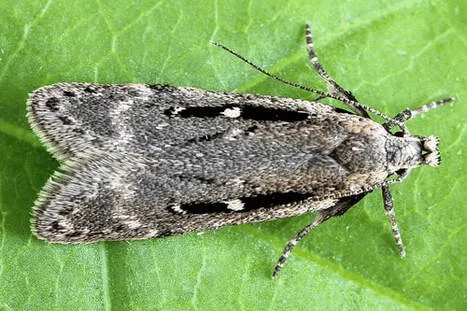
The apple rhombus moth (Gelechia rhombella) is a small lepidopteran insect belonging to the family Gelechiidae. It is widely recognized as a minor but persistent pest of apple trees.
Adult moths have a wingspan of approximately 12–15 mm. Their forewings feature a distinctive mottled pattern of brownish-grey scales, providing excellent camouflage against tree bark.
The larvae, or caterpillars, reach lengths of up to 10 mm. They are typically pale green or yellowish with a dark brown head capsule, which is a key diagnostic feature for field identification.
The life cycle includes four stages: egg, larva, pupa, and adult. They primarily overwinter as eggs or early-stage larvae tucked away within the crevices of the tree bark.
As nocturnal insects, adult moths are difficult to spot during the day, making them challenging to monitor without the use of specialized pheromone lures or light traps.
What it damages
The primary host for Gelechia rhombella is the domestic apple tree (Malus domestica). In some instances, it may also be found on other Rosaceae species present in the garden.
Larvae cause direct damage in early spring by feeding on swelling buds, which prevents normal leaf and blossom development, often destroying the potential yield of those buds.
As the season progresses, larvae feed on young leaves. They construct protective shelters by pulling leaves together with silk webbing, creating small, unsightly leaf nests.
By consuming leaf tissue, the larvae reduce the tree's photosynthetic capacity, which can weaken the plant and stress it during critical growth periods.
In cases of severe infestation, the cumulative damage leads to stunted growth, loss of fruit buds, and overall reduced productivity of the apple orchard.
When it appears
Larval emergence typically begins in early spring, synchronized with the bud-break phase of apple trees, which is the most critical time for preventative action.
The larvae are most active during the late spring and early summer months, corresponding with rapid shoot growth and the formation of fruitlets.
Adult moths emerge in mid-summer. This period is essential for mating and egg-laying, ensuring the continuation of the species for the following cycle.
Depending on geographical location and average temperatures, the moth may complete one or two generations within a single growing season.
By late autumn, the lifecycle concludes with the deposition of overwintering eggs, which remain dormant on the bark until the temperature rises the following spring.
Signs of infestation
The most visible sign of an infestation is the presence of silk webbing among leaves, which indicates the active feeding site of the larvae.
Early spring observations may reveal damaged or hollowed-out buds that fail to open, which are classic signs of larval feeding during the dormant-to-active transition.
The presence of fine, granular frass (excrement) trapped within the silk webs is a clear indicator that larvae are currently active and feeding.
Leaf clusters that appear rolled, folded, or stuck together are clear evidence of the moth's larvae creating their protective shelters.
- Hollowed-out or damaged buds
- Silk-webbed leaf nests
- Curled or skeletonized foliage
- Premature leaf drop
- Reduced vigor of fruit spurs
Control measures
Cultural control measures, such as scraping away loose, dead bark during the dormant season, can significantly reduce the number of overwintering eggs.
Targeted insecticide applications during the "green tip" stage of bud development can effectively kill larvae before they construct protective silken webs.
Biological control using Bacillus thuringiensis is highly effective against young larvae while remaining environmentally friendly and safe for beneficial insects.
Pheromone monitoring allows growers to time chemical interventions precisely, ensuring maximum impact on the moth population while minimizing the need for broad-spectrum pesticides.
Maintaining tree health through proper irrigation and fertilization improves the tree's resilience, helping it recover faster from minor larval damage during the growing season.
Taxonomy
- Latin name
- Gelechia rhombella
- Order
- Lepidoptera (butterflies)
- Family
- Gelechiidae
- EPPO code
- GELERH
Discussion
No discussions yet — be the first.