
Mint moth
Fumibotys fumalis
Description
How to identify
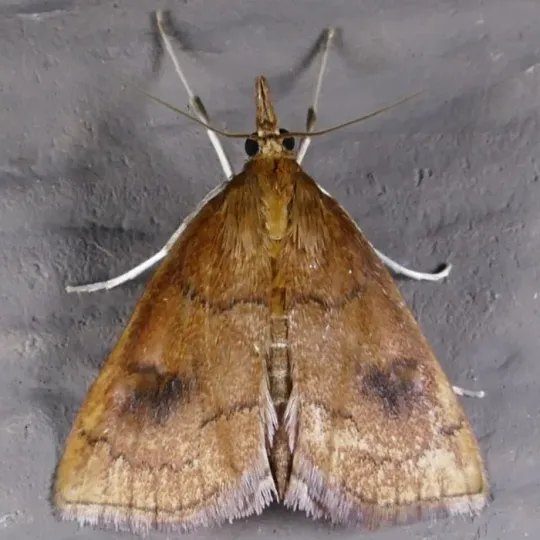
The Mint moth (Fumibotys fumalis) is a small moth belonging to the order Lepidoptera and the family Crambidae. Adults have a wingspan of approximately 20–25 mm, with a brownish-gray coloration and distinctive darker bands on their wings.
The larvae, or caterpillars, reach up to 20 mm in length. They are typically gray-green with dark longitudinal stripes and prominent tubercles, which provide effective camouflage on mint foliage.
The species undergoes a complete metamorphosis: egg, larva, pupa, and adult. The pupal stage is often spent in a cocoon, either in the soil or protected by plant debris, which helps the species survive winter conditions.
Accurate identification of the moth is essential for growers. While adults are nocturnal and often fly to light sources, larvae are frequently found hidden within webbed leaves, making them difficult to spot during routine inspections.
Biological monitoring and an understanding of the pest's developmental stages allow farmers to implement targeted management strategies before populations reach economic injury levels.
What it damages
The primary host for Fumibotys fumalis is peppermint (Mentha × piperita), though it can infest various other species within the Lamiaceae family. The larvae are the main destructive stage.
Larvae consume leaf tissue, starting with small punctures before progressing to skeletonizing the leaves. Heavy infestations can lead to significant defoliation, which severely reduces the plant's photosynthetic capacity.
Beyond leaf consumption, larvae may damage terminal shoots and flower spikes. This is particularly damaging to commercial mint production, as it negatively impacts the yield of leaves and essential oil content.
Damaged plants often show stunted growth and poor vigor. Furthermore, the presence of larval webbing and excrement reduces the marketability and quality of the harvested botanical material.
Continuous feeding pressure throughout the season can lead to substantial yield losses, making it imperative to control the population early in the development cycle.
When it appears
Adult moths emerge in late spring or early summer, triggered by rising temperatures. The timing can vary based on regional climatic conditions and local environmental factors.
The pest typically produces multiple generations per year in warmer climates. Successive waves of larvae can be observed throughout the summer, posing a persistent threat to late-season harvests.
Larval activity peaks during the mid-summer months when temperature conditions are optimal for development. This is the period when mint plants are most susceptible to damage.
As autumn approaches and temperatures decrease, larvae move towards the soil to prepare for diapause. They successfully overwinter as larvae or pupae, awaiting the return of favorable spring conditions.
Tracking degree-days and local seasonal trends is a highly effective way for agronomists to predict the peak emergence times for larvae and optimize spray applications.
Signs of infestation
The presence of fine webbing on the undersides of leaves or between leaves is one of the earliest indicators of an infestation. Larvae use these webs as protective enclosures while feeding.
Irregular holes or "windows" in the leaf blades are classic signs of early-instar larval feeding. As the caterpillars grow, these holes enlarge, eventually resulting in the destruction of the entire leaf surface.
Terminal shoots may appear distorted or webbed together. This "nesting" behavior is a common defensive mechanism, and finding these structures is a strong indicator of a localized outbreak.
Dark frass (droppings) on the leaves or webbing is a clear visual cue that larvae are actively consuming the plant. If this is observed, immediate investigation of the canopy is required.
Overall plant appearance, characterized by patches of chlorotic or skeletonized foliage, highlights the severe impact of larval feeding on the crop's health.
Control measures
Cultural practices, such as deep plowing in late autumn, are effective for burying pupae and larvae, thereby disrupting the pest's lifecycle and reducing overwintering success.
Effective weed management, particularly focusing on wild Lamiaceae, is critical. These weeds can act as alternative hosts, maintaining the pest population even when the main crop is absent.
Biological control methods, such as the application of Bacillus thuringiensis, offer a targeted approach that effectively kills young larvae while remaining safe for beneficial insects and the environment.
Chemical intervention should be reserved for threshold-exceeding infestations. Choosing selective insecticides and adhering strictly to pre-harvest intervals is essential for safety and compliance.
- Using pheromone traps to monitor adult flight activity.
- Promoting natural predators and parasitoids.
- Sanitation by removing crop residues after harvest.
Taxonomy
- Latin name
- Fumibotys fumalis
- Order
- Lepidoptera (butterflies)
- Family
- Crambidae
- EPPO code
- FUMBFU
Discussion
No discussions yet — be the first.